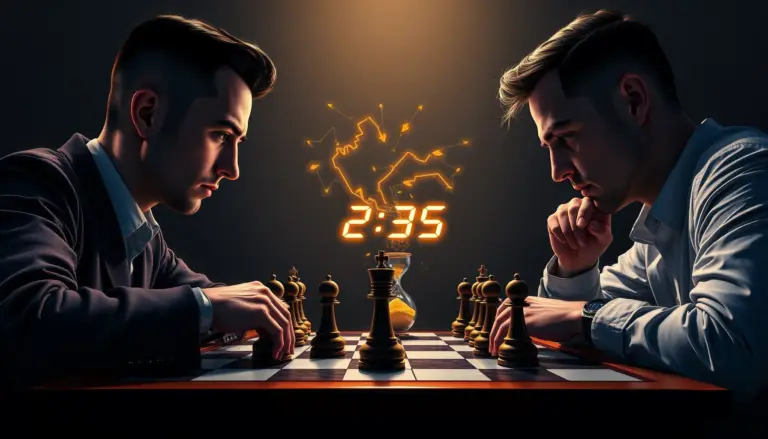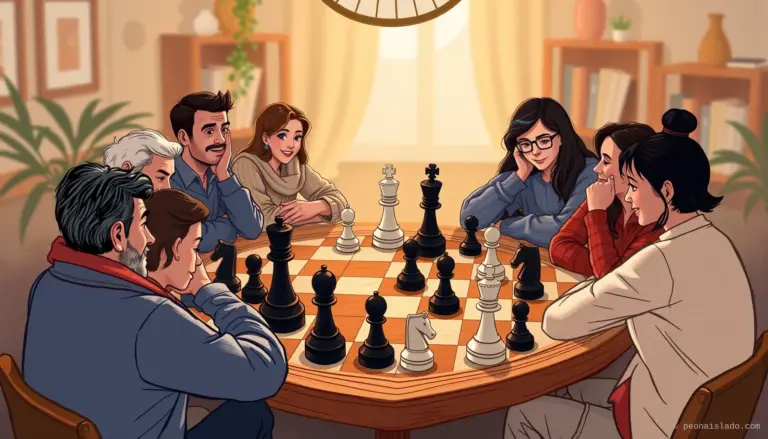
chess, that board 64 squares where silent battles are fought, has been for centuries a reflection of power structures, military strategy and collective intelligence. But there was a moment in history when gambling stopped being a simple pastime for elites and became an instrument of geopolitical domination.. In 1948, after the death of Alexander Alekhine, FIDE took control of the World Championship, and with it, chess entered a new era: that of Soviet rule. Mikhail Botvinnik was not only crowned champion, but he inaugurated a training system that would transform the game into an exact science, a champion producing machine. How did the USSR manage to monopolize chess for half a century? The answer is not just in individual talent, but in a methodology that combined military discipline, mass education and an obsession with excellence that still defines the standards of the game today.
Chess as a weapon of state: the soviet machinery
To understand Soviet dominance in chess, you have to go back to the years 20, when the Bolshevik regime identified in the game a perfect vehicle to project its ideology. chess, with its hierarchical structure and its emphasis on planning, It fit perfectly with the values of real socialism: discipline, collectivism and the supremacy of intellect over chance. But it was in 1948 when this vision crystallized into an organized system. FIDE, until then a rather symbolic entity, became the global referee of the world title, and the USSR took the opportunity to institutionalize its hegemony.
The Soviet model was based on three pillars: specialized schools, elite trainers y fierce internal competition. Unlike the West, where chess was a hobby of cafes and intellectual circles, in the USSR it became a professional career. Talented children were recruited from 6 years and subjected to a training regimen that combined theoretical analysis, physical preparation and psychology. This systematic approach not only produced champions like Botvinnik, Smyslov, Tal o Karpov, but also created an inexhaustible pool of high-level players. As we explain in our article on the Russian Chess School, the secret was not in the individual genius, but in the obsessive repetition of patterns, memorization of openings and collective study of games.
But the system went beyond the technical. Soviet chess was a propaganda tool. Every victory in an international tournament was celebrated as a triumph of socialism over capitalism.. The players were treated as national heroes, but also as soldiers in a cold war that was fought on the boards. This psychological pressure, far from being an obstacle, became a stimulus: the USSR not only wanted to win, but to demonstrate that their system was superior in all areas, even in the intellectual.
Botvinnik: the engineer who reinvented chess
Mikhail Botvinnik was not only the first world champion under the new FIDE order; He was the architect of a methodological revolution. Electrical engineer by training, Botvinnik applied scientific rigor to chess, transforming it into a discipline where pre-game preparation was as important as execution on the board. His approach was based on three principles: comprehensive opening analysis, psychological preparation y systematic study of rivals.
Botvinnik understood something that many of his contemporaries did not know.: chess was not an art, but a science. While players like Rudolf Spielmann They trusted their intuition and creativity, Botvinnik broke down each position with surgical precision. His most lasting legacy was the creation of a “chess laboratory” in Moscow, where teams of analysts worked in secret to develop new variants of openings. This collaborative approach, almost industrial, laid the foundations for what we know today as theoretical preparation, a fundamental aspect in modern chess.
But Botvinnik was also a pioneer in the psychology of the game. I knew that, in a duel of minds, the emotional factor could tip the balance. That's why, He trained his students to remain calm under pressure, a skill that would become crucial in confrontations against the West during the Cold War. His victory in the tournament 1948 it was not a coincidence: It was the result of a system that had turned chess into an exact science, where every move could be calculated, each anticipated strategy.
The Cold War in 64 casillas: chess as a battlefield
If Soviet chess was a machine for producing champions, The Cold War was the perfect setting to demonstrate its effectiveness. Each game between a player from the USSR and a Western player became a microcosm of the global conflict. It wasn't just a game; It was a battle for ideological supremacy. As we analyze in Chess and espionage: the cold war in 64 casillas, International tournaments were filled with intelligence agents, hidden codes in the games and strategies designed to destabilize the rival.
The most emblematic case was the duel between Bobby Fischer and Boris Spassky in 1972, known as the “Match of the Century”. Fischer, a lonely and eccentric genius, represented American individualism, while Spassky embodied Soviet collective discipline. The USSR had dominated chess for decades, but Fischer arrived with obsessive preparation and an impeccable psychological strategy. The result was a humiliating defeat for the USSR., who saw how his invincibility was cracked. However, beyond the result, the match showed something crucial: chess was no longer a game, but one more front in the Cold War.
But the USSR did not surrender. After the defeat, the Soviet system was restructured, incorporating new training and analysis techniques. Chess became a national priority, with unlimited resources and access to the best brains in the country. This obsession with regaining dominance led to the creation of a new generation of champions, like Anatoly Karpov and Garry Kasparov, who kept the world title in Soviet hands (and then russian) well into the decade of 1990.
The Soviet legacy: Why is your system still in effect??
Soviet dominance in chess was not ephemeral. His training system laid the foundations for what professional chess is today.. Analyst teams, physical preparation, sports psychology and the use of technology (like the first chess engines) They are direct inheritances from the Soviet methodology. Even today, when AI has revolutionized the game, the basic principles of Russian training remain the reference.
But the most important legacy is not technical, but cultural. The USSR showed that chess could be a tool for social mobility. In a country where access to education and sports was controlled by the State, Chess offered an escape route for thousands of young people. Players like Mikhail Tal, a sickly boy from Riga, o Vasily Smyslov, an opera singer, They found in chess a way to stand out and, in some cases, to survive in an oppressive system. How we explore Chess in dictatorships: endurance, freedom and silent rebellion, the board became a space of relative freedom, where creativity and critical thinking could flourish, although it was within the limits imposed by the regime.
Hoy, when chess is experiencing a global renaissance thanks to digital platforms and series like The Queen’s Gambit, It is easy to forget that its professionalization was the work of a system that turned it into a science. The USSR not only dominated the game for half a century; it transformed him forever, proving that, in the right hands, chess can be much more than a hobby: it could be a weapon, an educational tool and, above all, a reflection of human ambition for excellence.
Conclusion: chess as a mirror of history
The rise of Mikhail Botvinnik in 1948 It was not just the beginning of a new era in chess; It was the moment when the game became a symbol of geopolitical power. The USSR understood something that took decades for the West to assimilate: chess is not a game of chance, but of strategy, discipline and planning. Your training system, based on repetition, collective analysis and obsession with detail, not only produced champions, but it redefined the standards of the game.
Hoy, when artificial intelligence has surpassed humans in pure calculation, the Soviet legacy is still valid. Theoretical preparation, Game psychology and the ability to adapt to rivals are skills that no algorithm can completely replace. chess, in essence, it is still a human duel, where creativity and intuition play as important a role as logic. And in that sense, the USSR not only dominated the board; taught us that, in an increasingly automated world, Strategic thinking remains one of the most powerful tools we have.
Maybe that's why chess continues to fascinate us.. It's not just a game; It is a mirror of history, a laboratory of the human mind and, above all, a reminder that, in the battle for excellence, there are no shortcuts. I just work, discipline and the will to turn each game into a masterpiece.