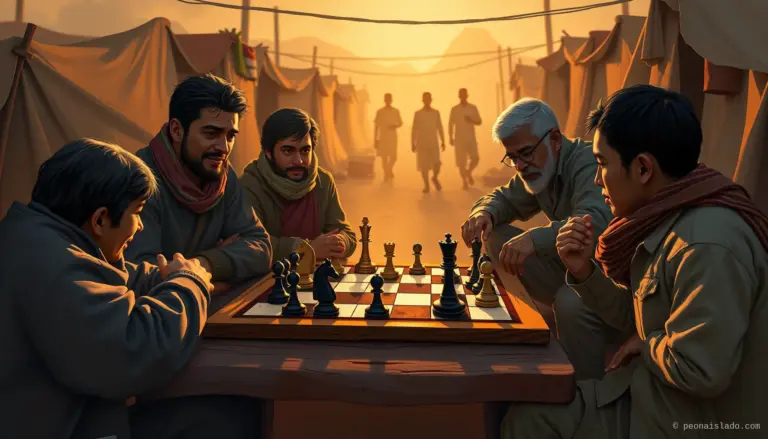
In the heart of the Atlantic Ocean, where the waves break against shores of solidified lava and the trade wind whispers among twisted palm trees, an archipelago rises that defies logic: Cape Verde. This group of volcanic islands, lapped by turquoise waters and crowned by rugged peaks, It is not only a paradise for nature lovers, but also a unique setting for chess. Here, each game becomes a metaphor of resistance, where players not only face their opponent on the board, but also to the Atlantic wind, that with its capricious force seems to want to alter the course of strategy. How does this environment influence the game?? What stories are woven between the pieces of wood and the salty gusts? This article explores the fascinating relationship between chess and the volcanic landscape of Cape Verde, where every move is a battle against the elements and every victory, a triumph over the unpredictable.
Chess as a reflection of life on the islands
In Cape Verde, Chess transcends mere entertainment to become a mirror of island life. The games, played in public squares, fishermen's bars or under the shade of centuries-old baobabs, They reflect the patience and adaptability that survival requires in a territory where resources are scarce and the climate, unpredictable. The local players, many of them self-taught, They develop a style of play that prioritizes flexibility over rigidity, a strategy that allows them to adjust to sudden changes in wind or sudden interruptions from a tropical storm.
This philosophy is manifested in unconventional openings, where creativity surpasses classical theory. For example, It is common to see variants of the King's Gambit or the Sicilian Dragon, plays with a more intuitive than technical approach. Cape Verdean players are not afraid to sacrifice pawns to gain initiative, a tactic reminiscent of the way fishermen on the island of São Vicente risk their nets in treacherous waters to ensure a good catch. chess, in this context, becomes a school of life, where each game teaches lessons about risk, patience and resilience.
The Atlantic wind: an invisible opponent on the board
If there is an element that defines chess in Cape Verde, that's the wind. The trade wind, blowing with constant force from the northeast, Not only does it shape the landscape—shaping black sand dunes and eroding cliffs—but it also influences the development of games.. At the outdoor tables, where informal tournaments are held, gusts can knock over parts, erase scores or distract players with your persistent whistling. However, far from being an obstacle, the wind has become another component of the game, almost like an additional rival that tests concentration and ability to adapt.
More experienced players have developed techniques to counteract this “invisible opponent”. Some place weights in the corners of the board, others choose tables protected by volcanic stone walls, and quite a few have learned to play with one hand on the pieces while the other holds a hat or cloth to prevent them from flying away.. This fight against the wind has generated a unique chess culture, where improvisation and physical resistance are as important as theoretical knowledge. In a way, the wind acts as a leveler: It doesn't matter if you are a grandmaster or a beginner, everyone must face it on equal terms.
The chess community: a social fabric in the middle of the Atlantic
Chess in Cape Verde is not a solitary sport, but a deeply communal activity. On islands like Santiago, São Vicente o Sal, Chess clubs function as meeting centers where people of all ages and social strata converge. These spaces, often modest and self-managed, They are the heart of a vibrant chess scene that has produced local talent and attracted the attention of international players.. One of the most notable examples is the Mindelo International Ajedrez Festival, which every year brings together competitors from Africa, Europe and America in a tournament where the volcanic landscape and the festive atmosphere are as protagonists as the games.
The Cape Verdean chess community is characterized by its warmth and collaborative spirit. More advanced players often mentor younger players, organizing workshops in schools and cultural centers. This transmission of knowledge is not limited to openings or endings, but includes lessons on how to handle pressure, the importance of sports ethics and, of course, how to play under the influence of the wind. Besides, chess has served as a tool for social inclusion, especially in rural areas where development opportunities are limited. Programs like “Chess in the Community” They have taken the game to marginal neighborhoods, using the board as a bridge to encourage discipline and critical thinking.
The future of chess in Cape Verde: between tradition and innovation
Chess in Cape Verde is at a crucial moment, where the tradition of outdoor play and improvisation meet the challenge of professionalization and globalization. On the one hand, There is a growing interest on the part of institutions in promoting chess as a national sport, with initiatives such as the creation of an official federation and the inclusion of the game in educational programs. On the other, the local scene is still mostly amateur, with a strong dependence on the passion of its players and the generosity of local sponsors.
One of the biggest challenges is the lack of adequate infrastructure. Although outdoor tournaments have an undeniable charm, Exposure to the elements limits the development of high-level games. Some clubs have begun to look for solutions, such as the construction of covered rooms with local materials or the organization of events in closed spaces during the season of strongest winds. Besides, access to educational resources remains unequal: while in Praia or Mindelo it is possible to find chess books and connections to online platforms, on smaller islands like Brava or Santo Antão, Players depend almost exclusively on their ingenuity and the oral transmission of knowledge.
Despite these challenges, the future of chess in Cape Verde is promising. The combination of a unique chess culture, An engaged community and a landscape that inspires creativity offers enormous potential. If a balance is achieved between preserving the local essence of the game and adopting modern tools, Cape Verde could position itself as a chess benchmark in Africa and the world. Whether it's an impromptu game on a black sand beach or an international tournament in a luxury hotel, chess on these islands will continue to be, first of all, a battle against the unpredictable: whether the wind, the opponent or one's own limits.
Conclusions: chess as a metaphor for Cape Verdean resistance
Chess in Cape Verde is much more than a game: It is an expression of the island identity, a reflection of the daily fight against the elements and a tool for social cohesion. In an archipelago where nature imposes its rules, players have learned to adapt, turning adversities—such as the Atlantic wind—into an integral part of its strategy. Every game played on these volcanic islands is a lesson in resilience, where victory does not depend only on technical skill, but also the ability to improvise and remain calm in the face of the unexpected.
The Cape Verdean chess community, with its collaborative spirit and innovative approach, shows that play can be a bridge between generations, cultures and social realities. However, The path to professionalization and international recognition still presents obstacles, from the lack of infrastructure to the need for greater institutional support. Despite this, the potential is immense. Cape Verde has the opportunity to become a model of how chess can take root in a culture, adapt to your environment and, at the same time, transcend borders.
In the end, Chess on these islands is a perfect metaphor for Cape Verdean life: a constant battle against the unpredictable, where every move counts and every victory is a shared triumph. May the wind blow in favor or against, Cape Verde players will continue to challenge the rules of the board and, with it, redefining what it means to play chess in the 21st century.