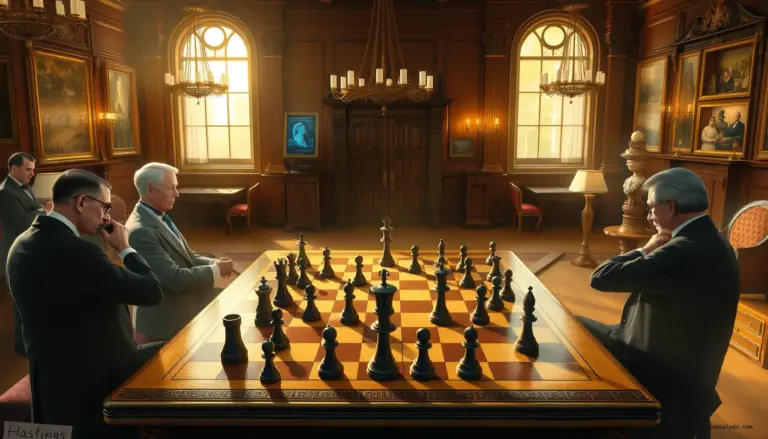
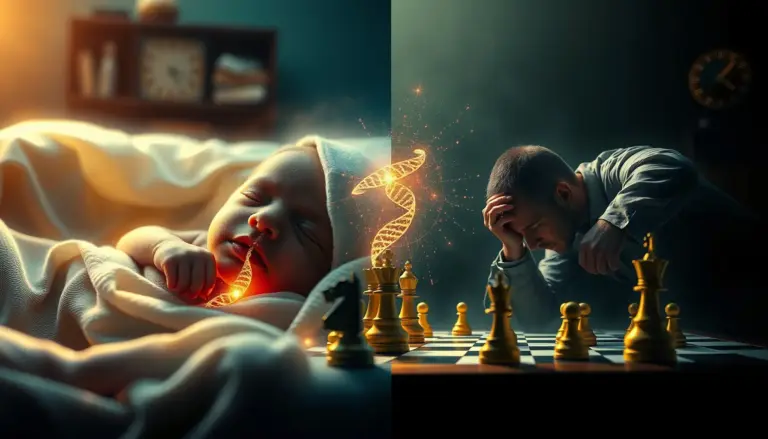
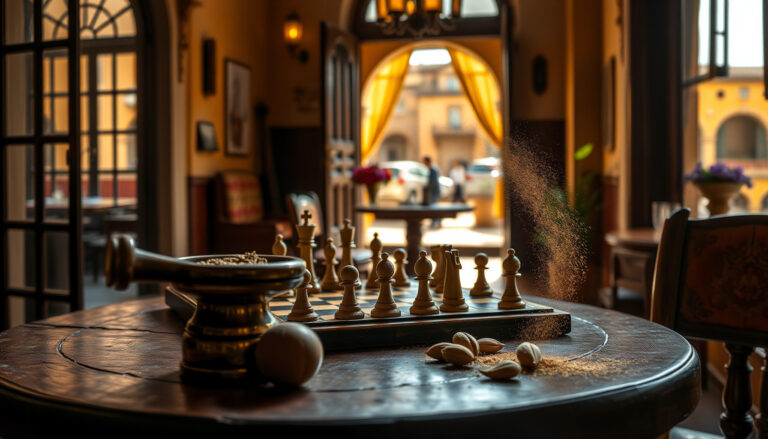
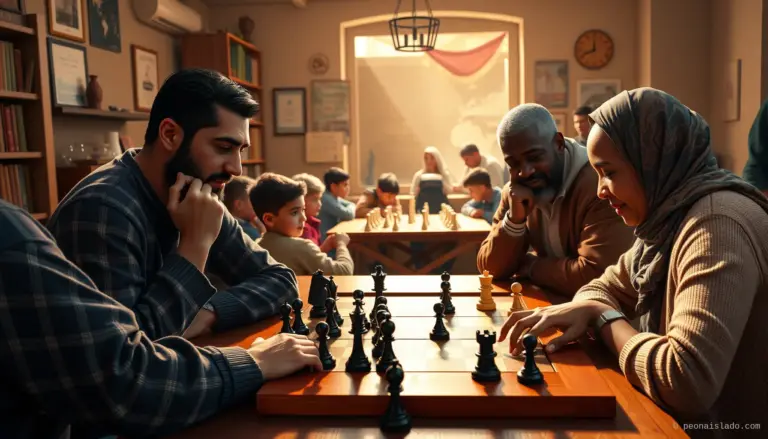
The chess board, with his 64 black and white boxes, becomes a microcosm of order within chaos. For those who have lost their home, your country or even your identity, the game is not just a distraction, but a refuge where the rules are clear, The strategies make sense and, for a moment, the outside world ceases to exist. In refugee camps, shelters or even on the streets of foreign cities, Chess emerges as a universal language that transcends borders, languages and trauma. But, Why does this ancient game exercise such power over those who have lost everything?
The board as a safe territory: when the world falls apart
Imagine arriving at a place where nothing belongs to you, where the future is an unknown and the past, an open wound. In that context, chess offers something invaluable: control. Every movement is a decision, although small, has predictable consequences. Unlike real life, where the variables are infinite and chance plays a crucial role, on the board each action has a logical response. This predictability is therapeutic for minds overwhelmed by uncertainty..
In prisons around the world, Chess has proven to be a rehabilitation tool, teaching patience, discipline and critical thinking. But its impact is even more profound in contexts of forced displacement.. Organizations like Chess for Refugees o Chess Without Borders have documented how play helps reduce anxiety, improves concentration and, in some cases, It even facilitates social integration. A study published in Frontiers in Psychology revealed that playing chess regularly decreases cortisol levels, the stress hormone, in a 20%. For someone who has lived through war, persecution or uprooting, that 20% can make the difference between despair and resilience.
But chess not only calms the mind; also rebuilds self-esteem. In an environment where refugees are often seen as passive victims, winning a game—or even learning to play—gives them back a sense of agency. As the great teacher said Garry Kasparov, “chess is a fight against error”. In a world where error can mean death, Mastering this game is a way to regain power over your own destiny..
From survival to strategy: How chess teaches you to navigate chaos
Chess is not just a game of memory or calculation; It's a metaphor for life. Each game requires anticipating threats, assess risks and adapt to changing circumstances. For those who have fled conflict, These skills are literally vital. In communities affected by violence in Latin America, programs like Chess for Peace have used the game to teach conflict resolution to at-risk youth. The logic is simple: if you learn to think several moves ahead on a board, You can apply that same mindset to avoid dangerous situations in real life..
But there is something deeper in this connection. chess, in its essence, It's a limited resource game.. You have a finite number of pieces, a certain time and a clear objective: protect your king. This shortage forces us to prioritize, to sacrifice the least important to save the essential. Isn't that what refugees do every day?? Decide what to pack, what route to take, who to trust your life to. In that sense, The board becomes a mirror of your daily struggles.
A poignant example is that of the Syrian refugee camps in Jordan., where volunteers have taught chess to children who had never seen a board before. for them, gaming is not a hobby, but a way to process trauma. As one psychologist in the field of Zaatari, “when a child moves a pawn, is making a decision. and make decisions, no matter how small they are, It is the first step to feeling master of your own life”.
Chess as a cultural bridge: When pieces unite what borders divide
Chess is one of the few games that is played in almost all cultures in the world., although with variations. In India, he Chaturanga —its predecessor— was played with dice and represented a battle between four armies. Not Persia, he shatranj introduced rules that we still recognize today, like the queen's limited movement. In Europe, the game became christianized, turning the pieces into symbols of the feudal hierarchy. And in the Arab world, chess was associated with poetry and philosophy, as in the writings of Al-Masudi o Al-Kindi.
This diversity is an advantage in multicultural contexts, like refugee camps, where people of different nationalities live together, religions and traditions. Chess acts as a universal language, allowing communication without words. It doesn't matter if you are an engineer from Damascus, a farmer from South Sudan or a student from Kabul: the rules are the same, and respect for the opponent is inherent to the game.
In Lesbos, a Greek island that has received thousands of refugees, a project called Chess for Solidarity organizes tournaments where locals and newcomers compete on equal terms. “There is no 'we' here’ and 'they'”, said one of the organizers. “There are only players”. These types of initiatives not only promote integration, but also challenge stereotypes. A refugee is not just someone who needs help; can also be a worthy rival, a teacher or even a friend.
When the board becomes home: stories of resilience in 64 casillas
There are stories that illustrate the power of chess in displacement contexts better than any theory.. One of them is that of Mohammed Al-Modiahki, the first chess grandmaster of Qatar. Al-Modiahki grew up in a Palestinian refugee camp in Syria, where he learned to play with pieces carved from olive wood. for him, chess wasn't just an escape, but an obsession. “in the field, we had nothing”, remember. “But the board was my world. I could control every piece, every movement. It was my way of feeling free”.
Another story is that of Wafa Al-Sayegh, a young Syrian who fled to Türkiye with her family. In Istanbul, Wafa discovered a chess club for refugees where, for the first time since leaving his country, felt part of a community. “There they didn't ask me where I came from or why I had fled.”, dice. “It only mattered if I could win the game”. Hoy, Wafa is a monitor at that same club, teaching other children what chess taught her: that even in adversity, there is room for strategy, creativity and hope.
But perhaps the most symbolic story is that of Bashir Eid, a Sudanese refugee living in a reception center in Berlin. Bashir arrived in Germany without knowing a word of German, but with a folding chess board in his backpack. “I took it everywhere”, account. “It was my way of connecting with people.”. One day, in a park, challenged an old German to a game. The man, who turned out to be a former local champion, He was so impressed by his skill that he invited him to join his club.. Hoy, Bashir competes in regional tournaments and dreams of becoming a FIDE master. “Chess gave me a home when I had none”, dice. “And now, is giving me a future”.
The challenge of bringing chess to those who need it most
Despite its benefits, Bringing chess to refugee populations is not an easy task. Obstacles range from lack of resources—boards, parts, safe spaces—to cultural resistance. In some communities, gambling is perceived as a frivolous distraction, especially when there are more urgent needs, like food, medicine or shelter. Besides, in contexts where survival is the priority, sitting down to play can seem like an unattainable luxury.
However, projects like Chess in Schools and Communities (CSC) in the UK or Kaspara Foundation in Colombia have shown that chess can be integrated into educational and mental health programs with tangible results. In schools in conflict zones, the game has been used to improve academic performance, reduce aggression and promote concentration. In Uganda, For example, the program Chess for Children He has taught chess to more than 10,000 children in refugee camps, with a measurable impact on your emotional well-being.
The key, according to experts, is to present chess not as an end in itself, but as a tool. “It's not about creating champions”, explains Javier Ochoa, founder of Chess for Refugees. “It's about giving people the skills they need to rebuild their lives.: patience, critical thinking, resilience”.
Conclusion: the board as a metaphor for humanity
Chess is much more than a game. It's a refuge, a language, a therapy and, in some cases, a lifeline. For those who have lost their home, your country or even your identity, the board becomes a space where the rules are fair, the opportunities exist and the future, although uncertain, can be shaped with every movement.
In a world marked by forced migration—with more than 100 million displaced people according to the UN—, chess offers something that is in short supply: esperanza. Not the passive hope of someone waiting for a miracle, but the active hope of those who know that, with strategy and determination, can change your destiny. As the poet wrote Jorge Luis Borges, “chess is an infinite game”. And for those who play it in the midst of chaos, that infinity is a reminder that, even in the worst circumstances, there is always a possible movement.
If this article has inspired you to explore the transformative power of chess, We invite you to discover how create your own club or immerse yourself in the lessons that the game offers for everyday life. Why, in the end, chess is not just a game: It is a way of understanding the world.