chess, that ancient strategy game, has transcended borders and eras, adapting to the most diverse worldviews. But what happens when indigenous communities not only adopt it, but they reinterpret it, integrating their symbols, rituals and philosophies in each movement? Far from being a simple adaptation, These versions of chess become an act of cultural resistance, where the board becomes a mirror of your identity. This article explores how chess, more than a game, It has become a bridge between ancient traditions and modernity, challenging the idea that rules are immutable.
The board as sacred territory: when chess becomes ritual
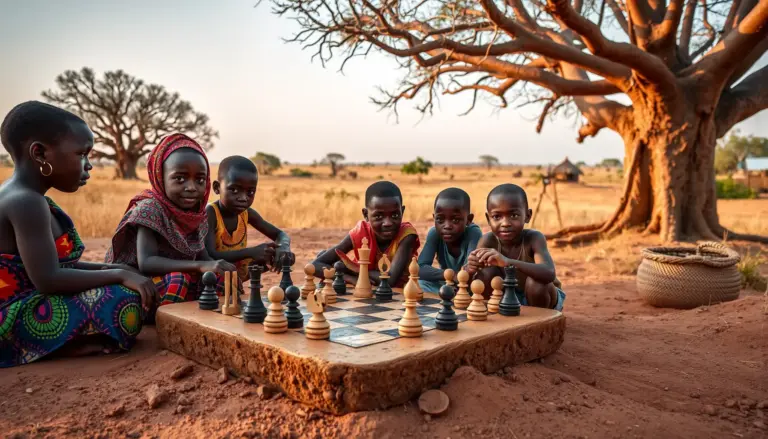
In communities like Warao of the Venezuelan Amazon or the Maya from Guatemala, chess is not played; you live. For the Warao, For example, the board represents the Orinoco River, and each piece symbolizes elements of its ecosystem: the king is the shaman, the lady the mother earth, and the pawns, the fish that navigate the waters. This reinterpretation is not merely aesthetic; is a reaffirmation of your connection with nature. In Guatemala, he ajedrez maya moderno incorporates sacred calendars in the initial arrangement of the pieces, where each movement follows time cycles linked to their worldview. These examples show that chess, far from being a westernized game, can be a universal language that adapts to local narratives, as explored in depth in this analysis of its ability to unite cultures.
The key question here is: To what extent do these adaptations alter the essence of chess? The answer lies in understanding that, for these communities, the game is not just competition, sino ceremony. In Bali, For example, Chess is practiced as part of religious rituals, where the games take place in temples and each checkmate symbolizes the balance between the earthly and the divine. This fusion between the sacred and the playful not only enriches the game, but it turns it into a tool of cultural transmission, something that is also observed in other contexts, like him sacred chess in various traditions.
Indigenous strategy: when chess challenges western rules
Western chess is governed by principles such as control of the center, part mobility and long-term planning. However, in indigenous communities, The strategy takes on radically different nuances. Los Mapuche in Chile, For example, they prioritize the collective work about individuality: in their games, players consult elders before moving, turning the game into an exercise in community wisdom. This practice contrasts with competitive chess, where the player's loneliness is almost a dogma. Is this way of playing less valid?? The answer is a resounding no.. In fact, Recent studies suggest that this collaborative approach could be more effective in developing social skills, a topic that is addressed in this article about chess and emotional skills.
Another fascinating example is Tuareg Chess, practiced in the Sahara. Here, The games are played with stones in the sand, and the rules are adapted to desert conditions: If a sandstorm interrupts the game, The game resumes the next day, regardless of the time elapsed. This flexibility challenges the rigidity of traditional chess, where time is a critical factor. The most interesting thing is that these adaptations are not arbitrary.; respond to a logic of survival and adaptation to the environment, something that is also observed in other contexts of resistance, like him chess in the trenches of Eritrea.
Pieces with soul: the art of reinventing the board
If the rules can be adapted, why not the pieces? In indigenous communities, chess boards and figures are works of art that reflect your identity. Los Zapotec from Mexico they carve pieces in copal wood, where the king is a jaguar warrior and the lady, a fertility goddess. These pieces are not simple objects; son resistance symbols in the face of cultural homogenization. In Equatorial Guinea, The boards are made with ebony and vegetable ivory, and each piece tells a story: the bishop represents the messengers of the jungle, and the horse, to the guardian spirits. This artistic approach not only beautifies the game, but it loads it with meaning, something that is also explored in this tour of handmade chess kings.
But the reinvention goes beyond the aesthetic. In some communities in the Amazon, The pieces are made with seeds and mud, materials that degrade over time. This choice is not accidental: reflects a philosophy of impermanence, where the game, like life, it is ephemeral. This idea contrasts with the Western obsession with the preservation of the pieces, as if they were untouchable relics. Isn't this vision closer to the essence of chess as a metaphor for existence??
Chess as a tool for empowerment and healing
In contexts of conflict or marginalization, chess becomes a act of rebellion. In Colombia, indigenous communities such as Nasa They use it to rebuild the social fabric after decades of violence. In his games, Players act out roles from their story: the king is the community leader, and the pawns, the displaced peasants. Each checkmate symbolizes a collective victory, no individual. This therapeutic use of chess is also observed in other contexts, like him therapeutic chess in prisons and hospitals, where play becomes a catalyst for personal transformation.
In Africa, Chess has been adopted by communities seeking to preserve their identity in the face of globalization. Not Guinea-Bissau, For example, the game is played in creole, the local language, and the games are accompanied by traditional music. This fusion of cultural elements not only enriches chess, but it turns it into a symbol of linguistic and cultural resistance. In a world where indigenous languages are disappearing at an alarming rate, initiatives like this show that chess can be an ally in the preservation of diversity.
A game for everyone? The challenges of cultural adaptation
Although indigenous adaptations of chess are fascinating, are not without challenges. One of the main ones is the lack of recognition by the international chess community. Federations usually prioritize standard rules, sidelining these alternative versions. However, This rigidity ignores a fundamental fact: chess, in its essence, it's a adaptation game. From its origins in India as Chaturanga until its evolution in Europe, chess has constantly changed, as detailed in this article about its ancient history.
Another challenge is the marketing. In a market dominated by brands like Staunton, indigenous pieces are often seen as exotic curiosities, not as legitimate expressions of culture. This raises an awkward question.: Are we willing to accept that chess is not a unique game, but a family of games with multiple voices? The answer to this question will define the future of chess as a truly inclusive space..
Indigenous chess is not an anomaly; is a silent revolution. By adapting the game to their worldviews, These communities not only enrich it, but they remind us that the rules, like cultures, They are not static. In a world obsessed with uniformity, indigenous chess invites us to celebrate diversity, to see the board not as a battlefield, but as a canvas of possibilities. Maybe, by learning from these adaptations, Western chess can rediscover its deepest essence: not like a game of elites, but as a universal language that, like art or music, transcends borders and unites humanity.
The next time you sit in front of a board, ask yourself: are you playing by the rules, or are you creating your own? Why, in the end, chess is not just a game; it's a mirror of what we are.