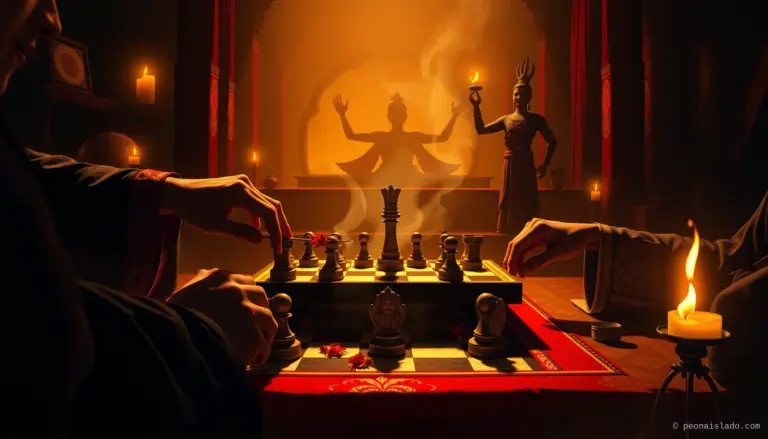
Chess is much more than a strategy game; It is a reflection of human intelligence, patience and creativity. Among the legends that surround its origin, one of the most fascinating is Remainder, the wise inventor of chess according to the Persian and Indian tradition. This story not only explains how the game came about, but also reveals its deep cultural and philosophical significance. through the centuries, chess has evolved, but its essence is still linked to cunning, the reward for ingenuity and humility in the face of complexity. In this article, We will explore the origins of the legend of Sisa, its impact on the diffusion of chess, the lessons it contains and how this narrative has transcended borders to become a universal symbol.
The origins of the legend: Who was Sisa?
The figure of Sisa, also known as Sissa ibn Dahir in the Arabic versions or Sessa in European adaptations, appears in ancient texts such as book of games by Alfonso X the Wise (13th century) and in Persian chronicles of the 9th century. According to tradition, Sisa was a brahmin or Indian sage who introduced chess to the king Shirham (the Balait, according to sources) as a gift to teach you the values of strategy, prudence and leadership. The most widespread story relates that the king, amazed by the game, He offered Sisa any reward she desired.. the wise, with apparent modesty, He asked for a grain of wheat for the first square of the board, two for the second, four for the third, and so on, doubling the amount in each of the 64 casillas.
What seemed like a humble request turned out to be a math lesson: The total amount of grains exceeded 18 trillions, an amount impossible to gather. This story, beyond its anecdotal value, symbolizes the genius of chess as a tool to understand geometric progression, patience and the consequences of seemingly simple decisions. some historians, as H.J.R. Murray in his work A History of Chess (1913), suggest that the legend could be an adaptation of earlier tales about board games, but its popularity endures because it encapsulates the essence of chess: a game where intelligence triumphs over brute force.
Chess as a mirror of culture and philosophy
The legend of Sisa is not just a story about the origin of chess, but also a metaphor for their role in society. In ancient India, he Chaturanga —forerunner of chess—was a war game that simulated the four divisions of the army: infantry, chivalry, elephants and cars. However, with the expansion of chess to Persia and the Islamic world, the game took on new layers of meaning. The Persians introduced terms like “shah” (rey) y “shah mat” (the king is trapped), that evolved to the current “jack dead”.
In Islamic culture, chess became a symbol of balance and justice. Philosophers like Al-Mas'udi (10th century) They described it as a reflection of the cosmic order, where each piece represented an element of society. Even the poet Omar Khayyam he mentioned it in his Rubaiyat, comparing life to a game of chess where destiny moves the pieces. This philosophical vision spread to Europe during the Middle Ages., where chess was associated with morality and the education of the nobility. He book of games by Alfonso, For example, presents it as a tool to teach military strategy and diplomacy.
The legend of Sisa, therefore, not only explains the birth of chess, but also illustrates how the game was adapted to different cultures, adopting new meanings without losing its strategic essence. This capacity for transformation is key to understanding its validity throughout the centuries..
The mathematical lesson and its impact on science
Shisha's request—that seemingly modest reward of grains of wheat—is one of the oldest and most famous examples of geometric progression. This mathematical concept, that today we study in basic algebra, It was used by the wise man to demonstrate the immensity of numbers and the importance of thinking long term. The formula to calculate the total sum of grains on a chess board is:
- Sum = 264 – 1 grain.
- This is equivalent to approximately 18.446.744.073.709.551.615 grain, or some 1.199 times the annual world production of wheat today.
This story has been cited in works by mathematicians such as Leonardo Fibonacci (13th century) y Pierre de Fermat (17th century), who used it to illustrate the power of exponential series. Even in modern computing, The wheat grain problem is used to teach algorithms of exponential complexity and the importance of optimization in computational systems.
Beyond its educational value, the legend highlights how chess has been a bridge between art and science. In the 20th century, scientists like Claude Shannon —father of information theory—studied chess as a model of decision making under uncertainty. Hoy, chess engines like Stockfish o AlphaZero They use mathematical principles similar to those that Sisa demonstrated more than a thousand years ago, combining logic, probability and creativity.
From legend to reality: chess in the modern world
Sisa's story transcends myth to become a symbol of how chess has shaped—and been shaped by—global culture.. In the 19th century, with the standardization of the rules and the creation of international tournaments, Chess stopped being an aristocratic pastime to become a mental sport accessible to all. Figures like Paul Morphy, Emanuel Lasker y José Raúl Capablanca They elevated the game to new heights., proving that strategy and intuition could overcome any social barrier.
In the 20th century, chess became politicized. During the Cold War, the duels between Bobby Fischer (EU) y Boris Spassky (USSR) They became a symbolic battleground between capitalism and communism. Fischer, with his victory in 1972, not only did he win a world title, but also revived global interest in chess, inspiring generations of players.
Hoy, chess is experiencing a new revolution thanks to the internet. Platforms like Chess.com y Lichess They have democratized access to the game, allowing millions of people to learn and compete online. The legend of Sisa, in this context, takes on a new meaning: It is no longer just a story about a wise man and a king, but a reminder that knowledge—like grains of wheat—can grow exponentially when shared. chess, in its essence, It's still a game strategy, patience and humility, values that Sisa taught more than a millennium ago.
The legend of Sisa and chess teach us that the simplest ideas can have profound consequences. From its origin as a war game in India to its evolution as an educational and sports tool, Chess has proven to be a reflection of human intelligence in all its forms. The story of the wise man who humiliated a king with a mathematical request is not just a popular tale; It's a metaphor for how ingenuity can overcome strength., how patience defeats impulsiveness and how a game can transcend its original purpose to become a universal language.
In a world increasingly dominated by immediacy and technology, chess invites us to stop, think and plan. Sisa's lesson—that even the smallest decisions can have monumental consequences—remains valid, either in a game, in everyday life or in science. Chess is not just a game; It's a school of thought, an art and, above all, a legacy that connects humanity through time. As the great teacher said Garry Kasparov: “Chess is the gymnastics of the mind”. And thanks to legends like Sisa's, that gymnastics is still as relevant today as it was in ancient times.