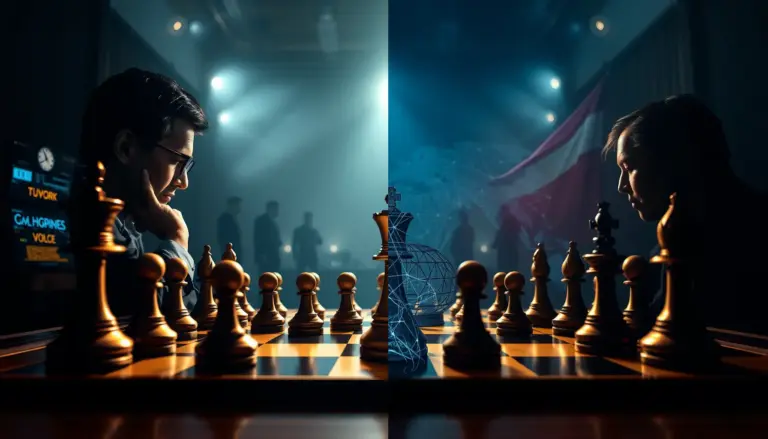
Chess has for centuries been an intellectual battlefield where only the brightest manage to stand out.. But, What unites minds like Albert Einstein, Elon Musk and Magnus Carlsen, beyond his genius? Although their disciplines seem distant—theoretical physics, technological innovation and mental sports—, Chess acts as a common thread that reveals common patterns in your thinking, solve problems and face challenges. This ancient game not only requires strategy and patience, but also shapes cognitive skills that transcend the board. Through their trajectories, We will discover how chess becomes a laboratory of the mind, where creativity, anticipation and resilience are trained like muscles. Is it a coincidence that so many geniuses have practiced it?, or is there something in your 64 squares that attract those who seek to dominate chaos?
Chess as a mental gym: beyond moving pieces
Chess is not a simple game; It is a simulator of decisions under pressure. Each move on the board forces the player to evaluate multiple variables in real time: the rival's intentions, the short and long term consequences, and the risks inherent in each choice. This dynamic replicates, in essence, the challenges faced by geniuses in their respective fields. Einstein, For example, He compared his creative process to a game of chess, where every physical theory was a “motion” who had to anticipate the objections of nature. Musk, for his part, He has acknowledged that chess taught him to think in complex systems, a key skill to manage companies like Tesla or SpaceX, where every decision affects supply chains, interconnected markets and technologies.
But, What specific skills does chess develop?? Studies in neuroscience have shown that its constant practice strengthens the working memory, the ability to hold and manipulate information in the mind, essential for solving abstract problems. It also improves the cognitive flexibility, the ability to adapt to sudden changes, something Carlsen masters when adjusting his strategy in the middle of a tense game. Besides, chess trains tolerance for ambiguity, since players must operate in an environment where information is incomplete and the opponent's rules are unknown. These abilities are not exclusive to great teachers: They are tools that any brilliant mind, from a physicist to an entrepreneur, need to navigate uncertainty.
Anticipation as a superpower: how geniuses see the future
One of the most fascinating characteristics of geniuses is their ability to anticipate scenarios before they occur.. Einstein did not arrive at the theory of relativity by chance; visualized the universe as a system of interactions where time and space were dynamic variables. Musk, instead, apply this skill to innovation: before launching a reusable rocket, had to foresee not only the technical challenges, but also the reactions of the market and competitors. Carlsen, for his part, He is a master at reading his opponent's intentions several moves in advance., as if i could “ver” the future of the board.
This ability to anticipate is not innate., but he trains. Chess is an ideal testing ground because it forces players to project consequences in a controlled environment. Each game is an exercise in counterfactual thinking: “What would happen if I move here? How would my rival respond?? What opportunities would arise next??”. This constant practice develops what psychologists call mental modeling, the ability to construct internal representations of complex systems and simulate their evolution. For Einstein, the universe was a cosmic chess board; for Musk, The technological market is a game where each movement of the competition alters the balance. Even Carlsen has stated that his greatest advantage is not memory, but his ability to “to feel” future positions as if they had already occurred.
But anticipation is not limited to the technical. It also implies manage emotional uncertainty. Geniuses don't just predict scenarios; They also control your reaction to them. Carlsen, For example, maintains legendary calm in decisive games, something that Musk has had to learn in crises like the SpaceX delays or Tesla's production problems. Chess teaches that anticipation without emotional control is useless: a player who obsesses over a possible future mistake loses sight of the present. This lesson is universal: in both science and business, genius requires balancing long-term vision with immediate action.
Creativity under pressure: when the rules are not enough
Geniuses don't just follow rules; they reinvent them. Einstein challenged Newtonian principles with relativity, Musk redefined the automotive industry with electric cars, and Carlsen revolutionized modern chess with a style of play that prioritizes positional dynamics about memorizing openings. In all three cases, Creativity arose from the need to break with the established when conventional solutions failed. chess, in this sense, It is an innovation laboratory: on a board where the rules are fixed, Players must invent new ways to win.
This creativity under pressure manifests itself in two ways:
- Strategic improvisation: Carlsen is famous for his ability to turn seemingly even positions into victories., not through spectacular plays, but with small adjustments that unbalance the rival. Musk applies a similar principle at Tesla, where problems like battery shortages are solved with unorthodox solutions, how to buy lithium mines or redesign the supply chain.
- Redefining problems: Einstein was not looking to improve classical physics; replaced it. In the same way, Carlsen does not limit himself to playing better than his rivals; changes the rules of the psychological game, like when he extends games until his opponents are exhausted. Musk, for his part, does not compete in existing markets; creates them, as he did with digital payments (PayPal) or private space travel (SpaceX).
Chess teaches that creativity is not a magical gift, but one trainable skill. Players who progress are not those who memorize more openings, but those who learn to ver lo invisible: hidden patterns, unexpected tactical resources and connections between seemingly disconnected pieces. This mentality is transferable: Einstein saw equations where others saw chaos; Musk identifies opportunities in crisis; Carlsen finds victories in positions that others would dismiss as a draw. The key is in embrace the discomfort. Geniuses are not afraid of the unknown; they explore it, because they know that that is where revolutionary solutions are born.
Resilience: why geniuses are not afraid of failure
Behind every genius there is a story of repeated failures. Einstein was rejected by universities and criticized by his colleagues before relativity was accepted. Musk has seen SpaceX rockets explode, set Tesla batteries on fire and face lawsuits for his tweets. Carlsen, despite being number one in the world, has lost games at key moments, such as his loss to Ian Nepomniachtchi in the Candidates Tournament 2021. What differentiates them is not the absence of errors, but his ability to learn from them without giving up.
Chess is a ruthless master of resilience because, in every game, failure is inevitable. A mistake can cost you victory in seconds, but great teachers don't collapse; analyze what went wrong, They adjust their strategy and get back to the board. This mentality is reflected in how geniuses deal with setbacks.:
- Failure as feedback: Carlsen does not see a defeat as an end, but as a diagnosis. after losing, Study the game to identify the exact moment when your strategy failed. Musk applies the same principle: Every rocket that explodes is a lesson that improves the next design. Einstein, for his part, He considered errors in his calculations as “signs that the universe is speaking to me”.
- Calculated risk tolerance: Geniuses do not avoid failure; they manage it. Carlsen takes risks in ranked games because he knows that, without them, can't win. Musk invests in projects like Neuralink or The Boring Company, aware that most will fail, but only one could change the world. Einstein, in his last years, explored unified theories that many considered impossible, because he understood that progress requires betting on the unknown.
- The growth mindset: Psychologist Carol Dweck has shown that geniuses do not believe that their intelligence is fixed; They see it as a muscle that gets stronger with effort.. Carlsen, For example, He wasn't born the best.; surpassed rivals such as Garry Kasparov and Vladimir Kramnik through obsessive training. Musk learned aerospace engineering from scratch to found SpaceX. Einstein, in his youth, He was a mediocre student who only found his way when he stopped memorizing and started questioning..
Chess teaches that resilience is not an abstract quality, but one survival strategy. on the board, like in life, mistakes are inevitable, but geniuses turn them into advantages. Carlsen uses his losses to refine his style; Musk transforms Tesla's failures into innovations; Einstein saw in the “errors” from classical physics the seeds of a revolution. The lesson is clear: failure is not the opposite of success, but its preamble. Those who avoid it, they never become geniuses.
Conclusions: chess as a mirror of genius
Einstein, Musk and Carlsen are not geniuses by chance, not even chess is a simple hobby for them. This ancient game acts as a mirror of cognitive and emotional skills that define the most brilliant minds: the ability to anticipate, creativity under pressure, resilience in the face of failure and the discipline to train the mind like a muscle. The board is not just a stage 64 casillas, but a microcosm where the challenges of science are replicated, business and life itself.
Most tellingly, these abilities are not exclusive to a select few.. Chess proves that genius is built, is not inherited. Carlsen was not born a world champion; He achieved this through methodical training that combined positional analysis, psychology and physical resistance. Musk was not a rocket expert when he founded SpaceX; learned as he went, applying the same trial and error logic that a chess player uses. Einstein, in your own words, I wasn't smarter than the others, but more curious, a quality that chess encourages by forcing players to question every move.
So, What do these geniuses have in common?? Not only his intelligence, but his way of thinking. Chess taught them to see the world as a system of interconnected patterns, where every decision has long-term consequences. Gave them tools to navigate uncertainty, innovate when the rules are not enough and get up after every fall. If there is a final lesson, is this: genius is not a destiny, but a path that is traveled with patience, strategy and the willingness to learn from every mistake. and on that path, chess is the best travel companion.