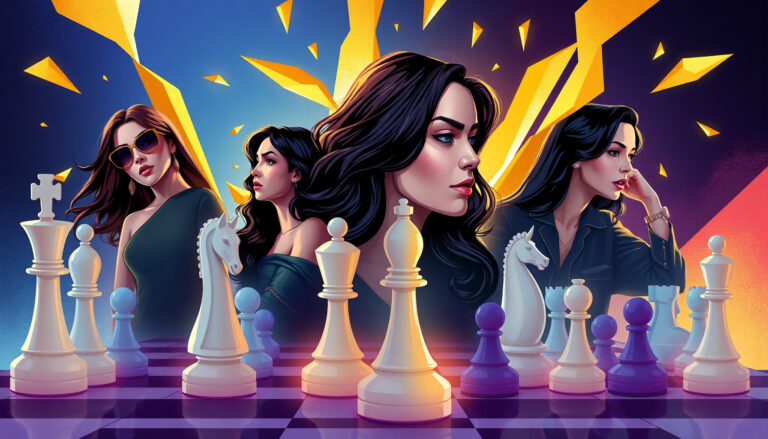
In recent years, Few series have captured the public's imagination like The Queen’s Gambit (2020), the acclaimed Netflix production that tells the life of Beth Harmon, a chess prodigy in the 1990s 1960. Beyond its addictive plot and retro aesthetics, the series raises a fascinating question: To what extent is the phenomenon it portrays true to reality?? Are there really chess prodigies like Beth, able to dominate the board with a mix of genius, obsession and emotional vulnerability? O, on the contrary, Has fiction exaggerated certain aspects to create a more dramatic and attractive story??
This article explores the intersections between reality and fiction in The Queen’s Gambit, analyzing everything from the veracity of the tournaments and the games shown to the psychological profile of elite chess players. The cultural impact of the series will also be examined, which not only revived interest in chess, but it redefined the public perception of this mental sport. Through expert testimonies, historical data and comparisons with real cases, We will unravel what is true in Beth Harmon's story and what elements belong to the realm of dramatization.
Chess in fiction: A faithful reflection or an artistic exaggeration?
One of the first questions that arise when analyzing The Queen’s Gambit is whether the chess shown on screen is an accurate portrayal of the real game or a stylized version for entertainment. The series, based on the novel of the same name by Walter Tevis, presents games that, mostly, They are recreations of historical encounters or original compositions by the great master Bruce Pandolfini., who advised on the production. However, There are creative licenses that deserve to be highlighted..
For example, The pace of the games in the series is noticeably accelerated. In reality, chess tournaments, especially the high level ones, can last for hours, with players spending up to two hours just for their first 40 movements. In The Queen’s Gambit, instead, Games are resolved in a matter of minutes, with movements executed with an almost supernatural fluidity. This responds to a narrative need: maintain the dynamism of the plot and prevent the viewer from losing interest. Nevertheless, This decision also reinforces the myth of the chess player as an almost superhuman being., capable of calculating complex variants in seconds.
Another aspect that generates debate is the representation of Soviet players. The series paints the chess players of the USSR as an unbeatable machine, with an almost military training system. While it is true that the Soviet Union dominated world chess for decades—thanks to a state program that identified and trained talent from an early age—, reality was more nuanced. Players like Mikhail Tal or Boris Spassky not only stood out for their technique, but also for his creativity and personal style. The series simplifies this complexity, presenting the Soviets as a monolithic entity, which reinforces the drama of the rivalry between Beth and her opponents.
Finally, the series omits less glamorous aspects of professional chess, like psychological pressure, physical exhaustion or long hours of theoretical preparation. In reality, great masters spend years studying openings, finals and historical games, a process that is rarely shown on screen. This omission is not accidental.: fiction prefers to focus on Beth's innate genius rather than the methodical work underlying success at chess.
Beth Harmon: A real prodigy or a literary archetype?
Beth Harmon's character is, definitely, the heart of The Queen’s Gambit. Your combination of natural talent, emotional fragility and determination make her an irresistible protagonist. But, Are there chess players in real life who resemble her?? The answer is complex and requires analyzing both the psychological profile of the chess prodigies and the fictional elements surrounding Beth..
First of all, It is important to note that chess prodigies are not an invention of the series. Historically, There have been figures like Bobby Fischer, who to the 13 years he already defeated established masters, o Judit Polgár, the best chess player in history, that to the 15 years she became a great teacher. These cases show that early talent in chess is a reality, although not necessarily accompanied by the same emotional conflicts that Beth faces. Fischer, For example, suffered mental health problems as an adult, but her childhood was not marked by abandonment and addiction like that of the series' protagonist.
Beth's most controversial aspect is her relationship with drugs and alcohol. in the series, These elements are presented as an escape mechanism to deal with pressure and loneliness. However, in reality, Substance use among elite chess players is rare. In fact, chess requires an optimal state of mind, and drug or alcohol abuse is often counterproductive. An exceptional case is that of the Russian grandmaster Vladimir Malakhov, who admitted to using amphetamines in his youth to stay awake during long study sessions, but this is the exception, not the rule. The series exaggerates this aspect to add drama, although it also serves to humanize Beth and show that, behind the genius, there is a vulnerable person.
Another fictional element is the speed with which Beth reaches the top of chess.. in the series, goes from being a beginner to defeating the best players in the world in less than a decade. In reality, The path to mastery is much slower and requires years of study, competition and, above all, defeats. Even the most outstanding prodigies, as Magnus Carlsen, They needed more than a decade to establish themselves as world champions. The series compresses this process to maintain the narrative rhythm, but also to emphasize the idea that Beth's talent is unique and almost magical.
The cultural impact of The Queen’s Gambit: a before and after for chess?
Since its premiere in October 2020, The Queen’s Gambit Not only did it become a critical and audience success, but also had a tangible impact on the world of chess. The series generated a phenomenon known as the “Queen’s Gambit effect”, which manifested itself in an unprecedented increase in the sale of chess boards, downloading learning apps and signing up for clubs and tournaments. According to eBay data, chess board sales increased by 250% in the weeks after the premiere, while platforms such as Chess.com recorded an increase in 600% in new users.
This resurgence of interest in chess is unprecedented in the digital age. Although the game had already experienced peaks of popularity in the past—such as during the “match of the century” between Fischer and Spassky in 1972—, Never before has an audiovisual production had such a direct and massive impact. The series achieved something that decades of promotional campaigns had not achieved.: demystify chess and present it as an accessible sport, exciting and, above all, cool. Before The Queen’s Gambit, Chess was perceived by many as a boring or elitist game., reserved for geniuses or people with exceptional IQ. The series changed this perception by showing that chess can be as intense and dramatic as any other sport..
The impact of the series also extended to the competitive sphere. Professional players, like the great Spanish master David Antón, They recognized that The Queen’s Gambit had inspired a new generation of chess players. Besides, the series contributed to making women's chess visible, a field historically dominated by men. Although Beth Harmon is a fictional character, Her success inspired many women to enter a sport where female representation is still a minority.. According to the International Chess Federation (FIDE), the number of registered female players increased by 20% in 2021, a growth attributed in part to the series effect.
However, not all the impact was positive. Some critics noted that the series may have created unrealistic expectations about what it means to be a chess player.. Beth's rapid rise and aggressive, creative playing style contrasts with the reality of modern chess., where theoretical preparation and mental resistance are as important as natural talent. Besides, the series does not address the less glamorous aspects of professional chess, such as the economic precariousness of many players or the psychological pressure that comes with competing at the highest level.
The psychology of chess: genius or madness?
One of the most fascinating topics that explores The Queen’s Gambit It is the relationship between chess and human psychology. The series suggests that chess genius is intrinsically linked to emotional instability, an idea that has been the subject of debate among psychologists and neuroscience experts. Is chess a sport that attracts brilliant but fragile minds, Or is this connection a myth perpetuated by fiction??
To answer this question, It is useful to analyze the psychological profile of some of the most outstanding chess players in history. Bobby Fischer, For example, It is a paradigmatic case. His genius on the board contrasted with his erratic personality and mental health problems., that led him to isolation in his last years. Fischer is not the only one: other great teachers, like Paul Morphy or Wilhelm Steinitz, They also suffered psychological disorders. However, It is important not to generalize. Players like Anatoly Karpov and Viswanathan Anand have shown that it is possible to reach the top of chess without suffering serious emotional problems..
Science offers some clues about this relationship. Neuroscience studies have shown that elite chess players have an exceptional ability to process information and anticipate moves, suggesting your brain works differently than most people's. However, This does not necessarily mean that they are more predisposed to suffering from mental disorders.. In fact, Some researchers argue that chess can be a therapeutic tool, since it improves concentration, memory and problem-solving abilities.
In the case of Beth Harmon, His emotional instability is presented as a counterpoint to his genius. The series suggests that his drug addiction and loneliness are the price he pays for his talent., an idea that reinforces the stereotype of the tormented artist. However, in reality, The relationship between creativity and mental health is much more complex. While some studies have found a correlation between genius and certain disorders, such as bipolarity or schizophrenia, Others point out that most creative people do not suffer from mental illnesses. in chess, competitive pressure and isolation can exacerbate pre-existing problems, but they are not the direct cause of genius.
The series also addresses another key psychological aspect: the obsession. Beth doesn't just play chess, but lives for him, to the point that the game becomes an extension of their identity. This trait is common among elite chess players., who often describe chess as a passion that consumes their lives. However, obsession is not exclusive to chess: It is a trait shared by many athletes, artists and scientists. What makes chess unique is the intensity with which it demands concentration and sacrifice., which can lead some players to neglect other aspects of their life.
Conclusions: reality or fiction?
Throughout this article, We have explored the multiple nuances that separate reality from fiction in The Queen’s Gambit. The series, definitely, It is a masterpiece of entertainment., able to combine drama, aesthetics and an addictive narrative. However, like all fiction, take creative liberties to build a more engaging story. The chess shown is not an exact replica of the real game, but a stylized version that prioritizes spectacle over precision. The games are faster, the most charismatic players and the most intense conflicts than is usual in the world of professional chess.
Regarding Beth Harmon's character, It is an amalgamation of literary archetypes and real cases. His precocious genius has parallels in figures such as Bobby Fischer or Judit Polgár., but his psychological profile—marked by addiction and emotional fragility—is a dramatic exaggeration.. The series uses these elements to humanize Beth and make her closer to the public., but it also reinforces stereotypes about geniuses as tormented beings. In reality, chess does not require madness, but discipline, patience and an analytical mind.
The cultural impact of The Queen’s Gambit es, maybe, his most lasting legacy. The series achieved what few productions have achieved: revive interest in an ancient sport and present it as something modern and exciting. He “Queen’s Gambit effect” showed that chess can be as addictive as any television series, and that its appeal transcends generations and borders. However, It's also important to recognize that the series created unrealistic expectations about what it means to be a chess player., especially with regard to learning pace and emotional stability.
Ultimately, The Queen’s Gambit It is a work of fiction that, as such, prioritizes entertainment over absolute truthfulness. Nevertheless, His greatest success is having brought chess closer to a mass audience, demystifying its image as an elitist and boring game. The series is not a documentary, but it doesn't pretend to be either. Its value lies in having captured the essence of chess—its beauty, its complexity and its ability to challenge the human mind—and to have conveyed it in a way that resonated with millions of people around the world. In the end, The question is not whether Beth Harmon is real or fictional, but if his story inspires us to look at chess—and, by extension, the world—with new eyes.