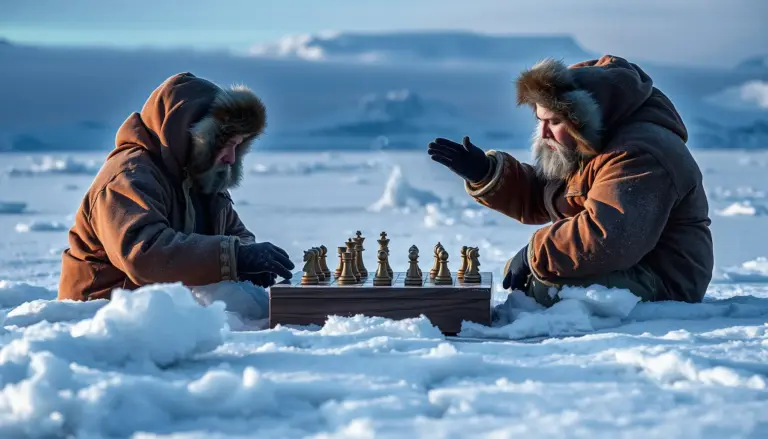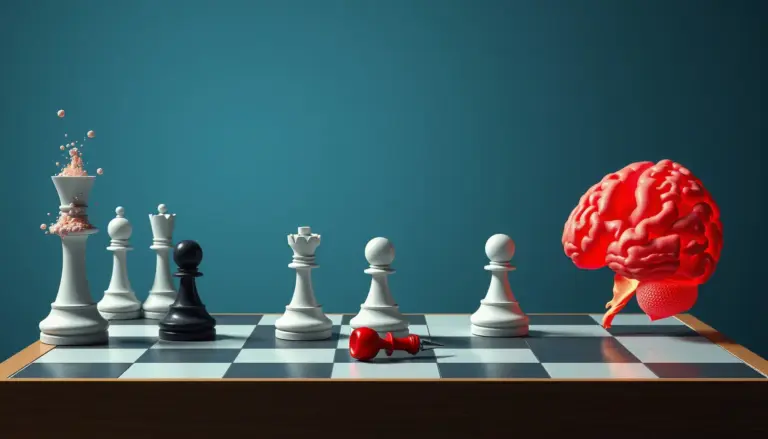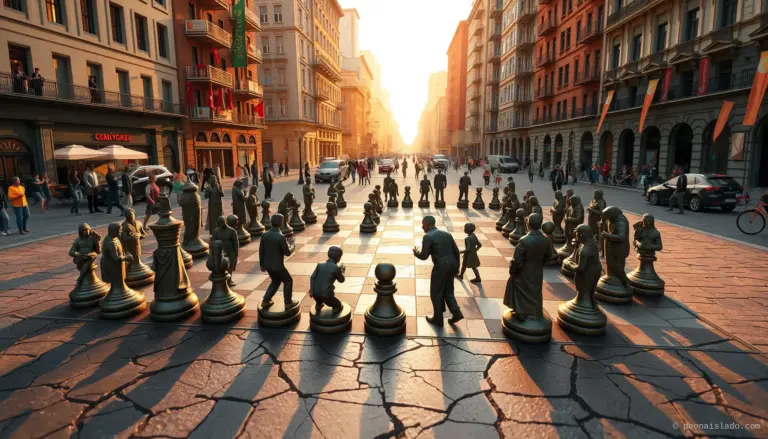
In the post-truth era, where objective facts have less influence than emotions and personal beliefs, Chess emerges as a symbolic and real battlefield. This ancient game, traditionally associated with logic and strategy, has become a reflection of contemporary tensions: information manipulation, the power of narratives and the fight for control of perception. But, Who really moves the pieces on this board? Are the players, the algorithms, the media or the power structures that operate behind the scenes? In this article, we will explore how chess, in its evolution towards the digital and media era, has become a scenario where the truth is as relative as the value of a pawn in a decisive game.
Chess as a mirror of society: from logic to emotion
Chess has been a symbol of rationality for centuries. Its essence is based on immutable rules, precise calculations and a clear hierarchy of parts. However, in the post-truth era, This game has ceased to be a refuge for objectivity and has become a microcosm of contemporary social dynamics.. The emergence of social networks, misinformation and polarization have altered the perception of chess, transforming it into a field where emotions and narratives compete with logic.
A clear example is the rise of figures such as Magnus Carlsen, not only because of his technical mastery, but for its ability to connect with global audiences. Carlsen has been able to capitalize on the power of digital platforms, as Chess.com o Twitch, to humanize the game and make it accessible. But this phenomenon has also given rise to distortions: viral games, cheating scandals (as the case of Hans Niemann in 2022) and conspiracy theories that question the integrity of the players. In this context, Chess is no longer judged only by the quality of the moves, but because of the media impact they generate.
Besides, the game has been instrumentalized as a political tool. During the Cold War, Chess was a scene of ideological confrontation between the United States and the USSR, where each victory was interpreted as a triumph of the system. Hoy, in a multipolar world, countries like Russia, China and India use chess to project soft power, financing tournaments and training young prodigies who become cultural ambassadors. The question is: Who really controls the narrative on this board? Do the players, the sponsors or the States that support them?
Algorithms and the new era of chess: who decides the rules?
The emergence of artificial intelligence (IA) has revolutionized chess, but it has also raised ethical and strategic dilemmas. Programs like Stockfish, Leela Chess Zero o AlphaZero have surpassed human capacity, redefining what it means “play well”. However, His influence goes beyond competition: have democratized access to knowledge, but they have also generated a dangerous dependency.
In the post-truth era, algorithms do not only analyze games, but they also shape the perception of the game. Platforms like Chess.com use AI-based cheat detection systems, but these are not infallible. In 2022, the scandal of Hans Niemann contra Magnus Carlsen highlighted the limitations of these systems. Niemann was accused of cheating in an online game, but the evidence was circumstantial and based on statistical patterns. To what extent can we trust an algorithm to determine the truth in a game where human subjectivity has always played a role??
Besides, AI has changed the way chess is taught and played. Analysis engines allow players to study openings and defenses with never-before-seen precision, but they have also homogenized the style of play. creativity, previously valued as a distinctive feature of great masters, now compete with algorithmic efficiency. This raises an awkward question.: If humans play like machines, What room is there for originality and emotion in chess??
The power of the media and the construction of narratives
In the information age, Chess is no longer limited to physical boards or competition rooms. The media and social networks have turned the game into a cultural phenomenon, but also in a minefield of misinformation. The virality of a game, a scandal or statement can overshadow the real value of the plays, distorting public perception.
An emblematic case is that of Bobby Fischer, whose figure has been mythologized and demonized in equal measure. Fischer was a chess genius, but also a controversial character whose anti-Semitic statements and erratic behavior made him a symbol of polarization. Hoy, His legacy is constantly reinterpreted, depending on who tells the story. Was he a hero who challenged the USSR during the Cold War, or a villain who betrayed his own principles? The answer depends on the narrative you choose to believe..
The media has also played a key role in popularizing chess among new audiences.. Series like The Queen’s Gambit (2020) revitalized interest in the game, but they also simplified its complexity. The protagonist, Beth Harmon, is a fictional character who embodies the archetype of the solitary genius, but its history is far from the reality of competitive chess. This poses a dilemma: How do you balance entertainment with precision when it comes to such a technical game??
Besides, social media has amplified the voices of players, but they have also exposed their weaknesses. Players like Hikaru Nakamura have built massive communities in Twitch, where they broadcast live games and discuss strategies. However, This exposure also makes them vulnerable to attacks and unfounded accusations.. In a world where any mistake can be magnified and distorted, How can players protect their reputation without engaging in self-censorship??
Chess as a tool of power: geopolitics and soft power
Chess has always been linked to power. From the times of kings and emperors to the present day, States have used this game as an extension of their influence. In the post-truth era, This dynamic has intensified, turning chess into a geopolitical battlefield where narratives and prestige are disputed.
Russia, For example, has historically been a chess power. During the Cold War, Soviet chess was a symbol of intellectual superiority, and players like Garry Kasparov o Anatoly Karpov They were considered national heroes. Hoy, the Kremlin continues to invest in the game, not only for its cultural value, but as a soft power tool. Russian Chess Federation receives state funding, and tournaments like World Chess Championship They are used to project an image of stability and greatness.
China, for his part, has emerged as a new chess power. In recent decades, The country has invested heavily in the training of young talents, with notable results. Players like Ding Liren have reached the top of the world ranking, and chess has been integrated into the educational system as a tool to develop strategic thinking. This approach reflects China's ambition to compete not only economically, but also culturally.
In the West, chess has been used as a symbol of resistance. During the Cold War, The United States promoted figures such as Bobby Fischer to counter Soviet influence. Hoy, in a context of geopolitical tensions, chess remains a field of symbolic confrontation. The exclusion of Russian players from international tournaments after the invasion of Ukraine in 2022 It is an example of how the game becomes politicized. To what extent do these decisions respond to sporting criteria?, and to what extent they are an extension of broader conflicts?
Conclusions: the board in the era of uncertainty
Chess in the post-truth era is a reflection of the contradictions of our time. On the one hand, It is still a game of logic and strategy, where precision and calculation are essential. On the other, has become a stage where emotions, algorithms and narratives compete for control of perception. on this board, The pieces no longer move only by the will of the players, but by external forces: the media, the states, digital platforms and geopolitical interests.
The initial question—who controls the board??—does not have a simple answer. The players are still the protagonists, But its influence is conditioned by a complex ecosystem where truth is relative and power is exercised in subtle ways.. Algorithms have redefined the rules of the game, but they have also generated new uncertainties. Media and social networks amplify voices, but they also distort them. and the states, aware of the symbolic value of chess, They use it as another tool in their soft power arsenal..
In this context, The challenge for chess lovers is to keep the essence of the game alive: the search for truth through reason. But in a world where post-truth reigns, this task becomes more and more difficult. Maybe, in the end, the real board is not that of 64 casillas, but that of human minds, where the most important battle is fought: that of discerning between what is real and what is manipulated. And in that game, we are all players.