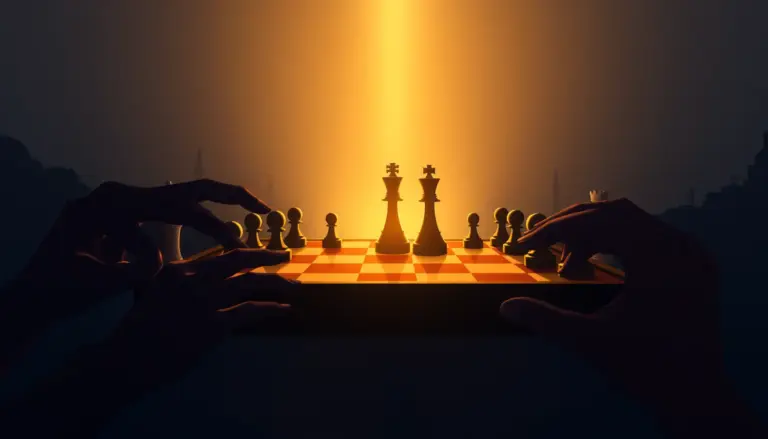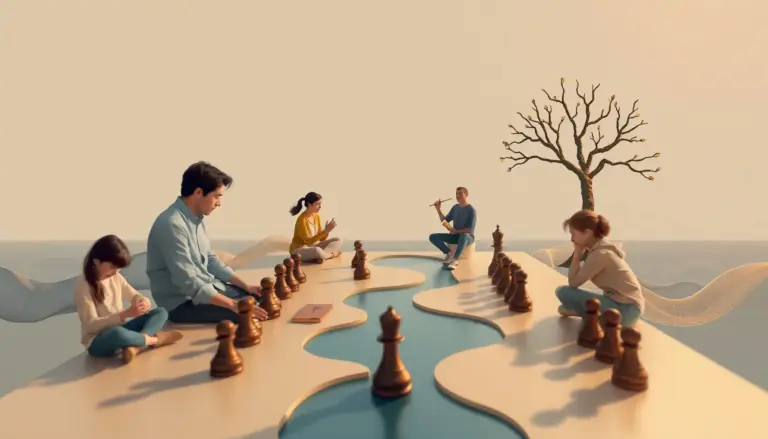
Chess is much more than a strategy game: It is a universal language that speaks in silence, a metaphor for life where each movement resonates as an existential decision. In a world saturated with noise, The board becomes a refuge where time stops and the mind dialogues with itself. But, What does this silence reveal about our human condition?? Is chess a mirror of our internal battles or a training ground for real life?
This article explores how chess, in its apparent stillness, encapsulates profound lessons in patience, resilience and the search for meaning. From its therapeutic dimension to its role as a tool of resistance in extreme contexts, the game transcends 64 boxes to become a symbol of the life in silence: that ability to act with intention when the world demands constant action. We will discover why figures like Borges or Cioran elevated it to a philosophical category, and how its practice can be an antidote to modern anxiety.
The board as a mirror of the soul
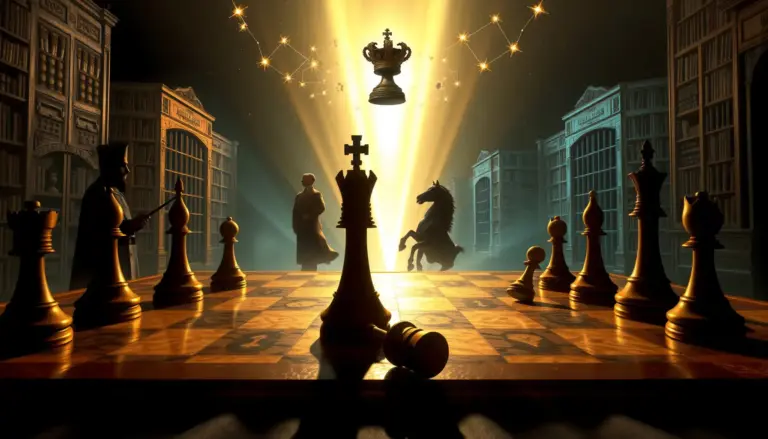
Chess not only challenges intelligence; also exposes human psychology. Each game is a duel where fears are revealed, ambitions and even traumas. The Argentine writer Jorge Luis Borges described it as a “miniature metaphysics”, a universe where the infinite unfolds in finite combinations. In his essay chess, Borges argues that the game is an allegory of life: “God moves the player, and this one, the piece. What god behind God the plot begins?”. This reflection suggests that, just like in chess, Our decisions are conditioned by forces beyond our control., whether they are destiny, genetics or social structures.
But the silence of chess also has a therapeutic power. In psychiatric hospitals in Serbia, the doctor Vladimir Raskovic demonstrated how the game helps patients with schizophrenia or depression to reconnect with reality. The concentration required to anticipate movements acts as a mental anchor, while the board structure provides a safe framework to explore emotions. This approach, known as therapeutic chess, does not seek to cure, but to offer a space where silence becomes an ally of healing.
Even in conflict contexts, chess emerges as a language of resistance. During the Cold War, The games between the United States and the USSR were symbolic battles where ideological prestige was at stake.. But beyond politics, the game has served as a bridge in war zones. In Israel and Palestine, Children from both sides compete in tournaments organized by NGOs, learning that, even in the midst of chaos, There are rules that everyone can accept. The silence of the board, in these cases, it is not absence of conflict, but the possibility of dialogue without words.
Patience as a revolutionary virtue
We live in an era of instant gratification, where impatience has become an epidemic. chess, instead, requires the opposite: the ability to wait, to postpone the reward. This virtue, almost subversive today, It is key to understanding its transformative power. The Romanian philosopher Emil Cioran, in his essay The fateful demiurge, He compared life to a game where “every move is a mistake, but error is inevitable”. Para Cioran, chess is not a game of perfection, but acceptance: learn to live with your own and others' limitations.
This idea resonates in modern psychology. Studies like those of the neuroscientist Jordan Grafman show that playing chess regularly strengthens the prefrontal cortex, the region of the brain associated with planning and impulse control. In a world where anxiety and ADHD are on the rise, Chess offers mental training to resist the temptation to act without thinking. It is no coincidence that countries like Armenia have incorporated gaming as a mandatory subject in schools: It's not just about training strategists, but to cultivate minds capable of navigating uncertainty.
But patience in chess is not passivity. It is a form of active resistance, like the one practiced by players in dictatorships. In Lukashenko's Belarus, For example, chess has become a symbol of dissent. Players like Vladislav Kovalev They have used international tournaments to denounce the regime's repression, while in prisons around the world, play is a rehabilitation tool. In these contexts, the silence of the board is filled with meaning: It is an act of rebellion against oppression, a way to affirm humanity when the system tries to strip it away.
Silence as a strategy
in chess, Silence is not just the absence of sound; It's a tactic in itself.. The great teachers like Magnus Carlsen They master the art of strategic pause: those moments when, instead of moving, they observe the rival, They study it and destabilize it with their stillness. This technique, known as zugzwang (force the opponent to move against you), has parallels in real life. How many times have we acted under pressure, only to realize that the best move was to do nothing?
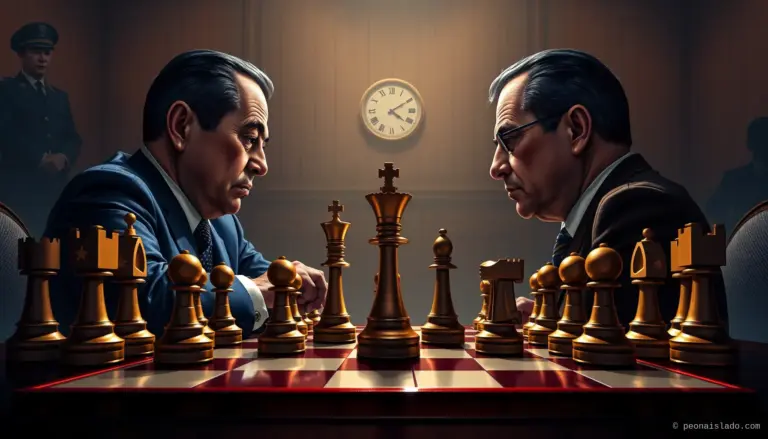
Silence is also a tool of power in diplomacy. During the Cold War, the games between Bobby Fischer y Boris Spassky in 1972 They were a symbolic battlefield where capitalist and communist ideologies were measured. Fischer, with his provocative attitude, y Spassky, with its Slavic calm, They represented two ways of understanding the world. But beyond the rivalry, The tournament showed that chess can be a language of understanding when words fail. Hoy, in a polarized world, This lesson is still valid: sometimes, the most effective dialogue occurs without saying a single word.
Even in business, strategic silence is a valued skill. CEOs like Elon Musk o Warren Buffett They have recognized that chess taught them to make decisions calmly, to anticipate market movements and resist the temptation to react impulsively. In an article about chess and business, highlights how play shapes leaders capable of navigating uncertainty. The key, according to these executives, it's not in the speed, but in the ability to read the board (or the market) before acting.
Chess as a refuge in the digital age
In a hyperconnected world, where attention is fragmented into a thousand stimuli, chess offers an oasis of pure concentration. Platforms like Chess.com o Lichess They have democratized access to the game, but they have also accelerated their pace. Games that used to last hours are now resolved in minutes, and even seconds. Is chess losing its essence in the digital age?
For some purists, he blitz (fast chess) and the bullet (ultra fast chess) They are a distortion of the game, a race for speed that sacrifices depth. However, others see this evolution as an opportunity. Digital chess has attracted new generations, especially to the Generation Z, which has turned it into a viral phenomenon thanks to platforms like TikTok. The success of series like The Queen’s Gambit the streamers like Hikaru Nakamura shows that the game is still alive, although its shape has changed.
But beyond fashion, Digital chess raises profound questions about the future of human intelligence. With engines like Stockfish o AlphaZero capable of beating any grandmaster, Are we facing the end of human creativity? O, on the contrary, Are these tools an opportunity to elevate the game to levels never before imagined?? As pointed out in an article about chess and AI, the relationship between humans and machines is not one of competition, but collaboration. AI can analyze millions of games in seconds, but he lacks the intuition and emotion that define great players.
Conclusion: silence as an act of rebellion
chess is, in essence, an act of rebellion against the noise of the world. In their 64 casillas, we find a space where silence is not empty, but plenitude: a place to think, to feel and to connect with the deepest part of ourselves. From its therapeutic dimension to its role as a tool of resistance, the game reminds us that life is not about always acting, but to choose when to do it.
In a future where technology threatens to accelerate every aspect of our existence, chess invites us to slow down, to observe and find meaning in the stillness. As Borges wrote, “chess is a game of God”, but it's also a men's game: imperfect, passionate and deeply human. Maybe, in your silence, let's find not only an escape, but a way of living with more intention, more patience and, above all, more humanity.
Are you ready to hear what the board has to tell you??