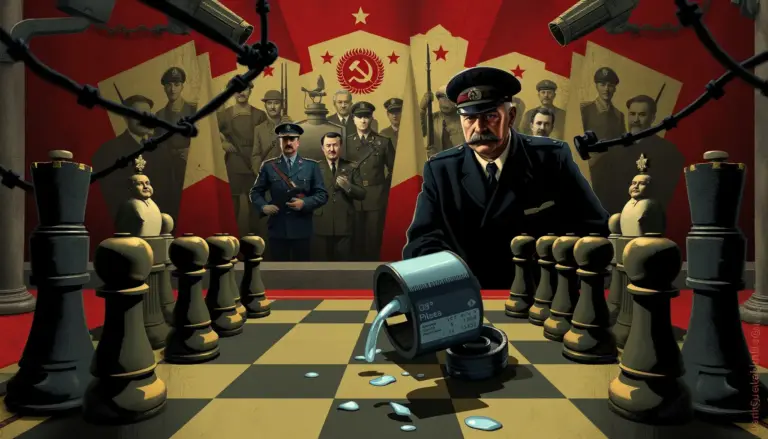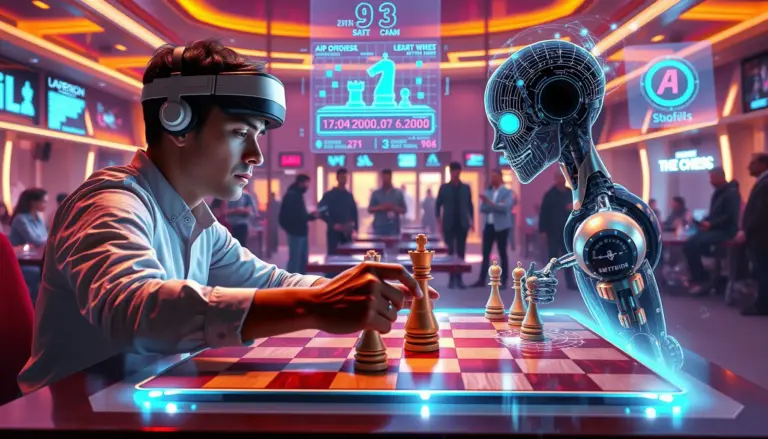
For centuries, chess has been the stage where human intelligence is measured in its purest form.: strategy, patience and creativity. but today, that ancient board faces an unprecedented revolution. The artificial intelligence He has not only surpassed the best players in the world, but it has redefined the limits of what is possible, asking uncomfortable questions: Are we facing the twilight of human genius or the dawn of a new era where the game is transformed into something deeper, accessible and, paradoxically, more human?
The emergence of engines like Stockfish o AlphaZero —the latter capable of learning from scratch without human intervention— has blurred the boundaries between cold calculation and intuition. But far from being a threat, AI has become a mirror that reflects our own capabilities, an ally that challenges our biases and forces us to evolve. In this article, We will explore how technology is shaping the future of chess, from the training of new talents to the democratization of knowledge, going through the ethical dilemmas that arise when machines dictate the rules of the game.
AI as a mirror: when the machine exposes our limitations
He 11 May 1997 marked a turning point. Deep Blue, the IBM supercomputer, He defeated Garry Kasparov in a match that transcended the board to become a symbol of the fight between man and machine. But what few remember is that, in the second game, Kasparov made a blunder in the opening, a move that no grandmaster would have considered. Was it a human error or a psychological manipulation of the AI? The answer is still up for debate, But the truth is that that moment revealed something deeper: artificial intelligence not only calculates better than us, but it exposes our vulnerabilities.
Hoy, engines like Leela Chess Zero o AlphaZero They have taken this concept to the extreme. AlphaZero, developed by DeepMind, not only plays chess, but reinvents it. Your style, based on reinforcement learning, prioritizes part activity over material accumulation, a philosophy that has inspired players like Magnus Carlsen to adopt more dynamic openings. But here lies the paradox: As AI teaches us new ways of thinking, It also forces us to question whether we are losing the essence of the game. What is left of human creativity when a machine can generate thousands of perfect games in seconds??
The answer, surprisingly, It's in how players are using AI not to replace their intuition, but to enhance it. Platforms like Lichess o Chess.com They integrate analysis engines that allow amateurs to study their games with a depth previously reserved for professionals. However, This democratized access also poses a risk: overdependence on technology. As the great teacher Peter Heine Nielsen warns, “AI is like GPS for chess: takes you to the destination, but if you don't understand the way, you will never learn to navigate by yourself”.
Hybrid chess: when humans and machines compete together
If AI has redefined competition, It has also given rise to a new format: he hybrid chess, where humans and machines collaborate in real time. In these tournaments, Players can consult chess engines during the game, but with limitations of time or depth of analysis. The result is a game where human strategy merges with precise AI calculation, creating a show that challenges traditional notions of what it means “play well”.
The first high-level hybrid chess tournament was held in 2020, with the participation of great masters such as Anish Giri and Vladimir Kramnik. What was fascinating was not only the level of play—which surpassed that of any human game—, but the way players interacted with technology. Kramnik, For example, described the experience as “a conversation with the machine”, where each engine suggestion was evaluated not for its objective correctness, but for its coherence with the human plan. This approach has given rise to a new school of thought in chess., where creativity is no longer measured by the originality of movements, but for the ability to integrate AI knowledge into a personal style.
But hybrid chess also raises ethical questions. Is it fair that a player with access to a more powerful engine has an advantage? Where do we draw the line between collaboration and deception? In 2022, the scandal of the “chips” in online tournaments — where players used hidden devices to receive AI suggestions — showed that technology can corrupt even the most controlled environments. The International Chess Federation (FIDE) has responded with measures such as electronic signal detectors, but the debate is still open: Are we facing a natural evolution of the game or a distortion of its fundamental principles?.
The democratization of knowledge: how AI is changing education
One of the most positive impacts of AI in chess is its ability to democratize access to knowledge. Before, Becoming a strong player required years of theoretical study, access to specialized books and, in many cases, an experienced mentor. Hoy, Anyone with an internet connection can train with chess engines, analyze grandmaster games or even receive personalized lessons from platforms such as Chessable o DecodeChess.
This change has had a transformative effect in regions where chess was an elite sport.. In Africa, For example, The proliferation of mobile applications has allowed young people in countries like Nigeria or Kenya to compete at the same level as European or American players. In 2023, the kenyan Martin Njoroge He became the first international teacher from East Africa, an achievement unthinkable a decade ago. But the true potential of AI goes beyond competition: in countries like India or Armenia, Chess has been integrated into educational programs as a tool to develop logical thinking and resilience in children. Studies such as the one carried out by the University of Trier in Germany have shown that students who practice chess improve their performance in mathematics and science., an evidence that has led governments like that of Spain to promote its inclusion in classrooms.
However, This democratization also has a dark side. Overexposure to AI can lead to dangerous dependency, especially in young players. As the sports psychologist points out Fernando Moreno, “when a child solves tactical problems with the help of a motor, you lose the opportunity to develop your own intuition. Chess is not just calculation; It is also art, emotion and, above all, humanity”.
The future of chess: towards a post-human era?
If AI has redefined the present of chess, Its future poses even more radical scenarios. Some experts, like the philosopher Yuval Noah Harari, suggest that chess could become a “spectator sport”, where humans no longer compete with each other, but watch how the machines play perfect games. Others, like the great teacher Viswanathan Anand, they are more optimistic: “AI will not kill chess; it will make it more interesting. Now, instead of memorizing openings, players will have to focus on psychology, creativity and time management, skills that machines have not yet mastered”.
One of the most promising trends is the development of engines “adjustable”, that allow players to train against versions of AI with specific styles. For example, An engine can be configured to imitate the aggressive play of Mikhail Tal or the positional accuracy of Anatoly Karpov. This customization not only makes training more effective, but also preserves the diversity of styles in chess, something that traditional engines, with its focus on objective perfection, had threatened to homogenize.
But the biggest challenge is not technical., but philosophical. What does it mean “play well” in a world where machines will always have the advantage? The answer could lie in rethinking the very purpose of chess. If before it was a battlefield for human intelligence, today it can become a laboratory to explore the limits of collaboration between humans and machines. As Kasparov said in a recent interview: “Chess is no longer a game of kings; It's a game of kingdoms, where humans and algorithms rule together”.
Conclusion: the board as a metaphor for human evolution
Chess has always been a reflection of its time. In the Middle Ages, symbolized divine order; in the Renaissance, human creativity; in the 20th century, the cold war. Hoy, in the age of artificial intelligence, It has become a mirror of our own evolution. AI hasn't destroyed the game; has transformed it into something more complex, more accessible and, ultimately, more human.
The future of chess is not in the supremacy of machines, but in how humans learn to coexist with them. It is no longer about beating AI - something impossible -, but to use it as a tool to explore new ways of thinking, creativity and connection. In a world where technology threatens to isolate us, chess can become a bridge between generations, cultures and, now, between humans and algorithms. As the poet said Jorge Luis Borges, “chess is an infinite game”. And in that infinity, artificial intelligence is not the end, but a new beginning.
The challenge for the players, coaches and fans is clear: embrace technology without losing sight of what makes chess unique: his ability to tell stories, to connect minds and to remind us that, in the end, even in a world dominated by machines, the essence of the game remains deeply human.