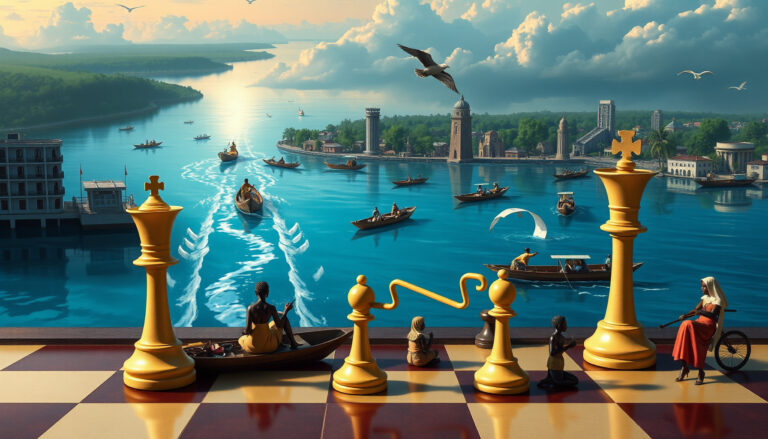
chess and Game of Thrones they share a universal language: the one of power. Both are boards where silent battles are fought, where every move is a calculated bet and where victory does not always belong to the strongest, but to the most astute. George R.R. Martin, creator of the saga, He did not hide his fascination with chess, and in his work, the game of thrones is, literally, a chess with swords and dragons. But what does this metaphor reveal to us about power?? How do board strategies translate to the intrigues of Westeros?? Y, above all, What lessons can we draw to navigate our own games of power in real life??
In this article, We will explore how chess becomes the perfect mirror of Game of Thrones, unraveling the tactics of his characters, the traps of their alliances and the sacrifices that define true strategists. Why, in the end, both on the board and in the Seven Kingdoms, power is not just a throne: it's a game.
The board as a battlefield: when the pieces are kingdoms
In Game of Thrones, The map of Westeros is not just a geographical setting, but a giant chess board. Every noble house—the Lannisters, go Stark, the Targaryens—represents a piece with specific movements and limitations. Go strong, For example, They are like pawns: loyal, resistant, but vulnerable if they advance without protection. His fall at King's Landing (the “red wedding”) is the equivalent of a pawn sacrifice in an aggressive opening, where the player accepts a smaller loss to gain positional advantage. As the article points out “Chess and politics: the game that explains power”, The pieces on the board are not just objects, but actors with defined roles, just like the houses of Westeros.
Los Lannister, instead, operate like the queen: versatile, lethal and capable of moving in any direction. Tywin Lannister, the patriarch, is the player who understands that control of the center of the board (in this case, King's Landing) It is key to dominating the game. Your strategy is based on patience and manipulation, like when he uses Tyrion as a pawn to negotiate alliances, knowing that your temporary sacrifice will strengthen your position in the long term. This dynamic is reminiscent of classic chess openings, where players give up space or material to gain initiative, as in the Queen's Gambit, where white offers a pawn to control the center.
But the true strategic genius of Game of Thrones lies in how the characters subvert the rules of the game. Daenerys Targaryen, For example, does not play with traditional pieces. Your strategy is disruptive: instead of pawns, has dragons; instead of towers, armies of Immaculate. Their approach is the equivalent of a chess variant where the rules are rewritten on the fly., as in the chess 960, where the initial position of the pieces is random, forcing players to improvise. Daenerys doesn't follow the manual; burns it, literally, and build your own path to power.
The art of sacrifice: when losing is winning
One of the most brutal lessons of Game of Thrones the thing is, sometimes, you have to sacrifice what you love most to win the game. in chess, this is known as “positional sacrifice”, a play in which material is delivered (a pawn, a tower, even the queen) to gain greater strategic advantage. in the series, This concept is taken to the extreme with examples like Ned Stark., whose beheading seems like an absolute defeat, but which actually sows the seeds of the North's rebellion against the Lannisters. His sacrifice is like that of a bishop in a chess game.: seemingly insignificant, but crucial to open lines of attack.
Another example is Tyrion Lannister, who on multiple occasions is forced to sacrifice his reputation, your safety and even your freedom to protect your family or yourself. In “The Red Wedding”, His decision not to intervene to save Robb Stark is an emotional sacrifice that, although painful, allows him to survive and maintain his influence in King's Landing. This dynamic reflects the essence of zugzwang, a chess term that describes a situation in which any move you make worsens your position, but not moving is not an option. As the article explains “zugzwang: what it is and how to apply it in everyday life”, This notion transcends the board and applies to difficult decisions in real life., where sometimes the best move is to accept a temporary loss to avoid a bigger disaster.
But the most symbolic sacrifice of the series is that of Jon Snow. His death and resurrection not only make him a stronger leader, but they also redefine their purpose. in chess, This would be comparable to sacrificing the queen to checkmate: a bold move that seems crazy, but what, if executed correctly, guarantees victory. Jon, like the queen on the board, It is the most powerful piece of the Starks, but his sacrifice is what finally allows him to defy the White Walkers and save Westeros..
Alliances and betrayals: the game of kings and pawns
In Game of Thrones, alliances are as fragile as a house of cards, and the betrayals, as inevitable as winter. This dynamic is identical to that of chess, where pieces can change sides in an instant, and where trust is a luxury that few can afford. Petyr Baelish, “Little finger”, He is the master of this game. His strategy is based on sowing discord between his rivals, like when he manipulates the Starks and the Lannisters into destroying each other. in chess, This would be equivalent to a “fork” o “fork”, a move in which one piece attacks two or more enemy pieces at the same time, forcing the rival to choose what to sacrifice.
The alliances in Game of Thrones They also reflect the importance of cooperation in chess, especially in team games or tournaments where the overall score depends on the collective performance. The alliance between Daenerys and Jon Snow, For example, It is an attempt to combine forces to confront a greater threat: the white walkers. However, like in chess, Temporary alliances often break down when individual interests conflict. Daenerys's betrayal of Jon at the end of the series is the equivalent of a player, after gaining positional advantage, decides to break a truce to checkmate.
But not all betrayals are equal.. Some, like Jaime Lannister's to Cersei, They are acts of redemption. Jaime, who starts the series as a villain, evolves into a more complex character, capable of sacrificing his loyalty to his family to do what is right. in chess, This would be comparable to a player who, after an aggressive opening, opt for a peaceful ending, prioritizing stability over victory at all costs. As the article points out “What your chess style says about your personality”, the way you play—whether aggressive, defensive or strategic—reveals a lot about your character, and the same goes for the characters of Game of Thrones.
The power of patience: when time is your best ally
in chess, patience is a virtue, and in Game of Thrones, it's a necessity. The characters who succeed are not necessarily the most impulsive, but those who know how to wait for the right moment to act. Tywin Lannister is the epitome of this strategy. Its approach is based on the accumulation of resources, consolidating power and waiting for the perfect moment to attack. in chess, this is known as “positional game”, a strategy in which the player prioritizes control of space and pawn structure over direct attacks.
Another example is Stannis Baratheon, whose military approach is methodical and calculating. Although his rigidity leads him to defeat, His initial strategy—siegeing King's Landing with a disciplined army—reflects the principles of positional chess.: control the center, limit the opponent's options and wait for him to make a mistake. In contrast, characters like Robb Stark or Daenerys in their first seasons are more tactical than strategic, acting quickly but without a long-term plan. His fall, in part, It is due to this lack of patience, like a chess player who sacrifices pieces without a clear vision of the end of the game.
Patience also manifests itself in the ability to adapt to circumstances.. Arya Stark, For example, spends years training with the Faceless Men, learning to wait, observe and act at the right moment. His revenge against Cersei and Walder Frey is not the result of a frontal attack, but of a patient and meticulous strategy, similar to a chess player waiting for dozens of moves to execute a decisive sacrifice. As the article points out “Chess and philosophy: the board as a mirror of the world”, Chess teaches that time is a resource as valuable as pieces, and knowing how to manage it is the key to victory.
The final checkmate: when power changes hands
In Game of Thrones, power is not static; It's a constant flow that changes hands like pieces on a board. The end of the series, with Bran Stark being crowned king, It is a perfect example of how power can shift from warriors to strategists.. Bran, who starts out as an innocent child, becomes the most cunning player of all, using his knowledge of the past and future to manipulate events in his favor. Your victory is not the result of brute force, but of intelligence and patience, like a chess player who sacrifices all his pieces to checkmate with a simple pawn.
This outcome reflects a fundamental truth of chess: Victory does not always belong to the player with the most material, but to the one who understands the game best. in the series, Characters who rely solely on strength—like Joffrey Baratheon or Ramsay Bolton—end up defeated, while those who combine intelligence, patience and adaptability—like Tyrion, Daenerys (in its best moments) and Bran—manage to survive and, in some cases, succeed.
But the real checkmate of Game of Thrones It's not Bran's coronation., but the lesson that leaves: power is ephemeral, and those who desperately seek it often lose it just as quickly.. like in chess, where a mistake can cost you the game in an instant, in Westeros, a bad decision can mean death. The series reminds us that power is not an end in itself, but a means to protect what really matters: the family, loyalty and, above all, humanity.
In the end, both in chess and Game of Thrones, The true strategist is not the one who accumulates the most power, but he who knows how to use it wisely. Why, as Tyrion Lannister says: “Power lies where men believe it lies”. And on the board, like in life, belief in power is what makes it real.
If this article has made you think about the power, the strategy and hidden lessons of chess, We invite you to explore other content of Penalty that delve into these topics. For example, discover how chess has been used as tool of war throughout history, or how Chess lessons can be applied to everyday life. Why, in the end, the board is not just a game: It is a mirror of the human condition.