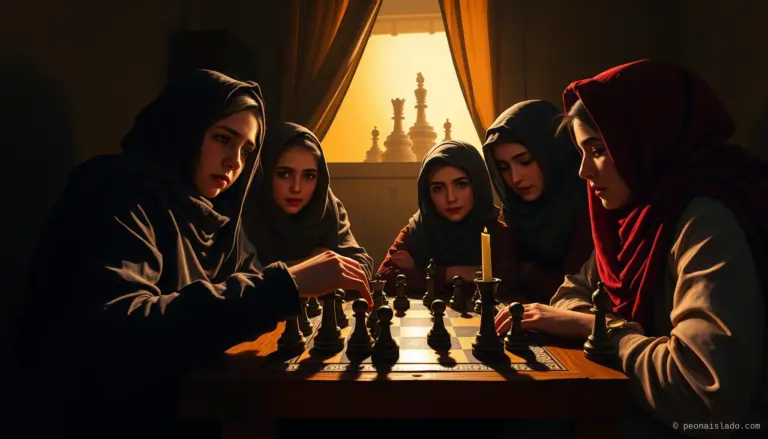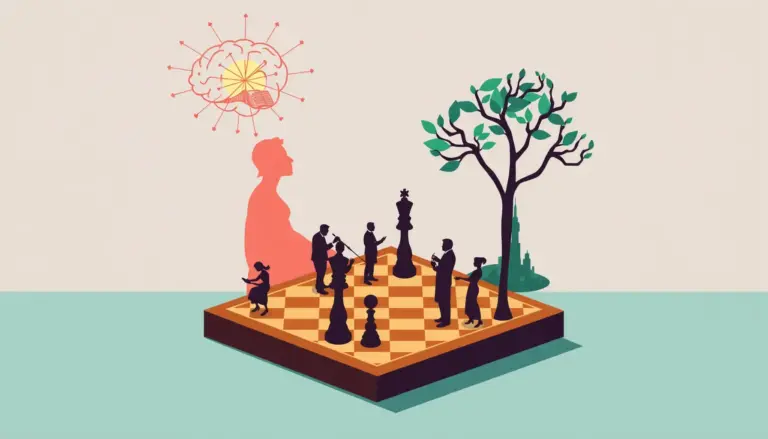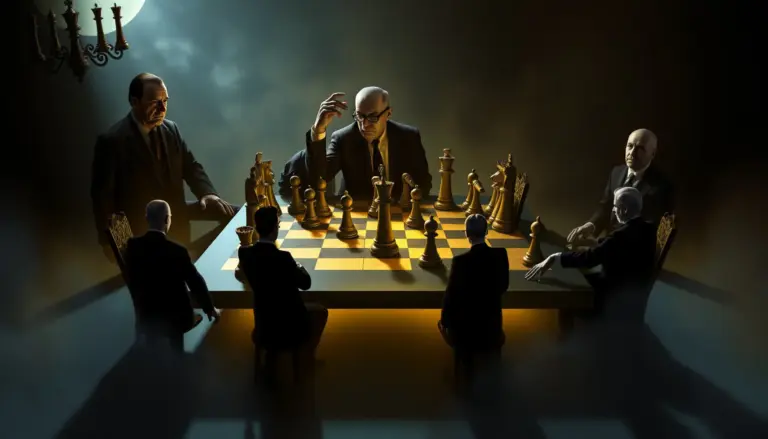
Chess and serial killers seem to inhabit opposite worlds: one is an ancient strategy game, associated with intelligence and discipline; the other, a dark phenomenon linked to violence and psychopathy. However, throughout history, Several notorious criminals have shared a fascination with this game, from Ted Bundy to “Zodiac Killer”. Is it a simple coincidence or is there something in the essence of chess that attracts disturbed minds?
This question not only arouses morbid curiosity, but also opens a window into criminal psychology, the mental structure of predators and the patterns that define their behavior. Through deep analysis, We will explore why chess—a game that rewards patience, cold calculation and anticipation—could be the perfect reflection of minds that operate outside conventional morality. From meticulous planning to obsession with control, We will unravel the threads that connect these two seemingly incompatible worlds.
Chess as a mirror of the criminal mind
Chess is not just a game; It is a microcosm of psychological warfare. Every move requires constant risk assessment, a projection of future scenarios and the ability to adapt to the opponent's plays. These characteristics are not foreign to serial killers, whose survival depends on their ability to manipulate, deceive and anticipate the actions of their victims or the authorities.
Studies in criminal psychology, like those carried out by the FBI in its Crime Classification Manual, highlight that many organized murderers—those who plan their crimes with precision—share personality traits such as meticulousness, patience and above-average intelligence. chess, with its emphasis on long-term strategy, acts as a training ground for these skills. For example, the serial killer Dennis Rader, known as “BTK” (Bind, Torture, Kill), He was an avid chess player and described his crimes as “projects” that required impeccable execution, similar to a well-played game.
Besides, Chess fosters a mindset of absolute control. on the board, the player has power over each piece, and every decision can alter the course of the game. For a serial killer, whose real life is marked by chaos and lack of emotional control, chess offers an illusion of dominance. This need for control is manifested in their crimes, where the victim becomes a “part” more in his macabre game.
The obsession with pattern and predictability
Serial killers are usually individuals obsessed with patterns. They look for victims who fit a specific profile, They repeat rituals in their crimes and, in some cases, they leave deliberate clues to challenge the authorities. This fixation on repetition and structure finds a parallel in chess, where the openings, gambits and defenses are studied over and over again until they become automatisms.
A notable example is the case of Harold Shipman, the British doctor who murdered hundreds of patients. Shipman was an amateur chess player and, according to psychological reports, his approach to crimes reflected a chess mentality: He chose his victims based on a “pattern” doctor (elderly patients with minor ailments) and carried out his murders with almost clinical precision. for him, every death was a calculated move, one more step in your “match” personal.
This obsession with patterns is also related to the controlled chaos theory, a concept that some psychologists apply to serial killers. in chess, even in chaotic positions, an experienced player can find order. Similarly, a murderer like Ted Bundy —who also played chess—saw in the chaos of his crimes an underlying structure that only he could understand. chess, in this sense, not only satisfies your need for order, but also provides them with a framework to justify their actions: “It's just a game, and I am the best player”.
Chess as an escape valve for psychopathy
Psychopathy, a personality disorder characterized by a lack of empathy, egocentrism and manipulation, It is present in many serial killers. However, not all psychopaths are violent; some channel their traits into professions such as politics, business or, even, competitive chess. For those who do cross the line into crime, chess can act as an escape valve “segura” for your darkest impulses.
Chess allows these individuals play God without immediate consequences. on the board, can experiment with destruction, sacrifice and domination without anyone being hurt (at least, not physically). This virtual experience of power can be addictive for minds that, in real life, They seek to exercise similar control over other human beings. The case of Bobby Fischer, one of the best chess players in history, illustrates this point. Although he was not a serial killer, Fischer exhibited psychopathic traits—paranoia, misogyny and an obsession with control—which manifested themselves both on the board and in his personal life.. His mental decline and his anti-Semitic statements (despite being Jewish) suggest that chess was not only his passion, but also a refuge for your inner demons.
For serial killers, Chess also offers a way to intellectualize violence. Instead of acting on impulse, They can rationalize their crimes as “plays” in a bigger game. This cognitive distortion allows them to separate their actions from any feelings of guilt., given that, in your mind, They are not killing people, sino “winning a game”.
The loneliness of the board and emotional isolation
Chess is a solitary game. Although it is played between two people, each player is immersed in his own world of calculations and strategies, isolated even from his opponent. This dynamic reflects the emotional life of many serial killers, who tend to be socially isolated individuals, unable to form genuine connections with others.
Isolation is a common factor in criminal psychology. Studies like those of the criminologist Robert D. Hare, creator of the Hare Psychopathy Scale, They point out that psychopaths often lack the ability to experience deep emotions, which leads them to seek intense stimuli to compensate for their internal emptiness. chess, with its intellectual complexity, provides that stimulus without requiring a real emotional connection. For someone like Anders Behring Breivik, the Norwegian terrorist who murdered 77 people in 2011, chess was a way to fill the void in his life before committing his crimes. In his writings, described the game as a “battle of minds” that prepared him for his “mission”.
Besides, Chess fosters a mindset of intellectual superiority. Serial killers are often considered more intelligent than the rest of humanity, and chess reinforces this belief. on the board, can demonstrate their “genius” without needing to interact with others in a meaningful way. This combination of isolation and perceived superiority creates a perfect breeding ground for the radicalization of their violent fantasies..
Conclusions: An innocent game or a reflection of darkness?
Chess doesn't turn anyone into a serial killer, But its structure and dynamics offer fertile ground for minds already inclined toward psychopathy., control and obsession with patterns. through this game, These individuals find a way to channel their darkest impulses., intellectualize their violence and satisfy their need for domination without immediate consequences. From meticulous planning to emotional isolation, Chess acts as a mirror that reflects—and in some cases, amplifies—the traits that define human predators.
However, It is crucial to remember that the vast majority of chess players are not criminals. The game, in himself, It is a neutral tool: Its impact depends on the mind that uses it. For millions of people, Chess is a hobby that stimulates creativity, patience and strategic thinking. The connection between chess and serial killers is not causal, sino contextual: reveals how certain disturbed minds find in this game a language that resonates with their way of seeing the world.
Ultimately, This relationship invites us to reflect on the duality of human intelligence. The same game that has inspired geniuses, philosophers and artists can also be adopted by those who operate in the shadows. Maybe, rather than wondering why chess attracts serial killers, We should ask ourselves what this tells us about human nature.: that even in the most unexpected places, light and darkness can coexist.