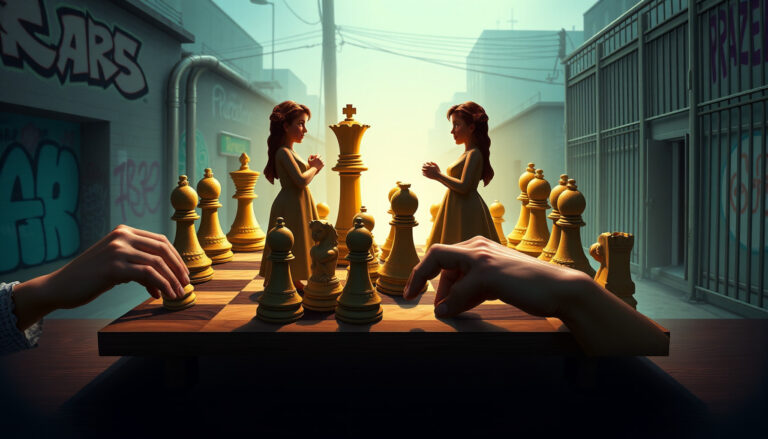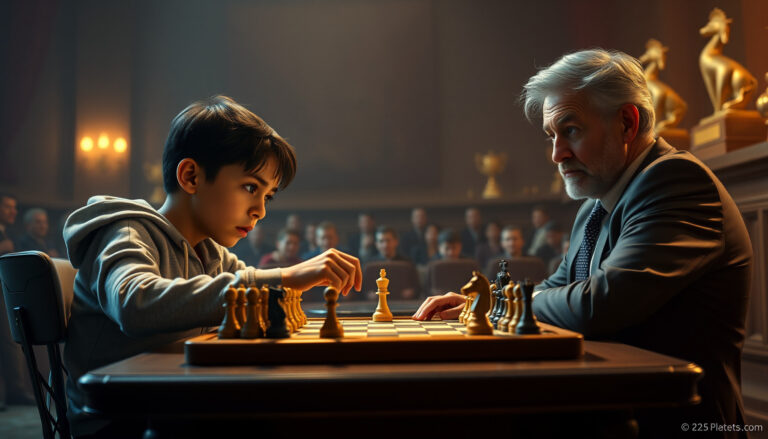
Imagine a classroom where two students, separated by an invisible barrier of resentment, they face each other not with fists, but with pawns. The board becomes a symbolic battlefield, where each movement requires anticipating the consequences, not only in the game, but in the relationship itself. This scenario, far from being a utopia, is the essence of school projects where chess resolves conflicts between students: a pedagogical tool that transforms confrontation into strategic dialogue, resentment in empathy and impulsiveness in reflection.
chess, in its essence, It's a microcosm of life. Each game forces players to negotiate with uncertainty, to manage emotions in the face of defeat and to celebrate victory without humiliating the rival. These lessons, applied in the school context, acquire a therapeutic dimension. It's not just about teaching openings or tactics, but to use the game as a coexistence laboratory, where students learn that every action has a reaction and that true mastery does not lie in winning, but in understanding.
Chess as a mirror of human conflicts
Conflicts between students rarely arise out of nowhere. Behind every discussion, every mockery or every act of exclusion, there is an unmet need: recognition, belonging or simply the desire to be heard. chess, with its shift structure and clear rules, acts as a secure framework where these tensions can be expressed without scaling. For example, in a project implemented in a school in Medellín, It was observed how two students who had been involved in a physical fight managed to, after several guided chess sessions, sit face to face without aggression. The key was not in the game itself, but in the process of chess and empathy that was encouraged: the mediators (trained teachers or peers) They were asked to verbalize their strategies before moving a piece, forcing them to put themselves in each other's shoes.
This approach goes beyond the resolution of specific conflicts. Studies such as the one carried out by the University of Cambridge in 2019 showed that students who participated in school chess programs developed a greater ability to regulate your emotions and make decisions under pressure. The board becomes a life simulator, where every mistake (how to lose a tower due to carelessness) teaches a lesson without real consequences, but with a profound impact on the way we relate to others.
From theory to practice: projects that change realities
One of the most emblematic cases is that of Club Peón Aislado in Medellin, where chess is used as a tool for social transformation. In this project, children and adolescents from vulnerable neighborhoods not only learn to play, but rather they participate in dynamics where the board becomes a bridge to address issues such as domestic violence or bullying.. For example, in an activity called “The board of emotions”, Students must associate each piece with a feeling (the king with leadership, the pawn with resilience) and then explain how that feeling influences your decisions in and out of the game. This methodology, that combines therapeutic chess with emotional pedagogy, has managed to reduce aggressiveness rates by 40% in schools where it is implemented.
Another inspiring example is that of project “Chess for Peace” in Burundi, where the game was used to reconcile communities divided by ethnic conflicts. After the genocide of 1993, Hutu and Tutsi children who had grown up in a climate of mutual distrust were brought together in chess tournaments. The dynamic was simple but powerful: The teams had to be composed of members of both ethnicities, and before each game, the players had to share a personal anecdote related to peace. The result was surprising: he 85% of participants reported a decrease in prejudice towards the other group, and many maintained friendships beyond the project.
Chess as a universal language of inclusion
School chess projects not only resolve conflicts, but they also break social and cultural barriers. In schools with high migratory diversity, like those in Europe, the board has become a invisible bridge that unites students from different backgrounds. A notable case is that of project “Chess at recess” in Barcelona, where children recently arrived from Syria, Ukraine or Morocco learn the rules of the game with their local colleagues. chess, being a language without words, allows integration to start from the first move. Besides, by not requiring specific physical skills, Levels the playing field for students with disabilities or learning difficulties, as explored in depth in the article on accessible chess.
This inclusive dimension is enhanced when chess is combined with other disciplines.. In it project “Art and Chess” from a school in Buenos Aires, students created thematic boards inspired by their cultures of origin. A group of Bolivian children designed a board with Andean motifs, while another, composed of students of Japanese descent, incorporated elements of shogi. This fusion of creativity and strategy not only enriched the game, but it fostered a sense of belonging and pride in one's roots..
The role of the teacher: beyond teaching openings
For these projects to be successful, the role of the teacher is fundamental. It is not enough to know the rules of chess; it is necessary to master mediation techniques and emotional pedagogy. In it Armenian model of school chess, which has been adopted by more than 30 countries, teachers receive specific training in social chess, an approach that prioritizes the development of soft skills over pure competence. For example, instead of rewarding the winner of a tournament, The student who demonstrates greater sports spirit o ability to resolve conflicts during games.
One of the most effective strategies is the use of guided games, where the teacher intervenes to ask reflective questions: “What would happen if your opponent sacrifices his queen in this move?”, “How would you feel if you were in their place??”. These questions, inspired by Socratic methodology, they force students to analyze not only the position on the board, but also the emotional consequences of their actions. Besides, is encouraged self-assessment through game diaries, where students record their emotions before, during and after each game. This exercise, which may seem simple, has proven to be key to developing the emotional intelligence.
Challenges and lessons learned
Implementing chess projects to resolve conflicts is not without challenges. One of the main obstacles is the initial resistance of the students, especially those who associate gambling with extreme competition or frustration. To overcome this, many projects begin with playful dynamics that demystify chess, as games with modified rules (For example, allow moving two pawns on the first turn) or cooperative games where the objective is not to win, but to achieve a joint checkmate.
Another challenge is sustainability. Many projects fail because they depend on the initiative of a single teacher or external financing.. To avoid this, It is key to integrate chess into the school curriculum in a transversal way. In Spain, For example, The Community of Madrid has included chess as an optional subject in primary school, with a focus on project based learning. Students don't just play, but they research the history of chess, They create their own variants or even organize tournaments to raise funds for social causes.
Finally, It is important to measure the impact of these projects beyond academic results. In it project “Chess in the Amazon” from Colombia, A qualitative methodology was used to evaluate changes in school coexistence. The researchers interviewed students, parents and teachers before and after implementation, and they found that the 78% of participants reported an improvement in their ability to resolve conflicts peacefully. Besides, an increase in school attendance was observed, especially in indigenous communities where absenteeism was high due to lack of motivation.
Conclusion: chess as a seed of a culture of peace
School projects where chess resolves conflicts between students are not a magical solution, but yes a powerful seed. In a world where polarization and violence seem to be gaining ground, the board offers a space where logic triumphs over impulse, where strategy replaces aggression and where empathy becomes the best move. As Grandmaster Garry Kasparov said: “Chess is a war on a board. The goal is to crush the opponent's mind”. But in the school context, that objective is transformed: It's no longer about crushing, but to understand; not to win, but to grow.
True victory is not measured in checkmates, but on the students' ability to apply the lessons from the board in their daily lives. When a child learns to think two moves ahead, not only does it improve your game, but develops an invaluable tool for navigating life's conflicts. And when a school decides to adopt chess as part of its culture, He's not just teaching a game., but by cultivating a generation of critical thinkers, empathetic and resilient. Ultimately, chess does not resolve conflicts on its own, but it gives them a language: the one of reason, patience and humanity.