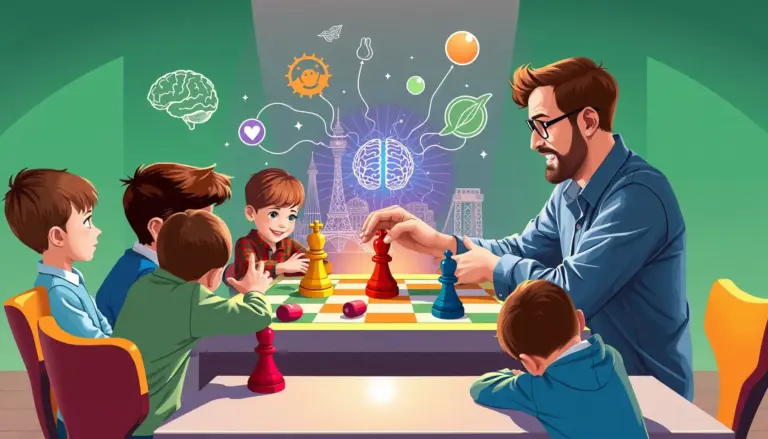
chess, that board 64 squares where silent battles are fought, It's much more than a game: It is a mirror of the human mind. Each game reveals not only strategies and tactics, but also the recurring errors that limit the progress of beginners. These failures, far from being simple oversights, They are symptoms of mental patterns that hinder the learning chess and the ability to retain knowledge over the long term. Why do some players advance quickly while others remain stagnant for years? The answer is usually hidden in how they manage—or waste—their memory and attention..
In this analysis, we will unravel the 10 Most common mistakes beginners make, but not from the surface. We will go beyond the obvious like “not develop the parts” o “leave the king in the center”. We will explore how these errors are intertwined with cognitive processes, how they affect the memory in chess y, the most important thing, how to correct them to transform frustration into growth. Why, in the end, Chess is not just about winning games., but to understand why we lose.
The illusion of “learn by watching”: the myth of passive memory
One of the most widespread mistakes among beginners is to believe that watching grandmaster games—whether on platforms like chess online or in books—enough to improve. This practice, although useful, becomes a double-edged sword when done without an active method. Human memory does not work like a hard drive that stores information by simple exposure; requires interaction, spaced repetition and, above all, practical application.
Neuroscientist Daniel Schacter, in his book *The seven sins of memory*, explains that passive memory—that which does not involve conscious effort—is ephemeral. in chess, This results in players memorizing openings without understanding their underlying ideas., or who repeat moves from famous games without analyzing why they worked. The result is fragile knowledge, that fades under the pressure of a real game.
The solution is not to stop studying games, but to do it with a critical approach. For example, when reviewing a game of Magnus Carlsen, a beginner should ask: Why did he sacrifice that pawn?? What threat hides its movement? How would I react in that position?? This type of question activates semantic memory, which is what allows concepts to be generalized and applied in new contexts. Without this step, learning comes down to an act of faith, not understanding.
The syndrome of “impulse movement”: when short term memory fails
The second mistake, closely linked to the previous, is the tendency to play moves based on emotional impulses or short-term memory. This occurs when a player, facing a complex position, choose a move because “it seems good” at the moment, without evaluating long-term consequences. Working memory—that limited capacity that allows us to retain information temporarily—is saturated, and the brain chooses the most accessible option, not necessarily the best.
A study published in *Nature* in 2016 showed that expert chess players not only have superior memory for patterns, but they are also more efficient at filtering out irrelevant information.. The beginners, instead, They often fall into the trap of considering too many variables at once., leading to hasty decisions. For example, A classic mistake is to capture a pawn with the queen early in the game., without realizing that this exposes her to further attacks.
The key to overcoming this error is to develop a decision protocol. Before moving, the player should ask himself three questions: What threatens my rival? Which piece is least active in my position? What long-term plan can I develop?? This method, although simple, forces the brain to prioritize information and reduces dependence on short-term memory. Besides, train with chess modules that analyze games in real time can help internalize these thought patterns.
The obsession with openness: the error of prioritizing memory over understanding
The third mistake is, maybe, the most paradoxical: beginners often spend hours memorizing openings, believing that this will give them an immediate advantage, when in reality it is one of the areas where it has the least impact on your level of play. Openness is important, but only if you understand its purpose. Memorizing variants without understanding the strategic ideas behind them is like learning phrases in a foreign language without knowing grammar.: can work in very specific contexts, but fails with any variation.
An emblematic case is that of players who dominate the Sicilian Defense until the movement 15, but what, by deviating from the script, they are lost. This occurs because their knowledge is based on the declarative memory —the one that stores facts—, instead of the memoria procedural —the one that stores abilities—. The first is rigid; the second, adaptable.
The solution is not to abandon the study of openings, but approach it intelligently. Instead of memorizing 20 movements of the Ruy Lopez, it is more useful to understand the general principles: control the center, develop the parts, castle early and connect the rooks. These concepts are universal and applicable to any opening. Besides, platforms like Lichess offer tools to practice openings in an interactive environment, where the player can experiment with variants and receive immediate feedback.
The carelessness of the end: when long term memory is ignored
If the openings are the beginning of the game, endings are their climax. However, many beginners underestimate its importance, believing that games are decided in the middlegame. This error is especially serious because endings require a different type of memory: the ability to remember specific patterns and apply them with pinpoint precision. A player who does not study finals is condemned to make basic errors, like not knowing how to mate with king and queen against king, or waste opportunities in winning positions.
Psychologist Anders Ericsson, known for his theory of 10,000 hours of deliberate practice, argues that excellence in any field requires focusing on areas of greatest weakness. in chess, Endings are one of those areas.. A beginner who spends only the 10% from your study time to finals is severely limiting your progress. The good news is that endings are easier to systematize than other phases of the game. Books like *100 Chess Endings You Need to Know* by Jesús de la Villa are an excellent introduction, since they present clear and repeatable patterns.
Besides, finals study has a beneficial side effect: improves the recognition memory. This is the ability to identify familiar patterns in new contexts., a crucial skill not only in chess, but in everyday life. For example, A player who has practiced the rook and pawn against rook ending will instinctively recognize when to activate his rook in a similar position., even if the board is full of pieces.
The trap of “me against the world”: the mistake of not analyzing one's own games
The fifth mistake is, in many ways, the most human: the resistance to analyzing one's own games. after a defeat, It's tempting to blame bad luck, to distraction or even rival. But chess, like life, does not forgive self-indulgence. Every match, whether victory or defeat, It's a learning opportunity, but only if examined honestly.
The problem is that the human brain tends to remember what confirms its beliefs and ignore what contradicts them.. This is known as confirmation bias. A player who believes he is “good at tactics” will remember your victories based on brilliant combinations, but you will forget the games where you lost because you did not calculate a sequence well. To counteract this bias, It is essential to adopt a scientific approach: register the games, analyze them with tools like Stockfish, and identify recurring patterns of errors.
An effective method is retrospective analysis. After a game, the player should reconstruct it from memory, without looking at the board, and note in what points your memory differs from reality. This not only improves memory, but also reveals which aspects of the game were most meaningful to him. For example, if a player clearly remembers a rook sacrifice, but forget a mistake in the opening, It's a sign that you need to work more on that aspect..
The myth of innate talent: when memory is underestimated
The sixth mistake is, In fact, a limiting belief: the idea that chess is a game for “geniuses” or people with innate talent. This notion, although romantic, is false. Studies such as that of Fernand Gobet and Guillermo Campitelli, publicado en *Psychological Science*, show that the most determining factor in success in chess is not IQ, but the quantity and quality of the practice. In other words, memory—trained through repetition and analysis—is more important than any assumption “don natural”.
The case of Bobby Fischer It is illustrative. Although he is remembered as a prodigy, his rise to the world title was the result of years of obsessive study. Fischer not only memorized games, but he broke them down until he understood every detail. His memory was not magical; It was the product of a rigorous method.
For beginners, this is good news: Chess is a game accessible to anyone willing to train their memory systematically.. The key is in the deliberate practice, a concept that involves focusing on specific areas of improvement, receive immediate feedback and get out of the comfort zone. For example, instead of playing quick games without thinking, a beginner should spend time solving tactical problems, where each exercise reinforces a different memory pattern.
The disconnect between theory and practice: when memory is not applied
The seventh mistake is the gap between what a player knows theoretically and what he applies in practice.. This is especially common in gamers who consume a lot of content—books, videos, courses—but they do not put it into practice in a structured way. memory, in these cases, becomes a storehouse of useless information, like a library full of books that no one reads.
A classic example is the player who knows the square rule in pawn endings., but what, in a real game, does not apply it because he is nervous or distracted. This occurs because the theoretical memory has not been integrated with the memoria procedural, which is what guides automatic actions. To close this gap, It is essential to combine theoretical study with active practice. For example, after learning a concept like zugzwang, The player should look for games where this resource appears and analyze how it was applied.
Another useful tool is the training with restrictions. For example, play games where the objective is not to win, but to apply a specific concept, such as center control or piece activity. This forces the brain to prioritize the application of what has been learned over the immediate result., reinforcing the connection between theory and practice.
The overload error: when memory is saturated
The eighth mistake is trying to learn too much in a short time. In the digital age, where access to information is unlimited, it's tempting to consume content non-stop: YouTube videos, online courses, opening books. But the human brain has limits. The working memory, that ability to retain information temporarily, can only drive between 4 y 7 elements at the same time, according to psychologist George Miller. When a beginner tries to absorb too much information, your memory is saturated, and what should be learning becomes noise.
A study from the University of California showed that students who distribute their study in short, spaced sessions retain more information than those who do it in hour-long marathons.. in chess, This means that it is more effective to study 30 minutes a day, focusing on a single topic, what to dedicate 5 hours on a Sunday to review everything that has been learned in the week.
Besides, It is crucial to prioritize quality over quantity. Instead of trying to memorize all the variants of the King's Indian Defense, It is better to master one or two main lines and understand their strategic ideas. This not only prevents memory saturation, but also facilitates practical application. Tools like Chessable They are useful in this regard, since they use spaced repetition algorithms to optimize learning.
The lack of feedback: when memory is not corrected
The ninth mistake is playing without receiving external feedback. memory, alone, not enough to improve; needs to be corrected and refined. A player who only plays online games without analyzing them or receiving guidance from a coach is condemned to repeat the same mistakes over and over again.. This is similar to trying to learn a language by speaking to yourself., without listening to native speakers or receiving corrections.
Feedback can come from multiple sources: a coach, a chess engine, or even a more experienced rival. The important thing is that it is specific and actionable. For example, instead of saying “you played the opening wrong”, good feedback would point out: “in the movement 5, your knight on c3 blocked the advance of the d4 pawn, what limited the development of your bishop”. These types of fixes allow the player to identify error patterns and work on them.
Besides, feedback does not have to be formal. Platforms like Chess.com offer automatic game analysis, which can be an excellent tool for players who do not have access to a coach. The key is not to settle for the result of the game, but understand because was won or lost.
The last mistake: confuse memorization with learning
The tenth and last mistake is, in many ways, the synthesis of all the previous: confuse memorization with learning. A player who memorizes openings, tactics and endings without understanding the underlying principles you are building your game on sand. memory, in chess, It is not an end in itself, but a tool to develop understanding.
A clear example is that of players who memorize the Immortal Departure de Anderssen, but they don't understand why the queen sacrifice works in that context. Without that understanding, They will not be able to apply the concept in their own games. True learning occurs when memory is integrated with logical reasoning, creativity and the ability to adapt.
To avoid this error, It is essential to take a holistic approach. This means studying not only games and openings, but also chess history, psychology of the game and even philosophy. For example, read about Wilhelm Steinitz and his theory of balance in chess can help understand why certain strategic principles work. In the same way, analyze games of Kasparov vs Karpov can reveal how psychology influences decisions on the board.
In the end, chess is a memory game, but not in the superficial sense. It's a memory game intelligent, where what is remembered are not isolated movements, but patterns, ideas and principles. The mistakes beginners make are not technical failures, but symptoms of a dysfunctional relationship with memory. Correcting them does not require genius, but discipline, curiosity and, above all, the willingness to learn from each game, whether victory or defeat.
The board is ready. The pieces, in position. The question is not if you can win, but if you are willing to remember—and learn—from every movement.
chess, like life, It's not about avoiding mistakes., but to understand them. Every game lost, every misapplied concept, every opening forgotten at the crucial moment, It is an opportunity to sharpen your memory and, with her, the mind. The errors we have analyzed are not simple stumbles; They are signals of how we process information, how we store it and how we retrieve it under pressure.
Memory in chess is not a passive store of data, but a muscle that is strengthened with intelligent use. A player who memorizes variants without understanding them is like a musician who repeats scales without feeling the music.. True progress comes when memory becomes understanding, and understanding, in intuition. When a beginner stops seeing the board as a set of pieces and begins to perceive it as a system of interconnected patterns, has made the qualitative leap that separates it from stagnation.
But this path is not linear. There will be games where, despite the study, memory will fail. Moments of frustration where what has been learned will seem to evaporate. It is in those moments where chess reveals its most valuable lesson: error is not the enemy, but the teacher. Every jack mate avoided, every combination calculated precisely, every final won with technique, It is the result of having fallen into the same traps before. memory, so, it's not just a file, but a map of experiences that guides towards wiser decisions.
The ultimate challenge is not to master chess, but to master the art of learning. Why, in the end, the board is nothing more than a mirror. It reflects not only our strengths and weaknesses, but also our ability to evolve. and that, maybe, be the most important game of all.