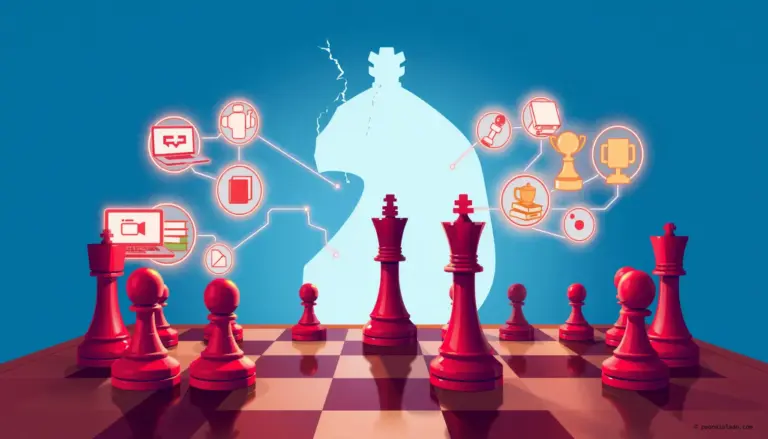
Imagine a chess board as a microcosm where each piece, every movement, It is a reflection of the internal struggle. For a young man trapped in the spiral of depression, that same board can become a bridge to reconnection: a space where silence is not loneliness, but concentration; where defeat is not failure, but learning. chess, with its structure and its demand for mental presence, offers more than just a game. It is a therapeutic tool that, according to recent studies, activates brain areas linked to resilience and decision making, precisely those that depression usually turns off. But, How does this ancient game achieve what sometimes neither medication nor conventional therapy achieve??
The board as a mirror of the fractured mind
Depression in adolescents is not just sadness; It is a progressive disconnection from the world. Young people who suffer from it often describe a feeling of “live under glass”, where emotions and external stimuli arrive distorted. Here, chess acts as a unique catalyst. Unlike other games, requires full attention: Each game forces us to anticipate consequences, to evaluate risks and accept that decisions have weight. A study published in The Journal of Affective Disorders (2021) demonstrated that adolescents with depression who participated in chess workshops for three months showed significant improvements in their ability to regulate emotions, compared to a control group. The key is in the metacognition: Chess teaches you to observe your own thoughts without judging them, an exercise similar to mindfulness, but with tangible rules and objectives.
Besides, The board works like a “safe space” where the error has no real consequences. In everyday life, a young person with depression can become paralyzed by the possibility of making a mistake; in chess, every failed move is a lesson, not a failure. This redefinition of error is crucial: according to clinical psychologist Vladimir Rašković, pioneer in therapeutic chess, “the game allows internal conflicts to be externalized. The game becomes a metaphor for life, but with the advantage that here you can go back, analyze and try again”.
The neuroscience behind the checkmate of depression
The brain of a teenager with depression usually has less activity in the prefrontal cortex, the region in charge of planning and impulse control. chess, being an exercise of forced calculation, precisely stimulates this area. A study from the University of California (2020) used MRIs to compare the brain activity of novice players before and after intensive six-week training. The results were revealing: not only did it increase connectivity in the prefrontal cortex, but a greater production of brain-derived neurotrophic factor (BDNF), a protein associated with neuronal plasticity and emotional resilience.
But there is an even more fascinating detail.: chess activates dopaminergic reward system gradually. Unlike video games or social networks, where gratification is immediate and superficial, In chess, pleasure comes after sustained effort. This is vital for young people with depression, whose reward system is usually “asleep”. As neuroscientist Wendy Suzuki explains, “Chess teaches you to tolerate frustration and postpone reward, skills that transfer to other areas of life”.
It is no coincidence that programs like Chess in Schools and Communities (CSC) in the United Kingdom have integrated chess in schools with high rates of youth depression. Their reports show that students who participate in these programs not only improve their academic performance, but they also report a greater sense of control over their lives. chess, in this context, acts as a will training: Every game is a reminder that, even in adverse situations, there are options.
The power of the collective: when the board joins
Depression isolates, but chess has the ability to reconnect. In cities like Medellín, where the street chess has flourished as a tool for social transformation, Chess clubs have become shelters for at-risk youth. Over there, the board functions as a common language that transcends social differences, economic or cultural. “Chess does not judge your past or your current situation; it just asks you to think”, comments Juan Pablo Montoya, founder of a club in the community 13. “For many boys, that is the first step to feel part of something”.
This community dimension is essential. A meta-analysis published in Frontiers in Psychology (2022) found that group chess programs reduce depression symptoms by a 30% more than individual approaches. The reason is twofold: on the one hand, the game encourages interdependence (win or lose depends on both players, which generates a sense of shared responsibility); for another, create a space of belonging, where the young man ceases to be “the depressed” to become “the chess player”.
Initiatives like Chess for Mental Health In the United States they have taken this approach a step further, combining chess with group therapy. In your sessions, Participants analyze games not only from a strategic point of view, but also emotional: “Why did you sacrifice that tower? What did you feel when your opponent checked you??”. These questions, apparently simple, help young people identify negative thought patterns and replace them with more constructive ones.
From theory to practice: how to implement chess as therapy
It is not enough to place a board in front of a young person with depression and expect miracles. Therapeutic chess requires a structured approach, where play is just one part of a larger process. Here, Vladimir Rašković's lessons are fundamental: “Chess does not heal by itself, but it is a powerful tool when used with intention”. These are some key principles to implement it:
- Focus on the process, not in the result: The goal is not to win, but learn to think. In the first sessions, it is useful to play games with modified rules (For example, without matte jacket) to reduce pressure.
- Integration with other therapies: Chess works best when combined with techniques of cognitive behavioral therapy. For example, after a game, The young person can be asked to write down three movements that have generated anxiety and how they would deal with them in the future..
- Creation of rituals: Establish a routine (how to always play at the same time or in the same place) helps create predictability, something crucial for those fighting depression.
- Use of technology: Platforms like Lichess or Chess.com offer tools to analyze games, allowing young people to identify mistakes without the pressure of a physical rival. Besides, he digital chess can be a gateway for those who feel overwhelmed by face-to-face interaction.
A concrete example is the program Checkmate Depression, developed in Canada. In it, participants receive a “game diary” where they record not only the movements, but also your emotions before, during and after playing. This self-observation exercise has been shown to be as effective as some traditional therapies in reducing rumination., one of the most debilitating symptoms of depression.
The limits of chess: when the game is not enough
Although chess offers undeniable benefits, It is important to recognize your limits. It's not a magic cure, and in cases of severe depression, must be complemented with professional treatment. Besides, not all young people respond the same: some may feel overwhelmed by the complexity of the game or frustrated by losses. Here, the figure of trainer-therapist is key. It's a role, that combines knowledge of chess and psychology, helps adapt the game to individual needs.
Another challenge is sustainability. Many therapeutic chess programs rely on volunteers or limited funding, which hinders its expansion. However, cases like that of chess in prisons show that, even with scarce resources, play can have a profound impact. In prisons in Colombia and Argentina, For example, chess has been used to rehabilitate young offenders, teaching them not only to think strategically, but also to manage frustration and work as a team.
Finally, There is the risk of idealizing chess as the only solution. As the clinical psychologist María Fernanda López warns, “chess is a tool, not a substitute for therapy. can open doors, but it does not replace deep emotional work”. Its effectiveness depends, to a large extent, how it fits into a broader treatment plan.
Conclusion: the board as a bridge to the light
Depression in young people is a silent epidemic, but chess offers an unexpected antidote: the possibility of reconnecting with the world through strategy, patience and community. It is not about turning teenagers into great teachers, but to give them back something that depression takes away from them: the ability to see options where before there was only darkness. Each game is a metaphor for life, but with a crucial advantage: in chess, there is always a next move.
The challenge now is to take this knowledge beyond specialized circles. Schools, community centers and even hospitals could integrate chess as part of their mental health programs, following the example of countries like Armenia, where the game is a mandatory subject since 2011. As Grandmaster Garry Kasparov said: “Chess is the gymnastics of the mind”. Maybe it's time to recognize that, for many young people, It can also be the physiotherapy of the soul.
If this article resonated with you, Explore how chess has transformed other realities in our article on therapeutic chess in foster care, or discover how gaming has brought generations together in the intergenerational bridge of chess. The board is ready; The only thing missing is for someone to sit down and play..