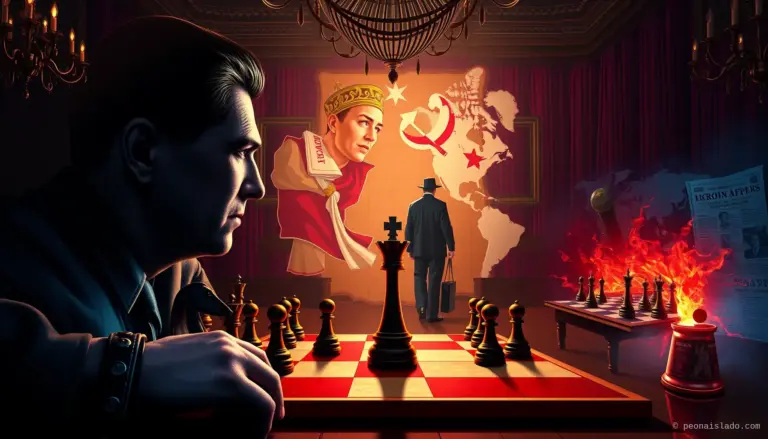
Imagine a board 64 boxes where each movement not only defines a strategy, but also a silent conversation between two minds. chess, more than a game of kings and pawns, It is a mirror of the human empathy: the ability to anticipate, understand and even feel the intentions of the other before they execute them. In a world obsessed with speed and individuality, chess forces us to stop, observe and connect with another's perspective. But, How can an ancient game teach us something as modern as empathy? The answer is not in the rules, but in the very essence of the game: the theory of mind applied to 64 casillas.
The board as a laboratory of the theory of mind
Theory of mind—that cognitive ability that allows us to attribute mental states to others—is the basis of empathy.. in chess, This ability is activated in an almost scientific way. Each game requires the player not only to calculate variants, but also interpreter the rival's intentions. Why did that pawn advance?? What threat does this castling hide?? These questions are not technical, but psychological. A study published in Frontiers in Psychology (2019) showed that expert chess players develop a greater ability to predict the actions of their opponents, not only for his tactical knowledge, but for his ability to “file” behavior patterns. This constant practice of strategic empathy transcends the board and becomes a tool for everyday life, as we explore in our article on chess in life: lessons to make better decisions.
But there is a crucial nuance: empathy in chess is not passive. It's not about feeling sorry for your opponent who loses a piece., but of understand your logic to anticipate your next move. It is an active empathy, Machiavellian case, where compassion is subordinated to strategy. This balance between human connection and cold calculation is what makes chess a unique training ground for the mind.. As cognitive psychologist Gary Klein points out, great teachers don't just watch plays, sino stories: attack narratives, defense and sacrifice that can only be built by understanding the other.
Chess as a bridge between cultures and generations
chess is, first of all, and universal language. The language doesn't matter, age or origin: two people can sit in front of a board and communicate without words. This quality makes it a powerful tool for inclusion and intergenerational connection.. In Medellin, For example, projects like the Isolated Pawn Club have shown how chess can break social barriers, uniting at-risk youth with older adults in a mutual learning space. Here, empathy is not just cognitive, but emotional: Players learn to value each other's experiences, whether it's the patience of a grandparent or the creativity of a child.
This ability to unite people from disparate backgrounds has historical roots. During the Cold War, chess became a silent diplomat between US. and the USSR. Games like that of Fischer vs. Spassky (1972) They were not only sporting events, but acts of communication in a divided world. On that board, two opposing political systems found common ground: the rules of the game. Hoy, in conflicts such as that of Israel and Palestine, chess remains a refuge. Organizations like Chess for Peace They use the game so that children from both sides interact, not as enemies, but as rivals in a neutral space. Empathy here is not abstract: es tangible, measure in checkmates and shared openings.
The paradox of competition: Can aggressive play teach compassion?
chess is, in essence, a confrontation game. Each game is a battle where the objective is to defeat the rival. However, This apparent contradiction—competition vs.. empathy—is precisely what makes it valuable. Psychologist Carol Dweck, in his theory of growth mindset, argues that challenges are opportunities to learn. in chess, every defeat is a lesson in humility: an invitation to understand one's own mistakes and the strengths of the other. This dynamic encourages a competitive empathy, where respect for the opponent becomes an integral part of the game.
A revealing example is the concept of zugzwang, a situation where any movement worsens the player's position. in life, like in chess, sometimes we are stuck in difficult decisions. Empathy here manifests itself in the ability to recognize that the rival also faces his own problems. forced to move, your own limitations. This perspective not only improves the game, but also cultivates a more understanding attitude off the board. As Grandmaster Jonathan Rowson points out, “chess is not just a strategy game, but of emotional strategy“.
This connection between chess and emotions is explored in depth in our article on therapeutic chess: how it helps young people with depression, where play is used as a tool to develop resilience and self-knowledge. Empathy, in this context, It's not just towards the rival, but towards oneself: understand one's own emotions to manage them better.
Chess as a mirror of human diversity
Each player has a unique style: some are aggressive, other defensive; some calculate variants with surgical precision, while others trust their intuition. This diversity is not an obstacle, but an opportunity to practice adaptive empathy. In a game, It's not enough to know the rules; you have to adapt to the rival's style, anticipate your preferences and even your fears. A positional player, For example, may feel uncomfortable facing a tactical opponent who sacrifices pieces without apparent logic. Empathy here consists of understanding that discomfort and exploiting it, but also in recognizing that both approaches—cold calculation and creativity—are valid.
This acceptance of diversity extends beyond the board. In it nonbinary chess, For example, the game becomes a space where gender identity does not define the rules, but the strategy. Here, Empathy manifests itself in the ability to play without prejudice, recognizing that the board is a place where everyone can express themselves freely. In the same way, in it chess for the blind, empathy takes a practical form: adapt the game to make it accessible, proving that barriers are human constructions, no limitations of the game itself.
Chess in the digital age: empathy or isolation?
The rise of online chess has democratized the game, but it has also posed a dilemma: Can empathy flourish in a virtual environment where the rival is just a username? Platforms like Lichess and Chess.com have tried to humanize the experience with features like chat and emojis, but the essence of chess—the face-to-face connection—is diluted. However, The pandemic showed that even in the distance, chess can be a bridge. Online tournaments like Chessable Masters brought together players from all over the world, creating communities where empathy was manifested in messages of support and collaborative analysis of games.
But there is a risk: the dehumanization of the rival. In online chess, It is easy to fall into the trap of seeing the opponent as an obstacle, not like a person. This is where empathy must be consciously cultivated.. As philosopher Byung-Chul Han points out, digital hyperconnection can lead to loneliness if it is not accompanied by a deep connection. chess, even in its digital version, offers a solution: the possibility of play with purpose, not just for Elo points, but for the pleasure of understanding the other. In this sense, the article social chess: the antidote to competitive obsession explores how games can be a tool to reconnect with humanity in an increasingly virtual world.
Conclusion: checkmate to indifference
Chess is not just a strategy game; it's a humanity exercise. In each game, we actively practice empathy: anticipating, understanding and, ultimately, respecting the other. This ability, grown in 64 casillas, It has the power to transform the way we relate to the world.. In a historical moment marked by polarization and individualism, Chess reminds us that true intelligence is not in beating the other, but in understanding it. As the great teacher Emanuel Lasker said: “in chess, like in life, the strongest rival is your own prejudice”.
The next time you sit in front of a board, remember: you are not playing against an opponent, but with a traveling companion. Every movement is a question, each answer an opportunity to connect. And in that silent dialogue, maybe you will find something more valuable than a checkmate: the ability to see the world through the eyes of another.