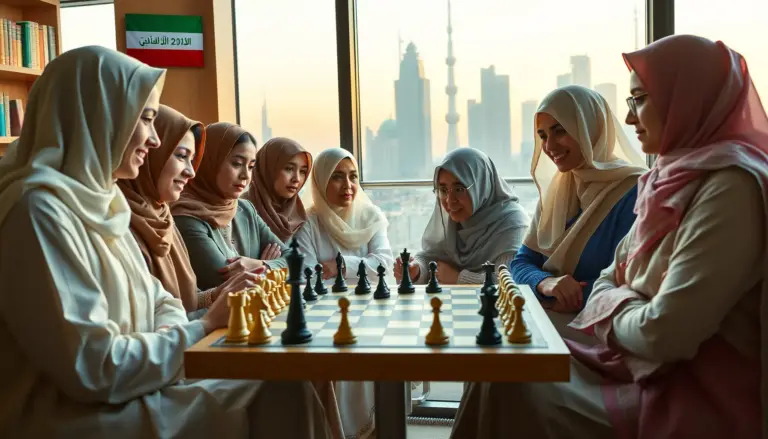
On a board 64 casillas, where each movement is a decision and each strategy a metaphor for life, chess stands as a space of radical equality. Here, the pieces do not distinguish gender, sexual orientation or identity: only logic matters, creativity and the ability to anticipate the next step. However, off the board, Reality has been less generous with those who have sought refuge in this ancient game. For the LGBTQ+ community, Chess is not only a mental sport, but a sanctuary where diversity is celebrated and prejudices are left at the door. How has this safe space evolved?? What lessons does it offer for building more inclusive communities??
Chess as a mirror of society: from exclusion to resistance
chess, as a reflection of society, has not been free of bias. For centuries, official competitions were dominated by men, and women—when allowed to participate—faced stereotypes that relegated them to secondary roles. This panorama, documented in depth in the article on women in chess, It also affected the LGBTQ+ community, whose members often hid their identity for fear of rejection. However, the resistance has been constant. Figures like Jennifer Shahade, two-time US chess champion. and LGBTQ+ activist, have shown that the board can be a scenario of empowerment. Shahade, who is also a writer and commentator, has used its platform to make visible the barriers that still persist, from lack of representation to discrimination in international tournaments.
The history of chess is full of moments in which the game has served as a tool of resistance. During the Cold War, For example, the board became a symbolic battlefield between the US. and the USSR, as explored in chess in the cold war. But it has also been a refuge for those seeking to escape oppressive realities.. In the decade of 1980, when the AIDS crisis devastated the gay community, some found in chess a form of connection and normality. Tournaments like Harvey Milk Chess Tournament in San Francisco, founded in 1986, They emerged as spaces where identity was not an obstacle, but a celebration.
LGBTQ+ clubs and tournaments: the board as a safe space
In recent decades, Chess has seen initiatives flourish that seek to create safe environments for the LGBTQ+ community. One of the most notable examples is the Chess Queer, a club founded in Berlin in 2018 which organizes tournaments and workshops with an inclusive approach. Your motto, “Everyone is welcome, no matter who you love or how you identify”, summarizes the philosophy of these spaces: chess as a universal language that transcends differences. In Spain, he Madrid LGBT+ Chess Club has followed a similar path, promoting not only competition, but also the visibility. These clubs not only offer a place to play, but they function as support networks, especially for young people who may feel isolated in their environments.
The creation of these spaces has not been easy. In many countries, Chess remains a sport dominated by traditional structures that, sometimes, resist inclusion. However, Community pressure and growing global awareness have led to federations such as the FIDE to adopt anti-discrimination policies. In 2021, FIDE launched a campaign titled “Chess for All”, that seeks to promote diversity in the game. Although these advances are significant, there is still work to do, especially in regions where LGBTQ+phobia remains a systemic problem. For those who want to create their own inclusive spaces, the guide to creating a chess club offers practical tools to get started.
Chess as a tool for healing and empowerment
Beyond the competition, Chess has proven to be a powerful therapeutic tool for the LGBTQ+ community. In cities like New York and London, organizations like Chess in the Park have used the game to work with homeless LGBTQ+ youth, offering them not just a hobby, but also life skills, like patience, resilience and decision making. These programs are based on the premise that chess can be a puente towards self-acceptance and community building, as detailed in therapeutic chess.
An emblematic case is that of Vladimir Raskovic, Serbian psychiatrist who used chess as part of therapy for patients with anxiety and depression disorders. Rašković discovered that the game helped his patients structure their thinking and manage frustration, skills especially valuable for LGBTQ+ people facing stress from discrimination or family rejection. Your work, documented in therapeutic chess and mental health, has been replicated in other countries, demonstrating that the board can be an ally in the search for emotional well-being.
Besides, chess has served as a platform for activism. In 2020, the great teacher Maurice Ashley, the first African American to achieve that title, organized an online tournament called “Chess for Change”, which raised funds for LGBTQ+ and racial justice organizations. Events like this not only make visible the causes, but they also send a clear message: chess can be a vehicle for social change.
Challenges and future: towards truly inclusive chess
Despite the advances, the path towards fully inclusive chess still faces obstacles. In some countries, The participation of LGBTQ+ people in official tournaments continues to be limited by discriminatory laws. Even in nations with more progressive legal frameworks, subtle prejudices persist, like the idea that trans women should not compete in women's categories. These discussions, although complex, are necessary to ensure that chess remains a space where everyone can participate on equal terms..
Technology has also played an ambivalent role. On the one hand, platforms like Lichess y Chess.com They have democratized access to the game, allowing people from all over the world to compete regardless of location or identity. On the other, online anonymity can facilitate toxic behavior, such as harassment or discrimination. To address these challenges, It is crucial that platforms implement clear moderation policies and that the chess community promotes a culture of respect, as discussed in ajedrez online vs. in person.
The future of LGBTQ+ chess depends on several factors. First of all, education: It is essential that federations and clubs incorporate diversity and inclusion training for their members. In second place, visibility: more LGBTQ+ public figures in chess can inspire new generations. Finally, the collaboration: alliances between chess organizations and LGBTQ+ groups can strengthen efforts to create safe spaces. An inspiring example is the work of Chess in Slums in Nigeria, that uses chess to empower young people in vulnerable situations, including members of the LGBTQ+ community.
Conclusion: the board as a metaphor for equality
chess, in its essence, It's a game of equals. on the board, all pawns have the same rules, and checkmate does not distinguish between kings or queens. However, outside the 64 casillas, reality has been more complex. For the LGBTQ+ community, chess has been both a refuge and a battlefield, a space where barriers have been broken and where there is still much to build. Creating inclusive clubs, The use of the game as a therapeutic tool and the fight for anti-discrimination policies are fundamental steps towards a future where chess is truly for everyone..
As the great teacher once said Garry Kasparov, “chess is life in miniature”. If that's true, so every game played in a safe space is a small act of resistance, a statement that, on the board and in life, We all deserve a place to be ourselves.. The challenge now is to take that philosophy beyond the boxes, towards a society where diversity is not only tolerated, but celebrated.