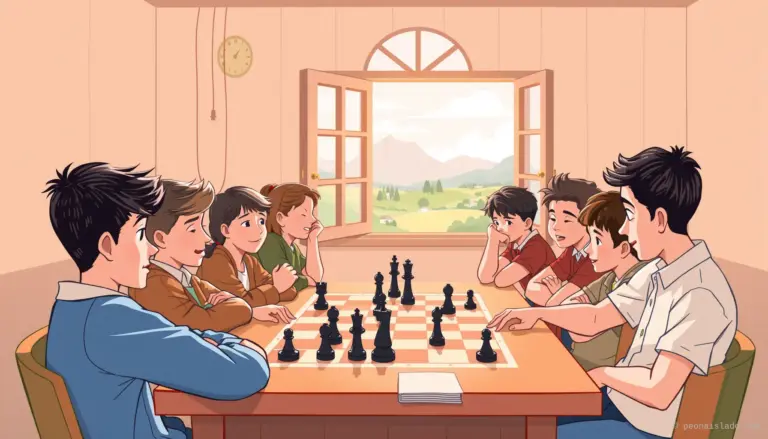
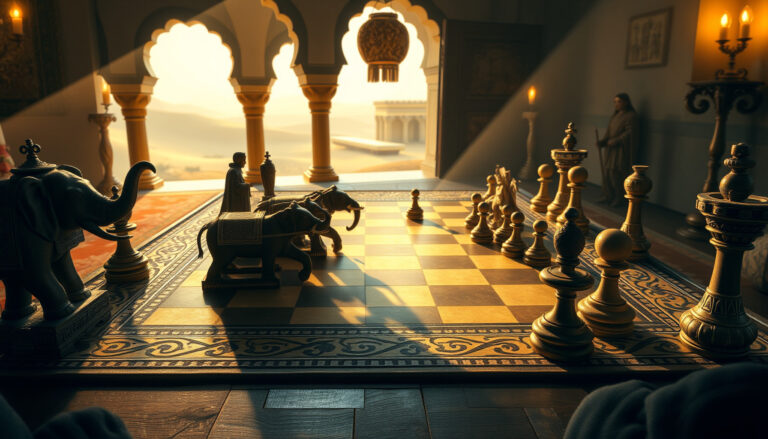
chess, that game of kings and strategists, has been for centuries much more than a simple hobby. In the Middle Ages, became a reflection of feudal society, a symbolic battlefield where not only games were settled, but also power conflicts, ideologies and even heresies. How did a game originating from the East manage to infiltrate European courts?, challenge the Church and shape the mentality of an era? The answer is not only in the movements of the pieces, but in political tensions, religious and cultural that surrounded him. This article explores how medieval chess transcended its status as entertainment to become a mirror of its time., an instrument of education and, sometimes, a weapon of resistance.
To understand its impact, It is essential to analyze its evolution from the Origin of chess in India and Persia, where he was born as chaturanga, until its transformation in Europe. During the Middle Ages, chess not only adapted its rules and pieces, but also absorbed the values and contradictions of a society in constant change. From the ivory carved boards of the nobles to the clandestine games in monasteries, the game became a universal language that spoke of war, diplomacy and, above all, of power.
Chess as a metaphor for feudal war
Medieval Europe was a continent fragmented into kingdoms, duchies and manors, where war was a constant and military strategy determined the destiny of nations. In this context, Chess emerged as a pedagogical tool for the nobility, designed to teach combat tactics without spilling blood. The pieces, with their movements and hierarchies, They reflected the military structure of the time: the king, central but vulnerable figure; the queen, initially weak but over time it would acquire unprecedented power; the bishops, representatives of the clergy; the horses, heavy cavalry; the towers, the strengths; and the pawns, the infantry.
However, medieval chess was not an exact replica of war. Unlike real conflicts, where luck and chance played a crucial role, chess was a game of pure logic. This made it an ideal intellectual exercise for the nobles., who had to learn to anticipate movements, calculate risks and adapt to rival strategies. As historian Harold James Ruthven Murray points out, chess “taught young knights to think like commanders, to evaluate the terrain and make decisions under pressure”.
But chess also served as a reminder of the limits of power.. In a time where kings ruled by divine right, the game showed that even the most powerful figure could be overthrown if he did not act prudently. This lesson was not always well received. In some courts, like that of Alfonso X the Wise in Castile, Chess was integrated into military strategy treatises, while in others, like that of the Church, he looked at himself with suspicion. Because? Because chess, in its essence, challenged the idea that power was absolute and divine, proposing instead a model where intelligence and foresight were the true weapons.
The Church and chess: between condemnation and acceptance
If chess was a game of strategy and power, It is not surprising that the Catholic Church, the most influential institution of the Middle Ages, I looked at him with distrust. For centuries, the clerics associated it with vice, idleness and, in some cases, with heresy. In the 11th century, Cardinal Pedro Damián even forbade it to priests, arguing that it distracted from their spiritual duties and encouraged vanity. “Chess is a game of demons”, wrote in a letter to Pope Alexander II, “where men pride themselves on defeating others with tricks, instead of seeking humility and salvation”.
However, This position was not unanimous.. While some sectors of the Church condemned him, others adopted it as a tool to teach morals and theology. in the monasteries, For example, Chess was used to illustrate concepts such as free will, destiny and the fight between good and evil. A game could be interpreted as an allegory of the Christian life, where each move represented a moral choice and checkmate, the final judgment. Treaties were even written, como el *Book on the morals of men and the duties of the nobles or on the game of chess* (Book of the customs of men and the duties of nobles, or about the game of chess), attributed to the Dominican Jacobus de Cessolis in the 13th century, who used chess to teach ethics and chivalric virtues.
The Church's ambivalence toward chess reflects a deeper tension in medieval society: the fight between dogma and reason. While the Church sought to control thought and customs, chess, with its emphasis on logic and strategy, represented a subtle threat. It is no coincidence that, in the 12th century, gambling was prohibited in some councils, like the one in Paris 1195, where it was associated with gambling. But, as is usually the case with prohibitions, These only increased his attractiveness.. By the 14th century, Chess was already a common pastime in European courts, and even some dads, like John XXII, They were known to be avid gamers.
the queen: from weak piece to symbol of feminine power
One of the most fascinating changes in medieval chess was the transformation of the queen, a piece that went from being the weakest on the board to the most powerful. In Indian chaturanga and Persian shatranj, The piece equivalent to the queen was the *firzān* or advisor, that could only move one square diagonally. This limitation reflected the secondary role of women in Eastern societies and, later, in feudal Europe. However, from the 15th century, the queen acquired her current movement, capable of moving in any direction and any distance, becoming the most versatile and feared piece in the game.
This change was not accidental.. It coincided with a period in which some women began to exercise unprecedented political power in Europe.. Figures such as Isabella the Catholic in Spain, Margaret of Anjou in England or Anne of Brittany in France demonstrated that women could govern with the same—or even greater—ability than men.. chess, as a reflection of society, adapted its symbology to include this new reality. As historian Marilyn Yalom points out in her book *Birth of the Chess Queen*, “The chess queen was not born overnight, but evolved alongside the status of women in medieval and Renaissance Europe”.
But the queen also became an ambiguous symbol. On the one hand, represented female power in a world dominated by men; for another, His ability to move freely around the board generated distrust. In some medieval treatises, It was associated with temptation and lust, an idea that would endure in the literature and art of the time. For example, in the *Book of Games* by Alfonso X the Wise, the queen appears as an ambivalent figure: necessary for victory, but also dangerous if not controlled. This duality reflects the complex relationship of medieval society with feminine power., admired and feared in equal parts.
Chess as a tool of education and resistance
Beyond its symbolic value, Medieval chess was a fundamental educational tool. At a time when education was reserved for an elite, the game offered an accessible way to develop cognitive skills such as memory, concentration and abstract thinking. The chess treatises, like the aforementioned *Liber de moribus* by Jacobus de Cessolis, They not only taught the rules of the game, but they also transmitted moral and social values. For the young nobles, Learning chess was as important as learning to ride a horse or use a sword., as it was considered to shape character and prepare for adult life.
But chess was also a space of resistance. In a rigidly hierarchical society, where social status determined the destiny of people, the game offered a rare opportunity for equality. on the board, a peasant could defeat a nobleman, and a monk, to a king. This idea of meritocracy, although limited, It was revolutionary in a time where birth dictated the future. As historian Richard Eales points out, “chess allowed people to experiment, even if it was symbolic, a world where ingenuity and strategy could surpass the cradle”.
This egalitarian dimension of chess made it a dangerous game for the elites.. In some regions, like in Muslim Spain, slaves were prohibited from playing chess with their masters, for fear that a subordinate's victory would undermine authority. In other places, like in 13th century England, Laws were enacted that limited access to gambling to certain social groups. But, as usually happens, These restrictions only increased its appeal. For the popular classes, chess became a symbol of cultural resistance, a space where they could challenge, even if it was indirectly, the power structures that oppressed them.
A notable example of this resistance is found in the street chess of the Middle Ages, where artisans, merchants and even beggars gathered in squares and markets to play. These spaces were not only places of entertainment, but also socialization and debate. In a world where the majority of the population was illiterate, Chess became a universal language that allowed people to discuss ideas, share strategies and, in some cases, conspire against the established order. It is not surprising that, in the 14th century, King Edward III of England banned chess in taverns and public places, arguing that it encouraged idleness and rebellion.
The legacy of medieval chess in modern Europe
Medieval chess laid the foundations for its evolution in the following centuries. Rules that were established in this era—such as queen movement and castling—remain in effect today., and many of the strategies developed by medieval players, such as control of the center or the importance of the pawn structure, They remain fundamental in modern chess. But beyond the technical, Medieval chess left a cultural and philosophical legacy that endures to this day.
First of all, chess became a symbol of human rationality. In an era dominated by superstition and dogmatism, the game offered a thinking model based on logic and foresight. This idea influenced the Renaissance and the Enlightenment, where chess became associated with reason and progress. Figures such as Leonardo da Vinci and Benjamin Franklin were avid gamers, and the latter even wrote an essay titled *The morality of chess*, where he presented it as an exercise in virtue and self-discipline.
In second place, medieval chess helped shape the idea that power is not absolute, but it depends on strategy and adaptability. This lesson was key in the transition from feudal to modern Europe., where states began to base their legitimacy not only on military force, but also in diplomacy and intelligence. As the philosopher Johan Huizinga points out in *Homo Ludens*, “chess is a game of abstract war, but also a game of civilization, where victory does not depend only on strength, but of cunning and patience”.
Finally, Medieval chess laid the foundations for its global expansion. Through the crusades, commerce and diplomacy, the game spread throughout the world, adapting to each culture. In Asia, For example, evolved into variants such as xiangqi in China or shogi in Japan, while in Africa and America it adopted unique forms that reflected local traditions. This ability to adapt is, to a large extent, a legacy of its medieval period, when chess proved to be a game flexible enough to transcend borders and eras.
The Middle Ages were a period of contradictions, where dogma and reason, power and resistance, They lived in a precarious balance. chess, as a reflection of this complexity, It wasn't just a game, but a symbolic battlefield where the tensions of the time were settled. From the courts of kings to the squares of artisans, Chess taught medieval society that power is not absolute, that strategy can defeat brute force and that, even in a divided world, There is a universal language capable of uniting people. Hoy, when chess remains a symbol of intelligence and resistance, Its medieval legacy reminds us that, beyond the pieces and movements, the real game has always been that of humanity itself.
Reflecting on medieval chess is, ultimately, reflect on ourselves. Don't we continue, chance, moving pieces on an invisible board, where the power, ambition and strategy determine our destiny? The difference is that, hoy, we have the opportunity to learn from the lessons of the past. Chess teaches us that victory does not depend on strength alone, but the ability to anticipate, adapt and, above all, think. In an increasingly complex and polarized world, These are skills more valuable than ever.. Maybe, so, the true checkmate is not the one that occurs on the board, but the one we manage to avoid in real life.