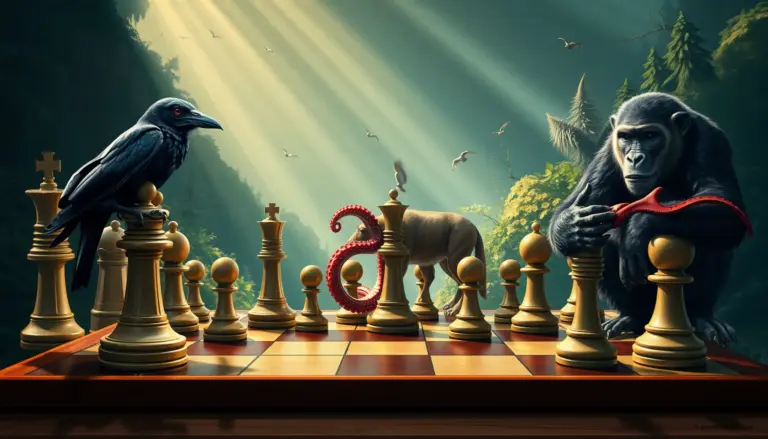
Deep in the jungles of Belize, where the green thickness is intertwined with ancient history, a practice emerges that defies time: he ajedrez maya moderno. This discipline, more than just a game, represents a unique fusion between ancestral traditions and contemporary strategies, a bridge between the past and the present that attracts both locals and travelers in search of authentic experiences. Belice, known for its archaeological ruins and biodiversity, thus becomes the perfect setting to explore how chess, adapted to the Mayan worldview, reinvents itself without losing its essence. How does this practice keep cultural heritage alive while integrating it into modern life?? What secrets do their movements and symbolisms keep?? Join us on this journey to discover how Mayan chess stands as a symbol of resistance, creativity and connection with nature.
The origins of Mayan chess: a legacy carved in stone and tradition
Mayan chess is not a recent invention, but a reinterpretation of board games that the ancient Mayans played more than a thousand years ago. Among the most notable is the Patolli, a game of betting and strategy that symbolized the cycle of life, death and rebirth, central concepts in the Mayan worldview. Unlike western chess, where the pieces represent a military hierarchy, in it Patolli and other similar games, movements were linked to deities, natural elements and astronomical events. For example, the board 52 Casillas reflected the sacred Mayan calendar, he Tzolk’in, while the tokens represented gods like K'inich Ahau (the sun) o Ixchel (the moon).
With the arrival of the Spanish, These games were banned because they were considered “pagans”, but its essence survived in the collective memory. Hoy, artisans and scholars in Belize have recovered these designs, adapting them to modern chess boards. The pieces, carved from mahogany or cedar wood, They are no longer simple abstract figures, but representations of sacred animals such as the jaguar, the quetzal or the feathered serpent, each with a spiritual meaning. This fusion not only preserves the Mayan aesthetic, but also enriches the gaming experience, where each movement becomes an act of connection with the divine.
Modern Mayan chess: innovation without losing the essence
The adaptation of Mayan chess to the 21st century is not limited to an aesthetic change, but rather it implies a restructuring of the rules to integrate elements of contemporary culture without betraying its original spirit.. One of the most interesting innovations is the incorporation of special moves inspired by Mayan myths. For example, he “jaguar jump” allows the king piece to advance two squares in any direction, evoking the agility of the sacred feline, symbol of power and protection. Another unique rule is the “eclipse”, where a player can sacrifice a minor piece to temporarily block the movement of a rival piece, representing the fight between light and darkness in Mayan mythology.
Besides, modern Mayan chess has found a space in the education and tourism. Schools in communities such as San Ignacio or Punta Gorda use it as a pedagogical tool to teach mathematics, history and cultural values. Students learn not only to calculate movements, but also to interpret the Mayan symbols and their relationship with nature. On the other hand, tourist workshops in places like Snail o Xunantunich They offer guided games, where visitors can play on giant outdoor boards, surrounded by ancient ruins. This immersive experience not only attracts chess lovers, but also to those interested in Mayan culture, generating a positive economic impact on local communities.
The symbolism behind the pieces: more than a game, a narrative
Each piece in modern Mayan chess is a story in itself, loaded with symbolism and teachings. Unlike traditional chess, where the pieces have fixed roles, In this version each one embodies an aspect of the Mayan worldview, and its strategic value is linked to its cultural significance. Next, We explore some of the most representative pieces:
- The King (I'm Kin): Represents the Mayan ruler, but also in the sun. Your movement is limited, but your presence is vital, since its capture symbolizes the end of a cycle. In some variants, the king can “be reborn” if you manage to reach a specific square on the board, reflecting the Mayan belief in reincarnation.
- The Queen (Ixchel): moon goddess, fertility and medicine, its role is more dynamic than in Western chess. Can move diagonally like a bishop, but also move in a straight line like a tower, symbolizing its ability to influence multiple aspects of life.
- The Jaguar (Baby): Horse equivalent, but with a unique movement: can jump in the shape of “L” or advance one square in any direction, imitating the agility of the feline. In Mayan mythology, the jaguar was a guardian of the underworld, so its capture can be interpreted as a victory over the dark forces.
- The Quetzal (Peeping): This piece, absent in traditional chess, represents the feathered serpent god. Moves like a bishop, but with the ability to “volar” about other pieces, symbolizing the connection between heaven and earth. Its capture is a key strategic event, as its loss weakens the player's spiritual connection.
These pieces not only add complexity to the game, They also invite players to reflect on the interconnection between human beings., nature and the divine. In communities like Toledo, where the Q'eqchi' and Mopán Mayan culture is still alive, Chess becomes a means of transmitting ancestral knowledge to new generations, ensuring his legacy is not lost.
Mayan chess as a tool for cultural preservation and community development
In a world where indigenous traditions face the risk of disappearing, modern Mayan chess emerges as a cultural resistance mechanism. Projects like “Game and Culture”, promoted by non-governmental organizations in Belize, have shown that this practice can be a bridge between generations. Mayan elders, that still remember traditional games, They collaborate with young people to design boards and pieces, fusing ancient carving techniques with modern tools. This exchange not only preserves artisanal skills, but also strengthens identity pride in communities that have been marginalized for centuries.
The economic impact is also notable. In towns like Saint Anthony, in the district of Toledo, Entire families are dedicated to the production of Mayan chess boards and pieces, selling them to tourists and collectors. These products, which can cost between 50 y 200 dollars depending on complexity, They represent a sustainable source of income for communities that have historically depended on agriculture. Besides, festivals like Mayan Culture Festival in Punta Gorda include Mayan chess tournaments, attracting international visitors and positioning Belize as a unique destination for cultural tourism.
However, The greatest achievement of modern Mayan chess is its ability to redefine the narrative about indigenous cultures. Instead of being seen as relics of the past, These traditions are presented as alive, dynamic and relevant to today's world. When playing a game, the participants not only compete, but they also learn about astronomy, Mayan mythology and values, such as respect for nature and the importance of community. In this sense, Mayan chess transcends entertainment to become an act of cultural vindication.
Conclusions: a game that transcends the board
Modern Mayan chess in Belize is much more than an adaptation of an ancient game: It is a testament to resilience., creativity and connection with the earth. Through its carved pieces, its innovative rules and its deep symbolism, This practice achieves what few traditions can.: keeping the essence of an ancient culture alive while integrating it into contemporary life. It's not just a hobby, but an educational tool, an economic engine and, above all, a bridge between generations.
In a globalized world, where cultural identities are often diluted, Mayan chess shows that it is possible to innovate without losing the roots. Belice, with its jungles, ruins and indigenous communities, has become the perfect setting for this merger, attracting travelers looking for authentic experiences and locals who find in this game a way to reaffirm their heritage. In the end, Every game played on a Mayan board is a reminder that culture is not static, but a constant dialogue between the past and the present. and maybe, in that dialogue, let's find not only entertainment, but also valuable lessons on how to live in harmony with nature and with ourselves.