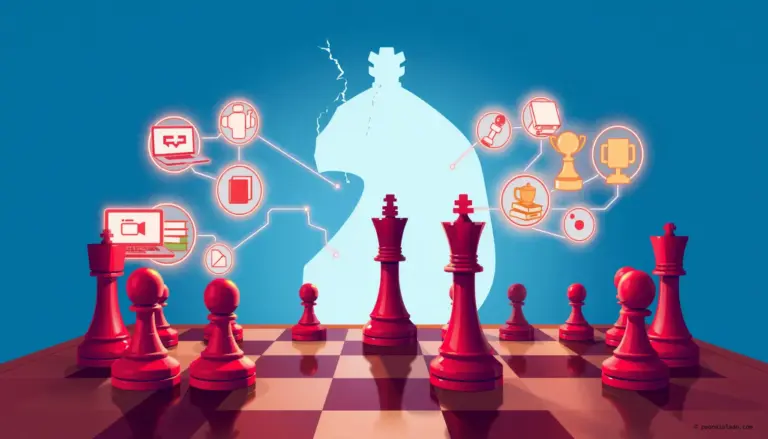
In recent years, Chess has experienced an unexpected resurgence on platforms like TikTok and Netflix, becoming a cultural phenomenon that transcends its status as an ancient game. What was once considered a niche hobby, reserved for enthusiasts and professional competitors, Today it attracts millions of people, especially young people, who discover a space for creativity on the board, strategy and even viral entertainment. But, What factors have driven this boom?? How did modern digital platforms manage to revitalize a game with more than 1500 years of history?
Chess has not only gained popularity for its intellectual essence, but also for its ability to adapt to the dynamics of social networks and the consumption of audiovisual content.. Series like Queen's Gambit and trends on TikTok have transformed the perception of the game, associating it with intense emotions, Captivating narratives and a growing global community. This article explores the reasons behind this phenomenon, analyzing how digital entertainment, accessibility and the reinvention of chess have converged to make it a massive success.
The power of narratives: as Queen's Gambit redefined chess
The launch of Queen's Gambit on Netflix in October 2020 marked a before and after in the public perception of chess. The miniseries, based on the novel of the same name by Walter Tevis, It was not only a critical and audience success., but achieved something deeper: humanize the game. Through the story of Beth Harmon, a chess prodigy with a life marked by addiction and improvement, the series presented the board as a drama stage, passion and genius.
What made unique Queen's Gambit was his ability to combine the strategic rigor of chess with an emotional narrative. The games were not simple technical movements, but moments of tension that reflected the internal conflicts of the characters. This attracted spectators who, in many cases, They had never shown interest in the game. According to Netflix data, The series generated an increase in 180% in searches for “how to play chess” on Google in the weeks after its release. Besides, platforms such as Chess.com reported an increase in 230% in new users, many of them inspired by the protagonist.
But the impact of the series was not limited to the quantitative. It also changed the cultural perception of chess, associating it with attributes such as intelligence, resilience and even style. Beth Harmon became a fashion icon, with her retro wardrobe and defiant attitude, while the game itself came to be seen as an activity “cool”. This change of image was key for chess to stop being perceived as a boring or elitist pastime., attracting a more diverse and younger audience.
TikTok and the democratization of chess: from great teachers to content creators
And Queen's Gambit was the trigger, TikTok became the amplifier that brought chess to the masses. The platform, known for its short and viral video format, found fertile ground for creativity in chess. Unlike other social networks, where chess content used to be technical or educational, TikTok allowed the game to adapt to trends such as humor, challenges and meme culture.
One of the most notable phenomena was the rise of creators such as GothamChess (Levy Rozman) y Hikaru (Hikaru Nakamura), who combined their chess expertise with an accessible and entertaining style. Rozman, For example, popularized formats such as “Chess for beginners” o “Epic games analyzed in 60 seconds”, that attracted millions of followers. Your didactic approach, but at the same time casual, broke the barrier to entry for those who considered chess too complex.
Besides, TikTok made it easy to create communities around the game. Hashtags como #ChessTok o #AjedrezViral accumulate billions of views, with videos ranging from quick games with witty commentary to absurd challenges, how to play chess while juggling. This mix of serious and playful content allowed chess to transcend its traditional image., attracting an audience that sought both to learn and to be entertained.
Another key factor was the interaction between professional players and content creators.. Figures like Magnus Carlsen, the world champion, They began participating in online games and collaborating with streamers, bringing elite chess closer to the general audience. This synergy between the professional and the amateur was essential to maintain interest in the game, proving that chess could be both a mental sport and an internet phenomenon.
Technological accessibility: How apps and online chess changed the rules of the game
The rise of chess on digital platforms would not have been possible without technological advances that made it more accessible than ever.. Before, learning chess required books, physical boards and, in many cases, a mentor. Hoy, applications like Chess.com, Lichess y Chess24 allow anyone to play, learn and compete from your phone or computer, eliminating geographical and economic barriers.
These platforms not only offer online games, but also adaptive learning tools. For example, Chess.com uses algorithms to analyze users' games and suggest improvements, while Lichess offers free interactive lessons. This has allowed beginners to advance quickly, reducing the initial frustration many felt when facing more experienced players. Besides, The possibility of playing against artificial intelligence at different levels of difficulty has made learning more dynamic and personalized.
Another revolutionary aspect was the integration of chess with streaming. Platforms like Twitch and YouTube allowed professional players and creators to broadcast their games live, commenting on their strategies and answering questions from the public. This not only generated a new form of entertainment, but also created a global community where viewers could interact in real time. Events like the Chess.com Speed Chess Championship or the Tata Steel Chess Tournament They became massive spectacles, with millions of spectators following the games as if they were football matches.
The COVID-19 pandemic also played a crucial role in this process. With the confinement, many people looked for activities to occupy their time, and online chess was presented as an ideal option: accessible, challenging and social. According to data from Chess.com, The number of games played on the platform tripled during 2020, passing from 10 million daily to more than 30 million. This exponential growth proved that chess was not just a niche game., but an activity with the potential to connect people from all over the world.
Chess as a cultural phenomenon: beyond the board
The success of chess on TikTok and Netflix is not limited to its role as a game or mental sport; It has also transcended into popular culture, becoming a symbol of intelligence, strategy and even rebellion. This change in perception has been driven by a combination of factors, from fashion to music, that have integrated chess into the collective imagination in a way never seen before.
One of the clearest examples is the influence of chess on fashion.. Brands like Gucci and Louis Vuitton have launched collections inspired by the game, while celebrities such as Pharrell Williams and A$AP Rocky have been photographed with chess boards as style accessories. Even in the world of hip-hop, chess has become a recurring metaphor. Artists like Jay-Z, Kendrick Lamar and Megan Thee Stallion have mentioned the game in their lyrics, associating it with cunning, patience and power. This connection between chess and urban culture has helped break stereotypes, presenting it as something modern and relevant.
Besides, chess has found a place in mainstream entertainment. movies like The game of fear (2021) and series like The Queen’s Gambit have used the game as a central element of their plots, exploring themes such as genius, competition and human psychology. Even in the world of video games, titles like Chess Ultra y Chess.com have gained popularity, attracting players looking for a more immersive experience.
But perhaps the most interesting aspect of this cultural phenomenon is how chess has served as a bridge between generations and communities.. In an increasingly polarized world, the game has proven to be a universal language, able to unite people of different ages, cultures and backgrounds. Events like the Chess in the Park, where players gather in public spaces to compete, o initiatives such as Chess for All, that promote inclusion, show that chess can be a tool for social connection.
This cultural change has also had an impact on education. Schools around the world have incorporated chess into their programs, recognizing its benefits for cognitive development, concentration and critical thinking. Programs like Chess in Schools in the United States or Chess at School in Spain have shown that the game can be a powerful pedagogical tool, especially in communities with fewer resources.
Conclusions: chess as a mirror of a digital age
The resurgence of chess on platforms like TikTok and Netflix is not an isolated phenomenon, but the result of a unique convergence between technology, culture and entertainment. What began as an ancient game has managed to adapt to the dynamics of the 21st century, demonstrating that its strategic and emotional essence can transcend times and formats. Queen's Gambit not only did he humanize chess, but turned it into a symbol of improvement and style, while TikTok transformed it into a viral phenomenon, accessible and full of creativity.
Technological accessibility has been another fundamental pillar. Apps like Chess.com and Lichess have democratized learning, allowing anyone, regardless of your level, You can improve your skills and connect with a global community. Chess online, driven by the pandemic, showed that gaming could be both a solitary pastime and a social experience, capable of bringing together millions of people around games, streams and challenges.
But perhaps the most lasting legacy of this phenomenon is its cultural impact. Chess is no longer seen as an elite or boring game, but as a dynamic activity, inclusive and even rebellious. Its integration into fashion, music and entertainment has broken barriers, attracting a diverse audience that finds the board a space for personal expression and human connection. Besides, Its educational and social potential positions it as a valuable tool for the future, capable of fostering skills such as critical thinking and resilience.
Ultimately, chess has reinvented itself without losing its essence. Its success in the digital age is a reminder that the most powerful cultural phenomena are those that manage to balance tradition and innovation.. As long as the platforms continue to evolve and new generations discover the game, Chess will continue to be a reflection of our ability to adapt, learn and connect, no matter what board we play on.