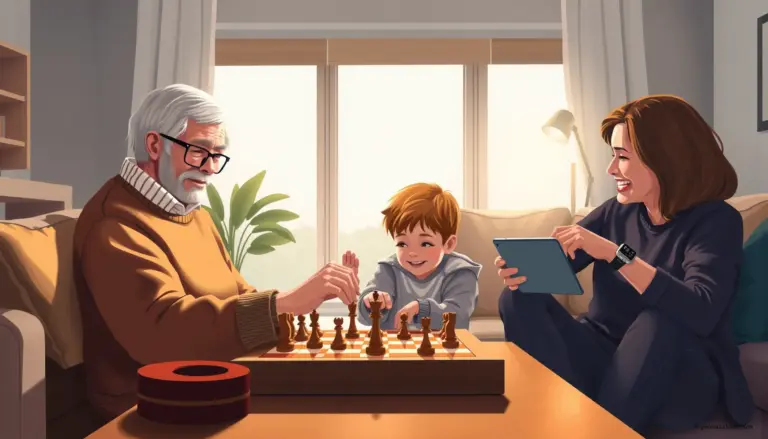
Imagine a classroom where silence is not imposed by fear, but for the concentration. Where a student who minutes before was shouting in the hallway now moves a pawn with the precision of someone who knows that every decision counts. This is not a pedagogical utopia, but the reality that schools in cities like Barcelona have adopted, Medellín or New York, where the therapeutic chess has replaced traditional punishments with games that teach patience, strategy and, above all, responsibility. How an ancient game can transform school discipline? The answer is not in the rules of the board, but in what happens in the minds of those who play it.
Chess is not just a mental sport; it's a mirror of life, as defined by the great teacher Savielly Tartakower. In it, each movement requires evaluating consequences, anticipate reactions and assume mistakes without excuses. These are precisely the skills that educational systems seek to instill, but that they rarely manage to transmit with punitive methods. When a school in Medellín replaced detentions with chess sessions, The results were revealing.: conflicts decreased 40% in one year, and students began to see the rules not as impositions, but as rules of a game that, after all, everyone wants to win.
Chess as a tool for emotional reeducation
The psychology behind this change is as fascinating as the game itself. Studies such as those by neuroscientist Robert Ferguson show that chess activates the prefrontal cortex, the region of the brain responsible for self-control and decision making. But there is something deeper: in a game, error is not failure, but a lesson. A child who loses by moving a horse without protection does not receive a scolding, but the opportunity to understand why that move was a mistake and how to avoid it in the future. This immediate and constructive feedback is what is missing in traditional punishments, where the message is usually “don't do it again”, without explaining the “because”.
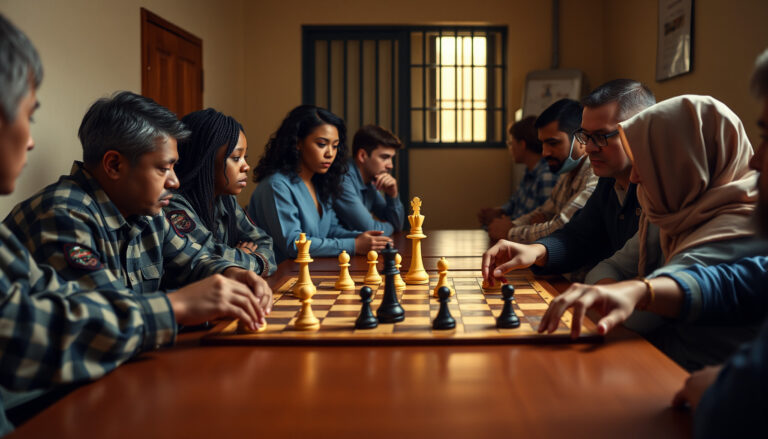
In schools of Barcelona, For example, a program called was implemented “Check Bullying”. Students involved in conflicts were invited to resolve their differences in front of a board.. It wasn't about them playing against each other., but rather that they collaborate to solve chess problems, like dunks in two or three moves. The dynamic not only reduced cases of harassment, but it fostered empathy: by working together, The students understood that, just like in chess, In real life the actions of one affect the other. This approach, based on the social chess, demonstrates that the game can be both a tool of competition and cooperation.
From sanction to reflection: the pedagogical turn
The paradigm shift is not easy. It requires teachers to stop seeing chess as a simple hobby and recognize it as a metaphor of life. In a New York school, A math teacher noticed that his most disruptive students were also the most strategic on the board. He then decided to integrate chess into his classes., using games to teach probability, geometry and even history. Academic results improved, but the most important thing was the change in the classroom climate: students began to see the teacher not as a distant authority figure, but as an ally in your learning.
This approach not only humanizes the discipline, but also democratizes access to the game. In vulnerable communities, where chess is often associated with intellectual elites, programs like those of Medellín have shown that the board can be a bridge to inclusion. Children who had never had contact with the game discover in it a universal language, where the origin, gender or social status does not matter. The only thing that counts is the ability to think, plan and adapt, skills that, ironically, are the same ones that traditional educational systems try to instill with punishments.
Chess as therapy: beyond the classroom
The effectiveness of chess as an alternative to punishments is not limited to the school environment. In rehabilitation centers for young people with behavioral problems, the game has become a therapeutic tool. In a center of Buenos Aires, adolescents with histories of violence participated in workshops where, instead of receiving sanctions for their actions, They had to analyze grandmaster games and explain the strategies used. The goal was not to make them experts, but to teach them to channel their frustration and aggression into something constructive. The results were surprising: many of them, who previously abandoned any activity at the first obstacle, began to persist until complex problems on the board were resolved.
This therapeutic approach has scientific roots. El psicologe ruso Vladimir Rašković, pioneer in the use of chess in psychiatry, discovered that the game helps structure thinking in people with anxiety or depression disorders. In your sessions, the patients didn't just play, but they had to verbalize each movement, which allowed them to identify negative thinking patterns and replace them with more rational strategies. Rašković showed that chess is not just a game, but a mirror of the mind, capable of revealing and correcting cognitive distortions.
The challenge of scaling the model: Is it possible in all schools?
Although the results are promising, the massive implementation of this model faces obstacles. The first is cultural resistance: many teachers and parents associate chess with exceptional intelligence, believing that only “geniuses” can benefit from it. However, as the Spanish pedagogue José Antonio Marina points out, chess is a mental gymnastics accessible to everyone, regardless of your IQ. The second challenge is training: not all teachers know how to play chess, and even fewer are trained to use it as a pedagogical tool.
Nevertheless, there are inspiring examples. In Armenia, Chess is a mandatory subject since 2011, and scores on standardized math and reading tests have improved significantly. The Armenian model shows that, with political will and resources, Chess can be integrated into the curriculum without needing to be an expert. It is enough to understand that the game is not an end in itself, but a means to teach transversal skills such as patience, resilience and critical thinking.
The third obstacle is infrastructure. Not all schools have boards, pieces or spaces suitable for playing. But even this has a solution: in rural India, boards drawn on the ground with chalk have been used, and the pieces are made with recycled materials. chess, after all, It is a game that requires nothing more than two minds willing to think.
Conclusion: checkmate to traditional punishments
Chess is not a panacea, but it is a powerful tool to transform school discipline. Its greatest virtue is that it turns conflict into learning, the sanction in reflection and the frustration in resilience. In a world where traditional punishments have proven to be ineffective—and even counterproductive—, the board offers an alternative that not only corrects, but it educates. As world champion Emanuel Lasker said, “in chess, like in life, the most dangerous opponent is oneself”. Schools that have adopted this model are not only teaching their students to play, but to know each other, to control yourself and, above all, to think before acting.
The challenge now is to scale this silent revolution. It is not about eliminating the rules, but to change the way they are taught. Chess does not punish; challenges. And in that challenge, students discover something more valuable than any medal: the ability to decide intelligently, both on and off the board.