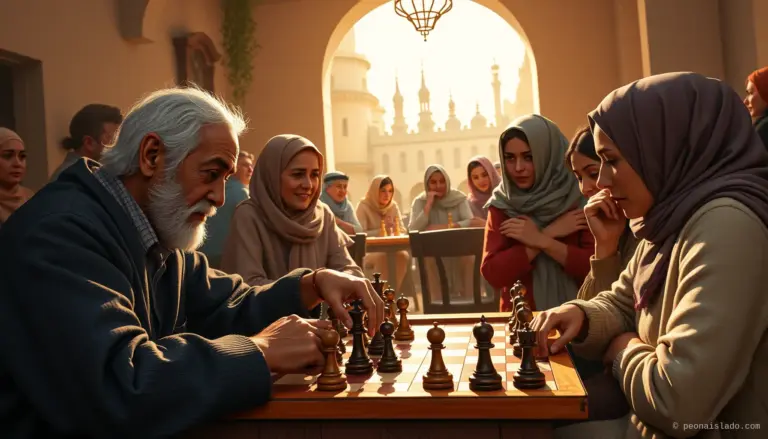
chess, that ancient game that has transcended borders and eras, finds in Asia a fascinating scenario where its evolution not only reflects strategic changes, but also cultural transformations, political and technological. From its roots in Chaturanga Indian to the contemporary dominance of China and India on the global chessboard, Asian chess has redefined what it means to be an elite player. How did he achieve a continent, historically associated with variants such as xiangqi or the shogi, become a Western chess powerhouse? The answer lies in a combination of pedagogical innovation, state investment and an obsession with excellence that challenges traditional paradigms. This article explores the keys to this metamorphosis, from the first movements on the Silk Road to the era of artificial intelligence engines, where Asia not only plays, but leads.
Chess in Asia: between the myth of origin and modern reinvention
The most widespread narrative places the birth of chess in 6th century India., with the Chaturanga, a war game that simulated battles between infantry, chivalry, elephants and cars. However, This story simplifies a more complex reality. Asian chess was not a mere precursor of the European game, but a diverse ecosystem where variants such as shatranj Persian o him xiangqi Chinese coexisted—and competed—for centuries. While Europe adopted chess as a symbol of chivalry and feudal power, In Asia the game was adapted to local philosophies: he xiangqi, For example, reflects Chinese military strategy with its “río” central that divides the board, while the shogi Japanese allows reuse of captured parts, a concept that evokes reincarnation.
The arrival of Western chess in Asia was a slow process, driven by colonialism and trade. In the 19th century, The British introduced the game to India, where he found fertile ground among the elites educated in colonial schools. But it was in the 20th century when chess began to separate itself from its image. “foreigner”. The independence of countries like India (1947) and the Chinese Revolution (1949) marked a turning point: chess became a symbol of modernity and cultural resistance. in China, Mao Zedong promoted it as a tool for “strengthen the minds of the people”, although its initial approach was more propagandistic than competitive. In India, Figures such as Manuel Aaron—the country's first International Master—laid the foundations for a generation that, decades later, would produce Viswanathan Anand, the first Asian world chess champion.
the chinese school: when the state plays chess
If there is a model that defines the evolution of chess in Asia, is the chinese. Unlike Europe, where the game developed organically through clubs and cafes, In China, chess was adopted as a state project. In 1956, the government included it in the educational system, but it was not until the years 90 when a systematic plan was implemented to turn the country into a power. The strategy combined three pillars: massive investment in infrastructure, coach training y early talent detection. Hoy, China has more than 30 millions of federated players and a pool of young prodigies that dominate the youth rankings.
Chinese success is explained by its approach “scientific”. The coaches, many of them former players, apply data-driven methodologies, with exhaustive game analysis and psychological preparation. A paradigmatic example is Ding Liren, current world champion, whose preparation includes sessions of up to 10 daily hours and the use of artificial intelligence engines such as Stockfish to refine openings. But the Chinese model goes beyond the technical: Chess is integrated into a system of values where discipline and individual sacrifice are at the service of the collective. As the article on the chinese school of chess, This approach has allowed China to surpass Russia in the Olympic medal table, an achievement unthinkable two decades ago.
However, The model is not without criticism. Some analysts, like the great Indian master Pentala Harikrishna, They argue that the pressure for results can generate stress in young players, limiting your creativity. Besides, The Chinese system prioritizes chess over other traditional variants, like him xiangqi, which has generated tensions between purists and modernizers.
India: individual talent in the era of digital democratization
While China opted for a centralized model, India has followed a different path, based on individual talent and the democratization of the game through technology. The country, cradle of Chaturanga, was slow to adopt western chess, but when he did, he did it big. The turning point was Viswanathan Anand's victory in the World Championships. 2007, a milestone that inspired a generation of young Indians to see chess as a viable career. Hoy, India is the second country with the most great teachers in the world (after Russia), with figures like Rameshbabu Praggnanandhaa, of alone 18 years, challenging the best on the planet.
Indian success is based on three key factors. First, the private training culture: unlike China, where players are trained in state academies, In India many young people receive private classes from independent trainers, like the legendary R.B.. Ramesh, who has molded several prodigies. Second, the technology: platforms like Chess.com y Lichess have allowed players in rural areas to access resources previously reserved for urban elites. And third, the family passion: in India, chess is often a family project, where parents and siblings sacrifice resources to support promising talent.
This model, however, has its limitations. Lack of state support means many players must finance their own preparation, which creates inequalities. Besides, The obsession with results has led to cases of burnout in young people, as happened with the prodigy Nihal Sarin, who to the 14 years I already felt the pressure of being the “next Anand”. Despite this, India has shown that chess can flourish without a rigid system, as long as there is a combination of talent, technology and determination. As analyzed in the indian school of chess, This approach has turned the country into an innovation laboratory, where traditional and digital merge.
Asia in the age of AI: ally or rival?
Asian chess has not only adopted technology; in many cases, has led it. China and India are today epicenters of the artificial intelligence revolution applied to gaming. In 2017, the team of AlphaZero —the AI engine developed by DeepMind—trained for just four hours before defeating Stockfish, the best engine in the world. What was surprising was not the result, but the style of play AlphaZero: bold sacrifices and an almost “human” that perplexed the great masters. This milestone had a profound impact in Asia, where AI has been integrated into player preparation like never before.
in China, The government has invested millions in developing its own chess engines, as Leela Chess Zero, an open source version inspired by AlphaZero. These engines are not only used to analyze games, but also to train young players in innovative tactics. In India, companies like ChessBase India have created accessible AI tools for players of all levels, democratizing access to technology that was previously reserved for the elites.
But the relationship between Asian chess and AI is not free of dilemmas. On the one hand, technology has accelerated learning, allowing players like China's Wei Yi to reach grandmaster level within 13 years. On the other, there are fears that reliance on AI will stifle creativity. As the article warns about chess and AI, Some Asian coaches already notice that their pupils imitate the movements of the motors without understanding the logic behind them.. Besides, AI has intensified competition, making the path to the elite more demanding than ever.
A paradigmatic case is that of the Indian Vaishali Rameshbabu, younger sister of Praggnanandhaa, who has stated that AI has helped him improve his positional game, but it has also generated anxiety due to the pressure of keeping up with the latest theoretical developments.. This balance between innovation and tradition will be key for the future of chess in Asia.
Chess as a geopolitical tool: the board of nations
Beyond sports, Chess in Asia has acquired a geopolitical dimension. China, in particular, has used the game as a tool of soft power, organizing high-level tournaments such as Grand Chess Tour in Shenzhen or the China Chess King Match, where he invites the best players in the world. These events not only promote chess, but they also project an image of modernity and openness, in contrast to the stereotype of a closed and authoritarian country.
India, for his part, has found in chess a symbol of its rise as a global power. Anand's victory in 2007 was celebrated as a national achievement, and today the country sees in players like Praggnanandhaa or Gukesh D an extension of its cultural influence. In 2023, India organized the Chess Olympiad en Chennai, an event that brought together more than 1,700 players of 180 countries and that was seen as a declaration of intent: India not only wants to be a relevant player in chess, but also a leader in your organization.
But chess has also been a battlefield in geopolitical conflicts.. During the Cold War, the USSR and the USA. They used the game as a propaganda weapon, and today that dynamic is repeated in Asia. In 2022, the International Chess Federation (FIDE) banned Russian and Belarusian players from competing under their flags due to the war in Ukraine, a measure that affected figures such as the Russian Ian Nepomniachtchi. China, Russia's ally, responded by organizing alternative tournaments, like him China-Russia Chess Summit, where players from both countries competed together. This episode shows how chess continues to be a reflection of global tensions, even on a continent that aspires to lead the game.
The future: towards an asian chess?
Asian dominance in chess is now a reality. In 2024, four of the ten best players in the world are Asian: Ding Liren (China), Fabiano Caruana (EU, but of Indian descent), Alireza Firouzja (Iran, but resident in France) y Praggnanandhaa (India). Besides, countries like Vietnam, Uzbekistan and the Philippines are producing talents that challenge traditional powers. But beyond the rankings, What defines Asian chess is its ability to reinvent itself. As Europe debates whether classical chess is in decline, in Asia the game adapts to the new generations: online tournaments, transmissions in Twitch and even chess games in virtual reality are commonplace.
However, The biggest challenge for Asia will be to balance tradition and modernity. in China, The government continues to control chess as part of its sports development strategy, but in India the game grows organically, driven by private initiative. Which of these models will prevail? The answer could define not only the future of chess, but also that of a continent that has found in this ancient game a metaphor for its own evolution: from the roots of Chaturanga to the era of artificial intelligence, passing through the board of global geopolitics.
Chess in Asia is not just a sport; It is a mirror of its history, its contradictions and its aspirations. and in that mirror, the whole world can see the future of the game.
In a continent where chess has gone from being a game of colonial elites to a tool of mass empowerment, the question is no longer and Asia will dominate the board, sino as will do it. The answer, like in a well-played game, It's in the strategy, adaptability and, above all, in the ability to see beyond the 64 casillas. because in the end, chess is not just a game: It is a universal language that Asia has learned to speak with its own accent.