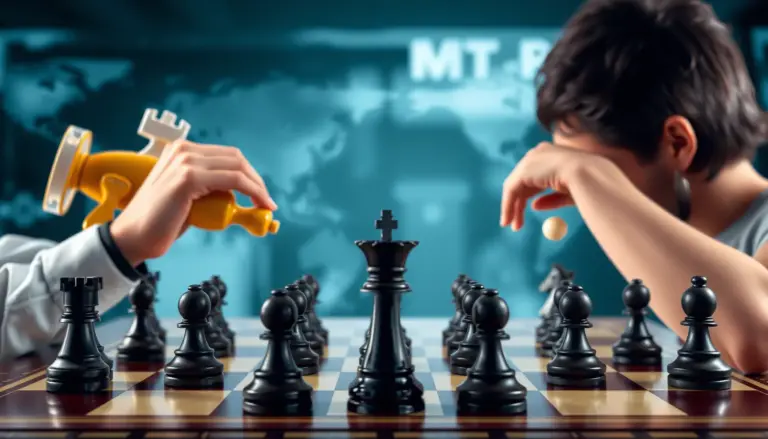
Chess has been a reflection of the human mind for centuries.: strategy, Patience and resilience are intertwined in every movement. But what happens when this ancient game becomes a refuge for those who have experienced the deepest trauma?? Chess clubs for veterans with Post-Traumatic Stress Disorder (PTSD) They not only offer a healing space, but they redefine the board as a battlefield where victory is not measured in checkmate, but in the reconquest of inner calm. This article explores how chess, beyond its competitive aspect, It becomes a therapeutic tool capable of reconstructing minds fractured by war., violence or pain.
Chess as a mirror of trauma: when the pieces reflect invisible wounds
PTSD Is Not a Battle You Fight Alone. Its symptoms—hypervigilance, flashbacks, anxiety—are like disordered pieces on a board that the veteran tries to rearrange without success. Here, chess acts as a structured metaphor: every movement requires concentration, but it also allows us to externalize internal chaos. Studies such as those cited in Therapeutic chess: how gaming relieves anxiety show that regular practice reduces cortisol levels, the stress hormone, by fostering a state of flow similar to meditation. For a veteran, this approach is not abstract: It's the difference between reliving a fight or learning to control it.
The key lies in the predictability of the game. In a world where PTSD turns everyday life into a threat, chess offers clear rules and logical consequences. A pawn advances, a bishop cuts diagonals, and every decision has tangible weight. This structure contrasts with the unpredictability of trauma, providing a cognitive anchor. As psychiatrist Vladimir Rašković—a pioneer in the use of chess in psychiatric therapies—points out,, “The board is a safe space where the veteran can practice control without risk”. Your work, documented in Vladimir Raskovic: therapeutic chess and mental health, reveals how patients with severe PTSD manage to reduce their crises by associating the game with a ritual of order.
From the trench to the board: how chess rebuilds trust
The transition from military to civilian life is a minefield of challenges. Many veterans describe the feeling of “be in combat mode” even years after his service, unable to turn off the constant alert. Here, chess acts as a symbolic bridge: instead of enemies, there are rivals; instead of bullets, there are calculated movements. Programs like the Chess for Veterans in the United States have shown that, after six months of practice, participants improve their ability to manage frustration and make decisions with greater clarity, essential skills to reintegrate into everyday life.
But the true power of chess in these contexts goes beyond the individual.. Clubs for veterans with PTSD often serve as peer communities, where the silence between games is not uncomfortable, but therapeutic. As the article explains Chess without words: inclusion and strategy in silence, the game allows for a non-verbal connection that many veterans find liberating. In a world where words often fail to describe the horror, the board becomes a universal language.
The checkmate to isolation: when chess breaks social barriers
PTSD not only isolates the sufferer, but also stigmatizes. Many veterans avoid seeking help for fear of being labeled as “weak” o “unstable”. chess clubs, however, offer a different approach: here, trauma is not a stigma, but a common starting point. In cities like Medellín, where initiatives like Chess clubs in Medellín: strategy, community and opportunities have integrated veterans into social programs, the game has become a reintegration tool. The logic is simple: Whether chess can unite political rivals on a board—as happened during the Cold War—, Why couldn't you do the same with those who share a conflicted past??
An emblematic case is that of the veterans of the Afghanistan war in the United Kingdom, where the program Chess in Recovery has managed to reduce suicide rates by 30% among its participants. The methodology is clear: it's not about “heal” el PTSD, but of reframe it. Chess teaches that, even in defeat, there are lessons. And for someone who has lost bigger battles, that perspective can be revolutionary.
Chess as mental training: neuroscience behind healing
Science Backs What Veterans Experience on the Dash. Research in neuroplasticity, like those mentioned in How chess transforms your brain, show that the game stimulates the prefrontal cortex - the area responsible for decision-making and emotional control - and strengthens working memory. For someone with PTSD, whose neural circuits are usually “hyperconnected” in areas such as the amygdala (responsible for fear), chess acts as a rebalance training.
A study from the University of California revealed that, after 12 weeks of intensive practice, veterans with PTSD showed a significant reduction in amygdala activation during stressful situations. In practical terms, This means that chess not only helps them think more clearly, but to to feel with less intensity the weight of the trauma. The board thus becomes a mental gym where, movement by movement, the ability to respond—and not just react—to adversity is rebuilt.
The future of therapeutic chess: beyond traditional clubs
While physical clubs remain at the heart of this initiative, technology is opening new frontiers. Platforms like Lichess have launched specific programs for veterans, where they can play online with others affected by PTSD, breaking geographical barriers. However, the challenge remains accessibility. As pointed out Accessible chess: innovation and resilience in 64 casillas, Designing adaptive dashboards—with touch pieces or voice interfaces—could be key to including veterans with physical or visual disabilities.
Another promising innovation is the integration of chess with virtual reality therapies. And Israel, A pilot project uses immersive environments where veterans can “play” in scenarios that simulate controlled stress situations, such as crowds or closed spaces. The idea is not to expose them to trauma, sino reentrenar your emotional response in a safe context. Preliminary results are encouraging: he 80% of participants reported a reduction in their anxiety symptoms after just eight sessions.
Chess for veterans with PTSD is not just a game. It is an act of resistance, a statement that even the most fractured minds can find order in chaos. In each game, there is more than strategy: there is hope. And in every checkmate, a small victory over the past. As Grandmaster Garry Kasparov said, “chess is life in miniature”. For those who have lived through war, It could also be the way back home..
In a world where trauma is often treated with pills or traditional therapy, chess offers something different: a tool that not only relieves, but empowers. It's not about forgetting what you've experienced, but to learn to live with it. and maybe, in that process, discover that the pieces of the board—like those in life—can be rearranged in infinite ways, as long as you have the patience to move them one by one.