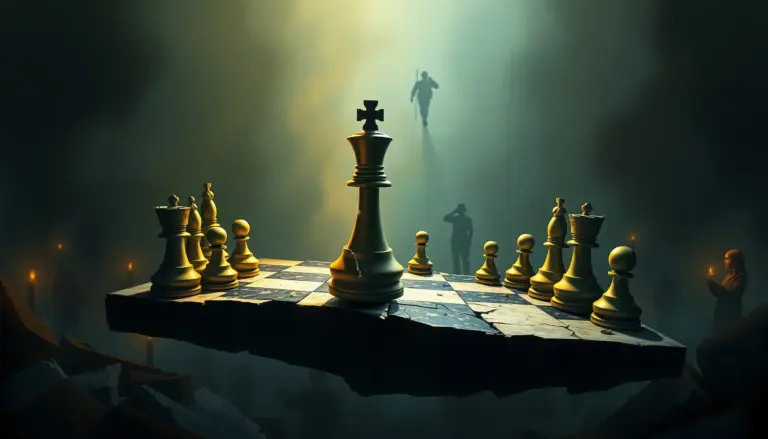
chess, that ancient game of strategy and elegance, It has been a symbol of intelligence for centuries, patience and fair play. However, behind its facade of nobility and sportsmanship, dark stories are hidden that have shaken the foundations of the board. From corruption schemes to doping scandals, going through accusations of fraud and ethical conflicts, The world of chess has not been without controversy.. These episodes have not only tarnished the reputation of players and organizations, but they have also called into question the integrity of a sport that is presumed pure. In this article, We will explore some of the most notorious scandals that have exposed the less glamorous side of chess, revealing how ambition, Money and power can corrupt even the most intellectual games.
The scandal of fixed games: when money speaks louder than honor
One of the darkest chapters in the history of modern chess is that of fixed games, a phenomenon that has affected elite players and prestigious tournaments. The most emblematic case is that of the Grand Master Boris Gelfand, who in 2012 was accused of offering bribes to his rivals to ensure his qualification in the Candidates Tournament. Although the tests were inconclusive, The scandal exposed a network of illegal betting and under-the-table deals involving gamblers, organizers and even referees.
But the problem is not limited to isolated cases.. In 2019, the International Chess Federation (FIDE) investigated a series of suspicious games in minor tournaments, where movement patterns identical to those of chess engines such as Stockfish were detected. This led to the suspension of several players., including some master level. The most worrying thing is that these frauds not only affect the credibility of the sport, but they also distort the classification system, harming honest players who depend on their performance to access sponsorships and opportunities.
The rise of online chess platforms has exacerbated the problem. Sites like Chess.com and Lichess have implemented AI-based cheat detection systems, but scammers always find new ways to outwit them. In 2020, An elite player was banned from an online tournament after being caught using a second device to consult a chess engine during the game.. These cases show that, in the digital age, Chess fraud has become more sophisticated and difficult to eradicate.
Doping in chess: a real problem or an exaggeration?
When talking about doping, The first thing that comes to mind is physical sports such as cycling or athletics. However, Chess has also had its scandals in this area, although with very different nuances. The key question is: Can a substance improve intellectual performance in a game that depends exclusively on the mind?
The answer is more complex than it seems. In 2008, the great teacher Vassily Ivanchuk was subjected to an anti-doping test during the Chess Olympics in Dresden. Although it did not test positive, The fact that tests were carried out in a mental sport generated an intense debate. The World Anti-Doping Agency (OR) includes substances such as modafinil, a drug used to treat narcolepsy, on its list of prohibited substances. This medicine, Known to improve concentration and reduce fatigue, It has been used by some players to stay alert during marathon games that can last more than six hours..
The most famous case was that of the Grand Master Igor Rausis, who in 2019 He was caught using an unspecified substance during a tournament in France. Rose, of 58 years, admitted to having resorted to doping to compensate for his physical and mental decline, a confession that shocked the chess world. Although doping in chess is not as common as in other sports, Its existence raises ethical questions: To what extent is it fair for a player to resort to substances to improve his performance?? Should chess be considered a sport and, therefore, be subject to the same anti-doping rules as football or tennis?
FIDE has adopted an ambiguous position on the matter. Although it carries out anti-doping controls in official competitions, does not apply them with the same rigor as in physical sports. This has led some critics to argue that chess is in a gray area., where intellectual doping is not prosecuted with the same seriousness as physical doping. Meanwhile, players like the former world champion Garry Kasparov have defended that chess is a mental sport and that, therefore, should be regulated differently. However, The line between ethical and unethical remains blurred..
Conflicts of interest and corruption in FIDE
The International Chess Federation (FIDE) has been the governing body of chess worldwide for decades, but its history is far from impeccable. From accusations of nepotism to corruption scandals, FIDE has been singled out on multiple occasions for its lack of transparency and questionable management. One of the most emblematic cases is that of Kirsan Ilyumzhinov, who presided over the organization since 1995 until 2018.
Ilyumzhinov, a Russian billionaire with political connections, He was repeatedly accused of using his position to benefit players and federations related to his interests.. In 2015, The United States Department of the Treasury included him on a list of those sanctioned for his alleged collaboration with the Syrian government., which generated an international scandal. Although Ilyumzhinov denied the accusations, his permanence in office became unsustainable, and in 2018 was replaced by Arkady Dvorkovich, a former Russian government official.
But FIDE's problems did not end with Ilyumzhinov's departure. In 2020, the organization was criticized for its handling of tournaments during the COVID-19 pandemic. While other sports suspended their competitions, FIDE continued organizing in-person events, which generated controversy for putting the health of the players at risk. Besides, irregularities were reported in the allocation of funds and in the transparency of the selection processes for important tournaments, like the world championship.
Another worrying aspect is the influence of governments and sponsors on FIDE decisions.. In 2022, the federation was accused of favoring Russian players in the context of the war in Ukraine, which led to the suspension of the Russian Federation from international competitions. However, some Russian players continued to participate under the FIDE flag, which led to accusations of double standards. These conflicts of interest have eroded trust in the organization, leading many to question whether FIDE truly acts for the benefit of chess or is more interested in maintaining its power and political alliances..
The dark side of rivalry: When competition becomes obsession
Chess is a game of rivalries, where fierce competition has led to some of the most memorable games in history. However, when ambition becomes obsession, the consequences can be devastating. One of the most extreme cases is that of Bobby Fischer, the American genius whose career was marked by his paranoia and erratic behavior.
Fischer, who became world champion in 1972 after defeating Boris Spassky in it “Match of the Century”, developed a deep distrust towards FIDE and its rivals. In 1975, He refused to defend his title against Anatoly Karpov due to disagreements with tournament conditions, which led FIDE to declare him champion by default. Fischer disappeared from competitive chess for almost two decades, until in 1992 agreed to play a revenge match against Spassky in Yugoslavia, violating sanctions imposed by the United States. This led to him being persecuted by the US authorities., and Fischer spent the rest of his life as a fugitive, dying in Iceland in 2008.
But Fischer is not the only case of a player whose obsession with chess led him to self-destruction.. Paul Morphy, considered one of the best players of the 19th century, he abandoned chess at 22 years after a series of humiliating defeats. Morphy developed a deep depression and spent the rest of his life in a state of mental deterioration., convinced that his rivals were after him. His story is a reminder that, in a game where the mind is the main tool, psychological balance is as important as technical skill.
In the modern era, the case of Magnus Carlsen and his renunciation of the world title in 2023 It has also generated debates about the limits of competition. Carlsen, who dominated chess for a decade, decided not to defend his title against Ding Liren, arguing that the format of the championship was not attractive to him. Although his decision was respected, Many saw it as a symptom of the extreme pressure that elite players face., where the obsession with staying on top can lead to mental and physical exhaustion.
Chess in the digital age: new challenges for an old sport
The arrival of the internet and online chess platforms has revolutionized the sport, democratizing access and attracting millions of new players. However, This transformation has also brought with it new challenges, from the rise of cheating to the commodification of the game. One of the most urgent problems is that of online chess addiction, a phenomenon that has affected players of all ages.
Platforms like Chess.com and Lichess have reported an increase in the number of users spending more than 10 hours a day playing quick games. Although chess is a game that stimulates the mind, excess can lead to mental health problems, like anxiety, insomnia and social isolation. In 2021, a study published in the journal Frontiers in Psychology found that players who spent more than 20 hours per week on online chess platforms had a higher risk of developing symptoms of depression and anxiety. This problem has worsened with the pandemic, when many players turned to online chess as a way to escape stress and boredom.
Another challenge is the commodification of chess. With the rise of streamers like Hikaru Nakamura y GothamChess, Chess has become a multi-million dollar business, where sponsorships and advertising revenue are as important as performance on the board. This has led some players to prioritize entertainment over competition., which has generated criticism from purists who argue that chess is losing its essence.
Finally, there is the problem of inequality in access to elite chess. Although the internet has allowed players from all over the world to compete on equal terms, The reality is that players from developed countries have significant advantages, as access to better coaches, technology and sponsorships. This has led to a concentration of talent in a handful of countries, while players from less privileged regions struggle to stand out. FIDE has attempted to address this problem with development programs, but the gap is still wide.
chess, like any other sport, is no stranger to scandals, controversies and ethical challenges. From match-fixing to doping, going through conflicts of interest and destructive obsessions, The dark side of the board has revealed the human weaknesses that are also hidden behind this ancient game. However, These scandals should not overshadow the beauty and depth of chess, but serve as a reminder that, even in the most intellectual games, integrity and ethics must prevail.
The digital age has brought with it new challenges, but also opportunities for chess to evolve and adapt to modern times. The key is to find a balance between tradition and innovation, between competition and entertainment, and between intellectual rigor and accessibility. If chess manages to overcome these obstacles, may continue to be a symbol of intelligence and strategy, but now with greater transparency and a more united community. In the end, The true value of chess does not lie in the scandals that have shaken it, but in its ability to inspire, challenge and connect people around the world, regardless of your background or skill level.