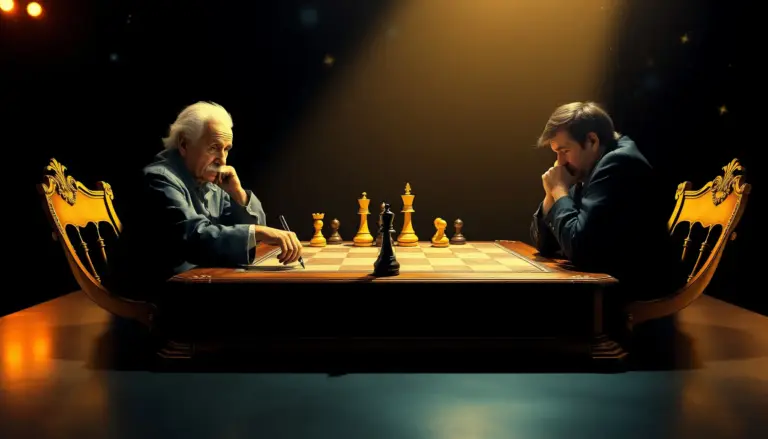
Imagine that you are about to lose a crucial game on a trading platform. chess online. The clock is ticking, your rival smiles behind the screen and, suddenly, a button flashes: “Takeback”. A lifeline or a trap? This function, present on platforms such as Chess.com or Lichess, allows you to undo movements as if time stopped. But its use divides the community: Is it a learning tool or a shortcut that weakens discipline?
He takeback It's not just a button; It is a mirror of our relationship with error. in chess, like in life, Every wrong move reveals an opportunity to understand patterns, fix bugs and, above all, learn without fear. However, Its misuse can turn the board into a simulacrum of reality, where pressure and responsibility are diluted. This article explores how to take advantage of this feature without falling into its traps., transforming it into an ally for your strategic growth.
Takeback as a laboratory for errors: beyond the “Ctrl+Z”
In classical chess, a mistake is irreversible. Every move leaves a mark on the board, and the only way to amend it is with a later superior move. But in the chess online, he takeback break this sacred rule. Is this an advantage or a disadvantage?
The answer depends on the approach. For beginner players, This function acts as a silent trainer. Imagine that, after a hasty movement, you discover that your tower is defenseless. When undoing the play, you can analyze the position calmly, identify the error and try alternatives. This process, repeated hundreds of times, strengthens the tactical vision and reduces the probability of making the same mistake in real games.
However, danger lurks when takeback becomes a psychological refuge. Instead of facing the consequences of a mistake, some players use it to avoid frustration, creating a false sense of invincibility. This habit, long term, weakens the mental resistance, essential in tournaments where every move counts. The key is to use it as an analysis tool, not as an escape.
From theory to practice: how to integrate takeback into your training
He takeback it is not a cheat code, but a scenario simulator. To make the most of it, you must follow a rigorous protocol. First, play the game as if it didn't exist: commit to every move, calculates variants and accepts errors as part of the process. Only after losing (or win), Activate the analysis mode and review each critical play with the takeback.
For example, Suppose you fall into a known opening trap. Instead of undoing the move immediately, Play the game until the end to understand the consequences. Then, go back and explore alternatives: What would happen if you developed the bishop instead of the knight?? How would that affect the control of the center? This exercise not only improves your understanding of openings, but also trains your ability to anticipate rival plans.
Another effective strategy is to combine the takeback with external analysis tools. Platforms like Lichess allow you to export games and review them with chess engines. If you use the takeback to correct a mistake, Compare your solution with the engine's suggestion. Do they match? But, dig deeper into why. This method accelerates learning by contrasting your intuition with the cold logic of artificial intelligence.
Takeback in rapid chess: Does it train or ruin your game?
He fast chess and the blitz They are modalities where time is another rival. Here, he takeback takes on a different dimension: Should it be used to correct errors under pressure or to simulate real conditions?
In it fast chess, he takeback can be a double edged sword. On the one hand, allows you to practice openings and tactics without the pressure of the clock, what is useful for memorizing patterns. On the other, eliminates the stress inherent to these modalities, a factor that defines great teachers. The solution is to dose its use: use it in training games, but avoid it in sessions where the objective is to improve your psychological resistance.
A revealing exercise is to play a game of blitz sin takeback, noting every mistake made by time or calculation. Then, repeat the same game with the function activated, but this time focusing on correcting only critical errors. This contrast will help you identify your weaknesses under pressure and work on them in a focused way..
Takeback and psychology: the art of learning without complacency
The greatest risk of takeback it's not technical, but psychological. in chess, as in any discipline, progress requires accept failure. Every lost game is a teacher; each error, a lesson. When you undo a movement, you are erasing that lesson. How to prevent this from becoming a harmful habit?
The answer is in the self-awareness. Before using the takeback, ask yourself: Am I avoiding a mistake for convenience or because I really want to understand it?? If it's the first, resist the temptation. If it is the second, use it as a microscope to examine the error. Besides, Keep track of bugs you fix frequently. If you always fall into the same trap, It is a sign that you need to study that topic in depth., not that you should continue using the takeback like crutches.
Another powerful technique is to combine the takeback with the chess meditation. After a game, take five minutes to reflect on your emotions. Were you frustrated by losing?? Did you feel relief undoing a mistake?? These questions will help you understand your relationship with failure and use the takeback more consciously.
Takeback in the age of AI: ally or unfair competition?
In a world where artificial intelligence dominates chess, he takeback raises an uncomfortable question: Are we using tools that make us stronger or that make us dependent?
Platforms like Chess.com already implement systems to detect excessive use of the takeback in ranked games, equating it to a form of trap. This reflects a growing tension: while some see it as a legitimate learning tool, others consider it a shortcut that distorts the system Elo. The solution is not to ban it, but use it ethically.
An innovative approach is to treat the takeback like a personal AI trainer. For example, after a game, use the takeback to explore variants that an engine like Stockfish would suggest. Then, Play those variants against the engine to see how they respond. This method allows you to learn from AI without depending on it, combining the best of both worlds.
Conclusion: takeback as a bridge to mastery
He takeback It's not a magic button, but a mirror that reflects your relationship with the error. Used with discipline, becomes a powerful tool to accelerate your learning, Delve into strategy and understand the nuances of chess. But if you fall into the temptation of using it as an escape, you will end up weakening the skills you need most: resilience, patience and the ability to think under pressure.
The next time you play an online game and see that flashing button, remember: every mistake is a seed of knowledge. Undo it only if you are willing to plant it, water it and watch a stronger tree grow. chess, after all, It's not about avoiding mistakes., but to learn to turn them into victories. And in that process, he takeback can be your best ally… or your worst enemy.