“`html
chess, that game of kings and strategists, has woven its history between the shadows of European salons and intellectual battlefields. From its roots in India and Persia, where the Chaturanga and the shatranj laid the foundations of military strategy, until its transformation into a symbol of power and culture in Europe, chess has been a mirror of civilizations. But, How did it evolve in the Old Continent to become the game that challenges minds today?, unites cultures and even defines the destiny of nations? This is not just a board story. 64 casillas, but the chronicle of how Europe shaped modern chess, adapting it to your conflicts, revolutions and intellectual aspirations. A journey that begins with medieval kings and culminates in the digital age, where artificial intelligence redefines what it means to be a teacher.
Chess comes to Europe: between prohibition and fascination
Chess arrived in Europe through two main routes: Muslim expansion in the Iberian Peninsula and the Crusades. The Arabs, who had perfected the shatranj lost, They introduced it to al-Andalus, where the Christian kingdoms cautiously adopted it. However, its reception was not unanimous. The Catholic Church, in an attempt to control vices and distractions, banned it on several occasions during the Middle Ages. In it Gratian's decree (12th century), It was associated with idleness and chance, although this position softened over time. By the 15th century, Chess was already an accepted pastime among the nobility, and even pedagogical virtues were attributed to him, how to teach patience and foresight.
It was in this period that the game underwent its first major European transformation.. The rules of shatranj —where the bishop could only move two squares diagonally and the queen was a weak piece—were modified to speed up the games and increase their dynamism. To the lady, inspired by figures such as Isabel la Católica, became the most powerful piece on the board, reflecting the growing power of women in European politics. This change, occurred in Spain and Italy, marked the birth of modern chess and laid the foundation for its expansion as an elite game.
If you are interested in delving into how these transformations influenced European chess schools, don't stop exploring the Spanish Chess School, where the philosophy and tactical legacy of this era still resonate.
The era of cafes and the first teachers: chess as a mental sport
The 18th century witnessed the democratization of chess in Europe. The cafes, especially in cities like Paris, London and Vienna, They became the new temples of the game. Places like the Regency Café in Paris they attracted figures such as Voltaire, Rousseau and Benjamin Franklin, who saw in chess a reflection of reason and enlightenment. It was here that the first professional teachers emerged, as François-André Danican Philidor, who revolutionized chess theory with his famous phrase: “Pawns are the soul of chess”. Philidor showed that control of the center and pawn structure were key to victory, laying the foundations of positional play.
This period also saw the birth of the first organized tournaments. In 1851, The London tournament marked a milestone by bringing together the best players in the world in a competitive format. However, It was the tournament Hastings 1895 the one who really revolutionized chess. With the participation of figures such as Emanuel Lasker, Wilhelm Steinitz y Harry Pillsbury, This event not only consolidated chess as a mental sport, but also introduced new openings and strategies that are still studied today. Hastings was the scene where chess stopped being an aristocratic pastime and became a global discipline..
Chess in the Cold War: the board as an ideological battlefield
If the 19th century was the era of cafes and teachers, The 20th century turned chess into a geopolitical weapon. During the Cold War, the board was transformed into a stage where the United States and the Soviet Union fought a battle for intellectual supremacy. The USSR, under the leadership of figures such as Mikhail Botvinnik, developed a scientific training system that produced a generation of world champions, from Tigran Petrosian to Anatoly Karpov and Garry Kasparov. Chess became a symbol of Soviet power, a demonstration that communism could produce superior minds.
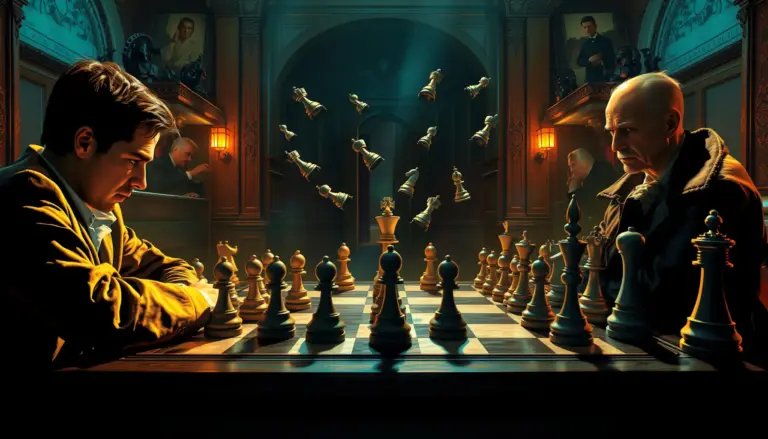
The most iconic confrontation of this era was the duel between Bobby Fischer and Boris Spassky in 1972, known as the “Match of the Century”. Fischer, an eccentric and lonely genius, challenged Soviet dominance and won the world title in a context of high political tension. His victory was celebrated as a triumph of democracy over totalitarianism., although his subsequent decline and his controversial statements tarnished his legacy. This confrontation not only changed the history of chess, but also demonstrated how a game could be used as spy and propaganda tool.
The digital revolution: from Kasparov vs Deep Blue to the era of online platforms
The 21st century brought with it a new challenge for European chess: artificial intelligence. In 1997, The world witnessed a historic moment when the Deep Blue supercomputer, developed by IBM, defeated Garry Kasparov in a six-game match. This event marked the beginning of a new era, where machines not only competed with humans, but they also surpassed them in calculation capacity and precision. However, far from destroying the game, AI transformed it. Hoy, Engines like Stockfish and AlphaZero are essential tools for grandmaster training, allowing them to analyze games with a depth unimaginable a few decades ago.
But the real revolution came with online platforms. Sites like Chess.com and Lichess democratized access to chess, allowing millions of people around the world to play, learn and compete regardless of their location or level. Europa, with its rich chess tradition, quickly adapted to this change. Countries like Norway, with figures such as Magnus Carlsen, and Russia, with his legacy of champions, led this transition. Carlsen, in particular, became a global phenomenon, breaking records and popularizing rapid and blitz chess. His playing style, based on flexibility and creativity, reflects the evolution of chess in the digital age, where memorizing openings is no longer enough to succeed.
If you want to understand how AI is redefining gaming, we invite you to read Chess and AI: how machines redefined gaming, an in-depth analysis of this fascinating topic.
European chess in the 21st century: between tradition and innovation
Hoy, Europe continues to be an epicenter of world chess, but his role has changed. While in the past the continent dominated the competitive scene, Today it faces competition from new powers like China, India and the United States. However, Europe continues to be a benchmark in the organization of elite tournaments, like him Tata Steel Chess Tournament in the Netherlands or Grand Chess Tour, that attract the best players in the world. Besides, Countries like Armenia and Azerbaijan have invested heavily in chess as an educational tool, integrating it into their school systems to develop critical thinking and creativity in children.
European chess has also known how to adapt to new times. The COVID-19 pandemic accelerated the transition to online gaming, but it also showed that face-to-face chess is still irreplaceable. Tournaments like Norway Chess combine the best of both worlds, offering live games with streaming transmission and real-time analysis. Besides, chess has become a cultural phenomenon, thanks to series like The Queen’s Gambit, that has inspired a new generation of players.
But the biggest challenge for European chess in the 21st century is to maintain its relevance in an increasingly digital and globalized world.. The key is to balance tradition with innovation, taking advantage of the legacy of European schools - such as German Chess School— while exploring new ways to teach and play. Chess is no longer just an elite game, but a tool for education, inclusion and personal development, and Europe has the opportunity to lead this transformation.
The evolution of chess in Europe is a testament to its ability to adapt to historical changes, political and technological. From medieval halls to artificial intelligence algorithms, chess has been a reflection of European society, a game that has challenged minds, united cultures and even influenced the destiny of nations. Hoy, in the digital age, chess faces new challenges, but also unprecedented opportunities. Its future will depend on how Europe – and the world – manages to balance tradition with innovation, competition with inclusion, and cold calculation with human creativity. One thing is for sure: chess will continue to be, as it has been for centuries, a mirror of our intelligence, our ambition and our ability to reinvent ourselves.
“`