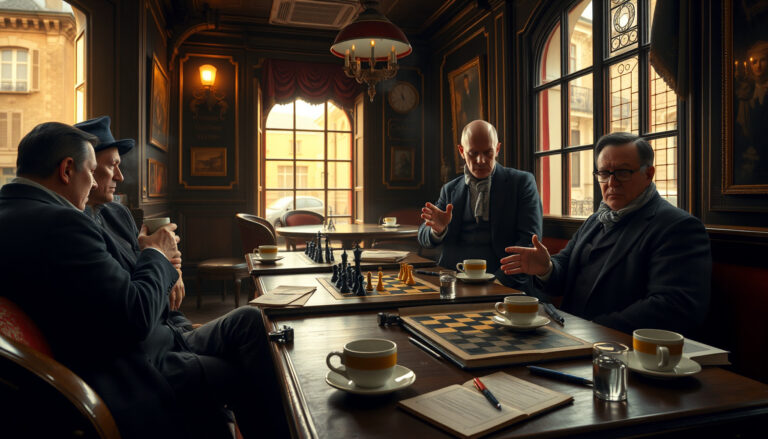
The Spanish Chess School is not just a chapter in the annals of this ancient game, but a philosophy that redefines the relationship between strategy, culture and thought. While other traditions such as Russian Chess School They focused on scientific systematization or Indian School in the fusion of mind and spirit, the Spanish emerged as a crucible where the tactical is intertwined with the human. How did a country without global chess hegemony manage to become the cradle of ideas that still challenge artificial intelligence engines today?? The answer lies in its ability to transform the local into the universal., the intuitive in methodical, and the artistic in lethal.
This article unravels the keys to a tradition that, although less widespread than its Russian or German counterparts, laid the foundations of what we understand today as modern chess. From the Renaissance treatises to the games of the great contemporary masters who draw on their legacy, We will explore how Spain not only exported players, but a way of understanding the board as a mirror of life itself.
The origins: when chess became spanish
Chess arrived to the Iberian Peninsula in the 9th century from the Arabs, but it was in the Renaissance when Spain reinvented it. Unlike other regions where gambling remained a courtly pastime, here it acquired an almost revolutionary character. The first milestone was marked by the treatise *Book of liberal invention and art of the game of chess* (1561) by Ruy López de Segura, considered the first structured analysis of openings in the West. López, a clergyman from Zafra, He did not limit himself to describing movements: proposed a system where the initial position of the pieces—especially castling, a European innovation—determined the flow of the game. Your approach, based on anticipation and control of the center, contradicted the Arab tradition of frontal attacks and spectacular sacrifices.
But the most fascinating thing about this period was not the technique, but the context. Spain, in full imperial expansion, He saw in chess a reflection of his own ambition: a game where strategic patience prevailed over brute force. López's treatise coincided with the publication of *El Lazarillo de Tormes* (1554), a work that, like chess, exposed the contradictions of society. Isn't it chess, after all, a struggle between structures—the nobility (larger pieces), the clergy (bishop) and the people (pawns)— where destiny is decided in the subtlety of movements?
The school that was never a school: the Spanish method as antithesis of dogmatism
Unlike the German School, who in the 19th century systematized chess as an exact science, Spanish tradition always maintained an organic component. There were no academies or rigid manuals, but an oral and written transmission where the theoretical was mixed with the practical. The great example is the *Chess Treaty* (1617) by Alfonso Cerón, a player from Granada who defended flexibility over memorization. Cerón argued that an opening like the *Spanish Defense* (1.e4 e5 2.Nf3 Nc6 3.Ab5) It should not be played mechanically, but adapting to the rival's style. This idea, apparently simple, contradicted the European obsession with pre-established variants.
The Spanish method was based on three pillars:
- positional intuition: Understand that a small advantage, as a weak pawn on d6, could be more valuable than a spectacular but ephemeral attack.
- The counterplay: The ability to turn a seemingly passive position into a dynamic threat, something that we see today in players like Fabiano Caruana.
- psychology: Chess as silent dialogue, where every movement is a question and every answer, a revelation of the rival's character.
This philosophy found its maximum expression in the 20th century with Arturo Pomar, he “Mozart of chess”, a prodigy that 13 years tied with Alexander Alekhine. Pomar was not a theorist, but an artist: their games, full of intuitive sacrifices, They showed that Spanish chess did not seek perfection, but the beauty in imperfection.
The Spanish Defense: the legacy that challenges AI
If there is a symbol of the Spanish School, that is the *Spanish Defense* (Ruy López, in honor of its creator). This opening, starting with 1.e4 e5 2.Nf3 Nc6 3.Bb5, It is one of the oldest and most analyzed in history, but also one of the most resistant to algorithms. Because? Because its essence does not lie in specific variants, but in abstract principles: center control, the flexibility of the pieces and the ability to transform a seemingly passive pawn structure into a lethal weapon.
Chess engines like Stockfish or AlphaZero tend to prefer more direct openings, like the *Siciliana* or the *India de Rey*, where advantage is built through precise calculations. However, *Spanish* continues to be a battlefield where human creativity has the advantage. A paradigmatic example is the *Marshall Variant* (8…d5), a gambit where black sacrifices a pawn to gain initiative. The engines initially considered it inferior, But humans—especially the Spanish—demonstrated that positional compensation could be devastating.. Hoy, even AlphaZero, after analyzing millions of games, recognizes that the *Marshall* is one of the few lines where human intuition still surpasses the machine.
This phenomenon is not coincidental. The *Spanish Defense* embodies the essence of Spanish chess: a balance between structure and chaos, where the important thing is not to gain material, but win the game. As the great Spanish master Miguel Illescas said: “In Hispaniola, every pawn is a soldier, and each box, a battlefield”.
Spanish chess in the 21st century: between tradition and globalization
Hoy, the Spanish School is no longer a local phenomenon, but an approach that has permeated players around the world. Magnus Carlsen, For example, He has used the *Spanish Defense* at key moments in his career, proving that its flexibility is ideal for modern chess, where theoretical preparation is as important as the ability to improvise. However, The greatest legacy of this tradition is not in the games, but in his philosophy.
In a world where chess has become increasingly technical and dependent on technology, the Spanish School offers an antidote: the idea that the game is, first of all, a human expression. This is reflected in initiatives such as the chess in schools, where countries like Spain have adopted the game not as just another subject, but as a tool to develop critical thinking. Unlike models like the Armenian, that prioritizes competition, The Spanish approach seeks to ensure that children understand chess as a language, not like a sport.
But the biggest challenge for this school in the 21st century is its survival in the digital age.. Platforms like Chess.com or Lichess have democratized access to the game, but they have also homogenized the styles. Hoy, many young players memorize variants without understanding the underlying principles, something that the Spanish School always rejected. How to keep alive a tradition that values depth over speed? The answer could be in players like David Antón, who combines theoretical preparation with a dynamic and creative style, or in the growing popularity of chess in cities like Seville or Barcelona, where clubs continue to be spaces for debate and not just competition.
Conclusion: chess as a mirror of a culture
The Spanish Chess School is a reminder that great traditions are not born from imposition, but of adaptation. While other schools sought to dominate the game through brute force or systematization, Spain opted for a more subtle path: understand chess as a dialogue between two minds, where victory is not the only objective, but mutual understanding. This philosophy, which today seems more relevant than ever, teaches us that in a world obsessed with efficiency, there is room for creativity, patience and beauty.
Perhaps the greatest legacy of the Spanish School is not an opening or a treaty, but the idea that chess, like life, It's not about winning at all costs, but to play with intelligence, respect and passion. On a board where each move is a decision and each game, a story, Spain left us a lesson: true mastery is not in knowing more, but to understand better.