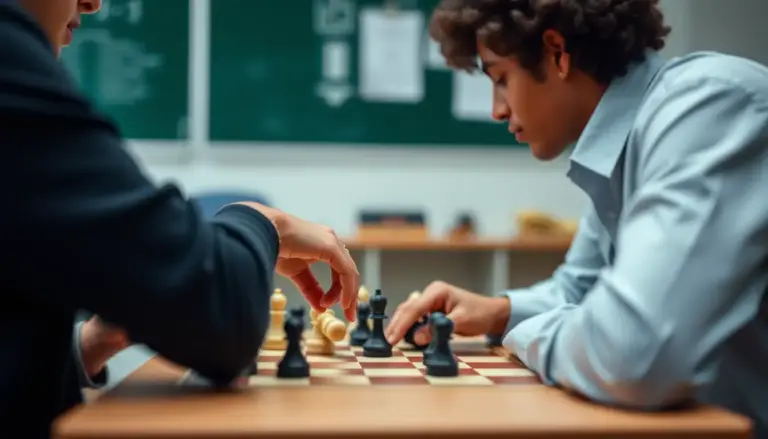
Chess is an ancient game that has fascinated generations for its combination of strategy, tactics and creativity. Among the most prominent players, los chess grandmasters occupy a privileged place, not only because of his exceptional ability, but for their ability to transcend the board and become references of logical thinking and mental discipline.. But, What really defines a great teacher?? Is it just a question of titles and rankings, or is there something deeper behind this recognition?
In this article, We will explore in detail what it means to be a chess grandmaster, from the formal requirements to the intangible qualities that distinguish these players. We will analyze how this level is achieved, What does it mean in terms of dedication and sacrifice?, and why its influence goes beyond sports, impacting culture, education and even science. Besides, We will demystify some misconceptions about this title and reflect on its relevance in the modern world.
The title of grandmaster: more than a simple recognition
The term great teacher (GM) It's not just an honorary title., but a distinction granted by the International Chess Federation (FIDE), the governing body of chess worldwide. to get it, a player must meet a series of technical and competitive requirements that guarantee excellence in the game. These are the three fundamental pillars:
- grandmaster rules: A player must achieve at least three “norms” in official tournaments, which consist of achieving a minimum performance (generally a rating performance of 2600 or more) in competitions where other grandmasters participate. These standards must be obtained within a period of at least two years.
- Rating FIDE: The player must overcome the 2500 Elo points in your official ranking. This system, developed by Hungarian physicist Arpad Elo, measures the relative strength of players based on their results against other competitors.
- Participation in high level tournaments: Standards must be achieved in tournaments where at least half of the opponents are grandmasters, and at least a third of them do not belong to the same country as the applicant. This ensures that the title is awarded for real merit and not for local advantages.
However, the title of grandmaster is not static. Many players get it in their youth, But maintaining it requires constant effort. FIDE periodically reviews the classifications, and a GM who does not compete regularly can lose his title if his rating falls below the 2500 points. This reflects the competitive and demanding nature of elite chess..
Beyond technical requirements, The title of grandmaster symbolizes a level of mastery that goes beyond simply memorizing openings or endings.. A GM must demonstrate a deep understanding of strategy, the ability to calculate complex variants with precision and exceptional adaptability to the styles of your opponents. Es, in essence, a seal of quality that certifies that the player has reached the pinnacle of competitive chess.
The path to mastery: sacrifice and dedication
Becoming a grandmaster is not an overnight achievement.. Behind every title there are years of study, training and personal sacrifice. This process can be divided into several stages, each with its own challenges and demands.
Early training: Most grandmasters start playing chess at a very young age, often before 10 years. At this stage, the focus is on developing a solid foundation in tactics, basic strategy and endings. Many outstanding players, as Magnus Carlsen o Bobby Fischer, They showed exceptional talent from childhood, but even they took years of practice to refine their skills.
The intensive training: As the player progresses, training becomes more structured and demanding. This includes:
- Game analysis: Study games from other grandmasters, especially those involving openings or pawn structures similar to those the player usually faces. Tools like ChessBase o Lichess are fundamental in this process.
- Work with coaches: Many aspiring GMs work with coaches who are grandmasters or international masters.. These mentors help identify weaknesses, fix bugs and develop a unique playing style.
- Physical and mental preparation: High-level chess requires great mental stamina. Players must be in optimal physical condition to endure games that can last more than six hours, with absolute concentration. Meditation techniques, Regular exercise and a balanced diet are common among professionals.
- Constant competition: Participating in tournaments is essential to gain experience and accumulate Elo points. Many players travel around the world to compete in high-level events, which implies great physical and emotional exhaustion.
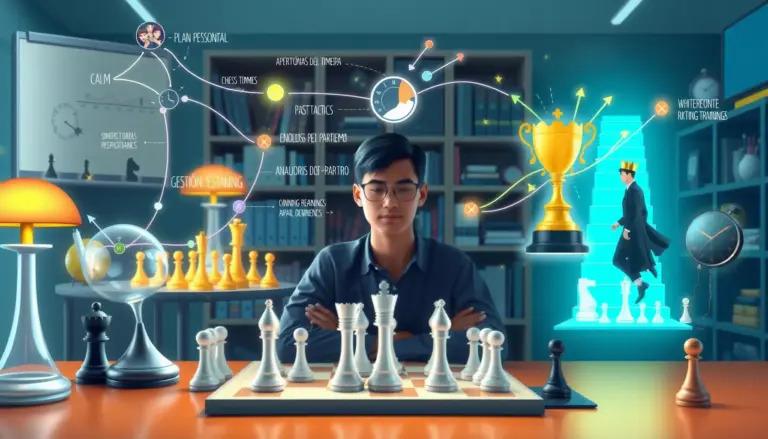
The jump to the elite: Achieving the title of grandmaster is just the beginning. Many players continue to improve and compete for the top positions in the world rankings.. At this stage, the focus is on perfecting details, such as preparing specific openings or time management in quick and blitz games. It is also common for GMs to develop a distinctive play style., whether aggressive, positional or universal, that differentiates them from other players.
The path to mastery is not without obstacles. Many talented players quit competitive chess due to pressure, lack of financial resources or difficulty balancing gambling with other aspects of life. However, Those who persevere and achieve the title of grandmaster demonstrate a resilience and passion that goes beyond the simple desire to win..
The intangible qualities of a great teacher
While technical requirements and training are essential to becoming a grandmaster, There are intangible qualities that distinguish the best players from the rest.. These skills are not always easy to measure, but they are essential to reach and maintain the elite level.
Chess intuition: One of the most fascinating traits of great teachers is their ability to “to feel” the position. Although chess is a game of pure calculation, GMs develop an intuition that allows them to quickly evaluate a position without having to analyze all possible variants. This skill is acquired through years of experience and study, and allows players to make quick and accurate decisions in complex situations.
Creativity and originality: Chess is not just a game of rules and patterns; It is also an art. The most outstanding great teachers, as Garry Kasparov o Mikhail Tal, They are known for their creativity and their ability to find unexpected plays that unbalance their opponents.. This originality not only makes your games exciting, but also allows them to outperform rivals who rely too much on established theory.
Psychological resistance: Chess is a mentally exhausting game. Grandmasters must deal with the pressure of competitions, the frustration of defeats and the fatigue of long games. The ability to remain calm under pressure, recovering from mistakes and not underestimating opponents is crucial. Players like Vladimir Kramnik o Viswanathan Anand are examples of how mental strength can make a difference in key moments.
Adaptability: Each opponent has a different playing style, and great teachers must be able to adapt quickly. This means changing your strategy in the middle of a game., adjust your opening preparation according to your opponent and take advantage of each player's specific weaknesses. Adaptability also extends to tournament conditions, like the pace of the game (classic, quick blitz) or the environment (in person or online).
Humility and continuous learning: Despite its level, great teachers never stop learning. They recognize that chess is an infinite game, where there is always something new to discover. Many GMs study games of younger players, They analyze their own losses in detail and seek to improve specific aspects of their game. This growth mindset is what allows them to stay on top for decades..
These intangible qualities are what make chess such a profound and fascinating game.. It's not just about memorizing openings or calculating variants, but to develop a holistic understanding of the game that combines logic, creativity and psychology.
The impact of grandmasters beyond the board
The legacy of a grandmaster is not limited to his victories on the board. Its influence extends to multiple areas, from education to popular culture, and even science. Next, We explore some of the ways GMs have left their mark on the world.
Inspiration for new generations: Grandmasters are role models for millions of players around the world. Its success motivates young talents to pursue their dreams and dedicate themselves to chess with passion.. Players like Magnus Carlsen o Judit Polgár (the best female chess player in history) They have inspired a new generation of players, proving that talent and hard work can break barriers.
Contributions to chess theory: Many grandmasters have left a lasting legacy in chess theory, developing new openings, variants or strategic concepts. For example, Ruy Lopez (16th century) gave name to one of the most popular openings, while Wilhelm Steinitz (first official world champion) laid the foundations of modern positional chess. More recently, players like Veselin Topalov o Fabiano Caruana have contributed to the evolution of openings such as Sicilian Defense o to Ruy López Berlinese.
Promotion of chess as an educational tool: Chess has been increasingly used as a pedagogical tool to develop cognitive skills in children and young people.. Great teachers like Garry Kasparov o Anatoly Karpov have promoted initiatives to teach chess in schools, highlighting its benefits in areas such as concentration, memory and critical thinking. Studies have shown that chess can improve academic performance, especially in mathematics and science.
Influence on popular culture: Chess has transcended the sporting field to become a cultural symbol. movies like The seventh seal (1957) o In search of Bobby Fischer (1993) have used chess as a metaphor for life, death and the pursuit of excellence. Series like Queen's Gambit (2020) have popularized the game among new audiences, and great teachers like Hikaru Nakamura They have brought chess to platforms like Twitch, attracting millions of viewers.
Advances in artificial intelligence: Chess has been a fundamental testing ground for the development of artificial intelligence. The famous game between Garry Kasparov y Deep Blue (1997) marked a milestone in the history of AI, proving that machines could outperform humans in complex games. Hoy, chess engines like Stockfish o Leela Chess Zero They are essential tools for the training of great teachers, and its development has driven advances in areas such as machine learning and algorithm optimization.
The impact of great teachers goes beyond their individual achievements. His legacy lives on in the way chess is taught., It is played and perceived throughout the world. They have turned a simple board game into a discipline that challenges the limits of the human mind and that continues to evolve with each generation..
Being a chess grandmaster is much more than a title or a number in a ranking. It is the result of years of dedication, sacrifice and passion for a game that, despite its apparent simplicity, contains infinite depth. From the technical requirements that define it to the intangible qualities that distinguish the best players, The path to mastery is a journey of self-discovery and constant improvement.
Grandmasters not only dominate the board, but also inspire others, They contribute to the development of chess as a discipline and leave a legacy that transcends generations.. His influence extends to education, culture and science, proving that chess is much more than a game: It is a tool to understand the world and challenge the limits of the human mind.
In a world where technology and artificial intelligence advance by leaps and bounds, chess remains a reminder of the human capacity for creativity, strategy and resilience. The great teachers, with his combination of talent, discipline and passion, They are the guardians of this legacy, and his example invites us all to think beyond the obvious, to calculate accurately and never stop learning.
If you've ever wondered what it takes to reach the top of chess, The answer is not only in the hours of study or the tournaments won, but in the ability to see the game as a reflection of life itself: a constant challenge that rewards those who dare to dream big and work tirelessly for their goals.