chess, that game of kings and strategists, found in 1851 a turning point that would transform him forever. Imagine London in full Victorian effervescence, where the Great Exhibition celebrated the technological and cultural advances of an era believed to be invincible. Between mechanical wonders and inventions that promised to change the world, an apparently modest tournament became the Big Bang of competitive chess. It wasn't just a competition; It was the birth of a new order, where the rules, The players and even the perception of the game changed forever.. Adolf Andersen, a German mathematician with a penetrating gaze, emerged as the first modern grandmaster, not for an official title, but for a style of play that defied the canons of its time. But, How did an apparently secondary event manage to redefine chess and lay the foundations for what we know today as mental sport??
The historical context: when chess was a parlor game
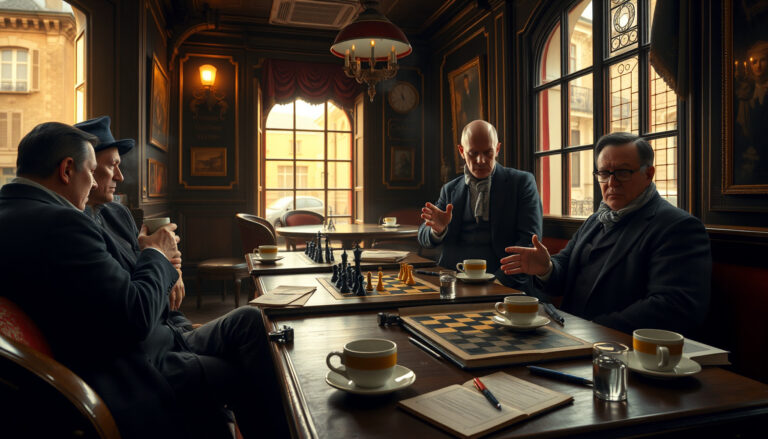
Before 1851, Chess was a pastime reserved for intellectual elites and aristocratic circles.. It was played in cafes, private clubs and lounges, where the games were long, symbolic bets and prestige were measured more by the elegance of the game than by victory. Europa, heir to a tradition that dates back to It's done and to the Arab wise men who systematized it, saw chess as a reflection of war, but also as an art. However, lacked a structured competitive system. Meetings between teachers were sporadic, and although there were treaties such as that of Lucena, who laid the theoretical foundations, there was no scenario where the best could be measured under uniform rules.
Howard Staunton, an English chess player of controversial reputation, He understood that chess needed to evolve. It wasn't enough to be a parlor game; It had to become a sport with clear rules, where talent and preparation were the only arbiters. The Great Exhibition of London, with its spirit of innovation and its ability to bring together the most select of society, It was the perfect setting. Staunton, with an almost prophetic vision, He saw in that event the opportunity to organize the first international chess tournament, an experiment that would change history.
The structure of the tournament: the birth of modern rules
The London tournament 1851 It was not a typical competition. Participate 16 players, selected by invitation, and it was played under a direct elimination format that would be familiar to us today, but at that time it was revolutionary. Each game was played at a pace of two hours per player for the first few 40 movements, a standard that sought to balance strategic depth with the need to conclude games in a reasonable time. This detail, apparently smaller, It was crucial: for the first time, chess shed its aura of eternity to adapt to the demands of a public event.
But Staunton's true legacy wasn't just the format, but the creation of a regulatory framework. Established rules about behavior at the table, the annotation of the games and even the arrangement of the pieces, which had to be placed evenly. He even introduced the concept of “reflection time”, an idea that today seems obvious to us but that in 1851 It was a radical innovation.. These rules, although rudimentary compared to the current ones, They laid the foundations for what would become competitive chess. Without them, tournaments like Hastings 1895 or the subsequent World Championship would not have been possible.
Adolf Andersen: the first great teacher and his romantic legacy
If Staunton was the architect of the tournament, Adolf Anderssen was its undisputed star. The German mathematician, Known for his aggressive and creative style, not only did he win the tournament, but he did it with a game that would become legend: the Immortal. in it, Anderssen sacrificed both towers, a bishop and the queen to checkmate with three minor pieces, a demonstration of audacity that left his contemporaries astonished. This game, more than any other, encapsulated the spirit of romantic chess: a game where beauty and creativity took precedence over calculating coldness.
Anderssen was not a chess professional in the modern sense. He was a math teacher who played for passion, but his victory in London catapulted him to fame and made him the first “great teacher” unofficial story. Your style, based on attack and initiative, contrasted with the positional game that Wilhelm Steinitz would later popularize, but it laid the foundations for what would be competitive chess: a game where individual talent could shine under clear rules and on a public stage. Anderssen showed that chess was not just a hobby, but a sport where the preparation, strategy and psychology played a fundamental role.
Chess as a mirror of Victorian society
The London tournament 1851 It was not just a sporting milestone; It was a reflection of the values of Victorian society. In an era where scientific and technological progress was celebrated as the maximum expression of human ingenuity, chess was presented as a perfect metaphor: a game where logic, planning and intelligence triumphed over brute force. The Great Exhibition, with its emphasis on innovation, found in chess a symbol of European intellectual superiority, a game that, like industry or science, could be mastered through study and discipline.
But there were also shadows. The tournament, although international in theory, was dominated by European players, and the participation of chess players from other regions was marginal. This reflected a broader reality: chess, like many other areas of Western culture, It was a space where colonial powers imposed their rules. However, The event also opened the doors to an incipient globalization of the game. Players like the Hungarian József Szén or the French Lionel Kieseritzky, who participated in London, They showed that chess could be a universal language, capable of transcending borders and cultures.
The legacy of 1851: from the elite to the mainstream
The London tournament 1851 It marked the beginning of an era where chess stopped being a parlor game and became a global phenomenon.. The rules established by Staunton were refined over time, but its essence endured. The figure of the professional player, first embodied in Anderssen, was consolidated, and chess began to attract sponsors, media and an increasingly broad public. Tournaments like the one Hastings 1895 or the World Championship 1886, where Steinitz was crowned the first official champion, They were direct heirs of that London experiment.
But perhaps the deepest legacy of 1851 It was the idea that chess could be more than just a game.: an educational tool, a mental sport and even a symbol of cultural resistance. Hoy, in the 21st century, chess continues to evolve, driven by technology and globalization. Platforms like Chess.com or Lichess have democratized access to the game, and figures such as Magnus Carlsen or Judit Polgár have brought chess to mass audiences. However, All these transformations draw from that founding moment in London, where a group of visionaries decided that chess deserved a stage worthy of its greatness.
The London tournament 1851 It was not only the first international chess tournament; It was the founding act of a new era. An era where the game of kings became the game of all, where strategy and creativity found a home in the 64 casillas, and where, for the first time, the world understood that chess was not just a hobby, but a reflection of the human mind at its finest. Hoy, more than 170 years later, His legacy lives on in every game, in every tournament and in every player that, like Anderssen, He dares to dream of the perfect play.