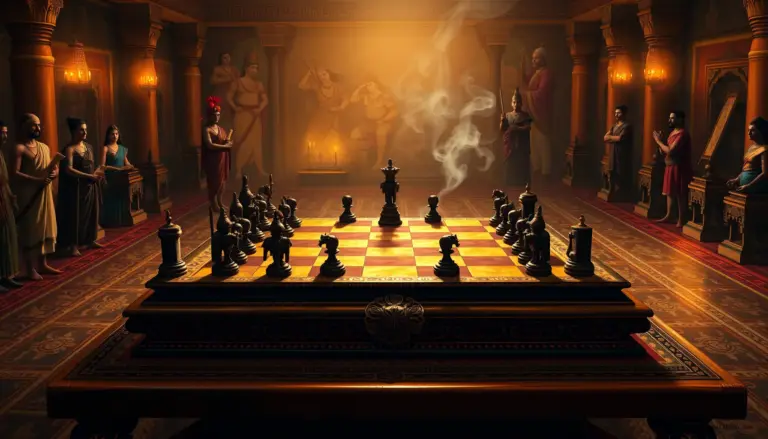
In the 8th century, when the shatranj crossed the Strait of Gibraltar alongside the Muslim conquerors, Nobody imagined that that Persian game would become the intellectual laboratory of a civilization. What began as an elite pastime became, under the sky of Al-Andalus, in a codified knowledge system. The Arab wise men not only played chess; they broke it up, They analyzed it and turned it into a mirror of human logic. His treatises, like him Kitab al-Shatranj by Al-Adli, They were not mere rule manuals, but the first attempts in history to tame strategic chaos. How did they achieve, with ink and parchment, lay the foundations of what we call chess theory today?
El Shatranj: a game in search of order
Before the Arabs systematized chess, Shatranj—its Persian version—was a game of intuition and memory. The pieces moved with different rules: he bishop (called fil, “elephant” in Arabic) moved only two squares diagonally, jumping the first, and the agitate (so firzán, “visor”) moved a single square diagonally. There was no castling, nor pawns that would crown on any piece. Era, in essence, a slower and less dynamic game than modern chess, but just as profound in its simplicity. What fascinated Islamic scholars was precisely this apparent contradiction: a board of 64 boxes that contained infinite possibilities. As historian Harold Murray points out, “the shatranj was a microcosm where war, mathematics and philosophy met”.
The Arabs, heirs of the Hellenistic and Persian tradition, They saw in the shatranj an opportunity to apply the scientific method. They were not satisfied with playing; they wanted to understand. And for this, they needed something revolutionary: documentary. This is how the first chess literature was born, a corpus of texts that sought to classify openings, study finals and, above all, preserve knowledge. He It's done, remote origin of the game, had been a reflection of military philosophy, but the Arabs raised it to an intellectual level. As Al-Adli wrote in his treatise: “Shatranj is not just a game; It is a dialogue between the mind and destiny”.
Al-Adli and the first treaties: when chess became science
He Kitab al-Shatranj (Chess Book) by Al-Adli, written in the 9th century, It is considered the first chess manual in history. Although the original text has been lost, fragments cited by later authors reveal its content: analysis of openings such as “Elephant Game” (precursor to the Queen's Gambit), basic final studies and, the most important thing, a classification of players according to their level. Al-Adli divided chess players into five categories, from the beginner (mubtadi) until the teacher (ali), a hierarchy that anticipates the modern ratings system. His work not only described games; tried explain why certain plays worked and others didn't.
But Al-Adli was not alone. Other wise men like Al-Suli, considered the best player of his time, expanded their legacy. Al-Suli wrote a treatise that included commented games, tactical problems and a section dedicated to the psychology of the game. In one of his most famous passages, claimed: “A good player does not win by luck, but to foresee the consequences of each movement, like a general anticipates the enemy's maneuvers”. This idea—that chess is an exercise in causality—would be taken up centuries later by European theorists.. In fact, many of the principles that we take for granted today, such as control of the center or the importance of pawns, They have their origin in these Arabic texts.
The fascinating thing about these treatises is that they were not isolated works. They were part of a broader intellectual ecosystem, where chess was studied along with astronomy, poetry and mathematics. In the Baghdad library, For example, manuscripts were preserved that related the shatranj with Euclidean geometry. As historian Richard Eales points out, “Arab chess was a bridge between science and art, between logic and creativity”. This holistic view of the game explains why, when chess came to europe, He did so accompanied by a theoretical corpus that had already laid the foundations for positional analysis..
From Al-Andalus to Europe: how Arabic knowledge saved chess
The transmission of Arab chess to Europe was not a linear process, but a series of cultural meetings. One of the most important milestones occurred in the 13th century, when King Alfonso X the Wise commissioned the translation into Spanish of several Arab treaties, including the Book of Games. This manuscript, richly illustrated, it not only described the rules of the shatranj, but also explored its symbolism: the board as a representation of the cosmos, the pieces as metaphors of social classes. As he explains medieval chess, the game became a mirror of feudal society, where each piece had a predetermined role, just like the establishments of the time.
But beyond the symbolism, What Europe inherited from the Arabs was a methodology. The Andalusian treaties introduced concepts such as tabiya (initial arrangement of parts), that would evolve into modern openings. They also popularized chess problems., known as attribute, which were tactical exercises designed to train the mind. These problems, which often presented checkmate situations in just a few moves, They were a way to teach thought patterns. As the Persian poet Omar Khayyam wrote: “Chess is a lake where a mosquito can drink and an elephant drown”. The metaphor illustrates the paradox of the game: simple in its rules, but infinite in its possibilities.
However, The Arab legacy was not limited to theory. It also influenced the practice of the game. For example, The custom of writing down games—something we take for granted today—has its origins in Islamic manuscripts.. Arab players recorded their games not only to analyze them, but also to preserve them as works of art. This idea that a game of chess could be as valuable as a poem or a mathematical theorem is deeply Arabic.. As historian David Shenk points out, “Chess became a universal language because the Arabs treated it as such: a system of signs that could convey complex ideas”.
Chess as a tool of power: more than a game, a political instrument
In the Islamic world, chess was not just a hobby; It was a tool of power.. The caliphs and sultans promoted it as a symbol of intellectual refinement, but also as a means to train his advisors in the art of strategy. At the court of Haroun al-Rashid, For example, tournaments were organized where players not only competed for prizes, but also for political influence. As the historian Ibn Khaldun relates, “Chess was the mirror where rulers saw their own decisions reflected”. This idea that the game could serve as a metaphor for power would continue in Europe, where kings like Philip II of Spain used it to teach military tactics to their generals.
But chess also had a subversive side. In a society where knowledge was power, mastering the game conferred status. Shatranj masters were respected not only for their skill, but for his ability to think abstractly. As Al-Suli wrote: “A good player is one who can see beyond the board, who understands that each movement is a question and each answer, a consequence”. This mentality, that today we associate with strategic thinking, It was revolutionary in a time where most decisions were made by instinct or tradition.
Arab chess also had an impact on diplomacy. During the Crusades, For example, games between Christians and Muslims served as a form of non-violent communication. In a context of war, the board became a neutral ground where cultural differences could be put aside. As pointed out by article about chess and diplomacy, This game has historically been a bridge between civilizations. The Arabs, by systematizing it, not only did they preserve their essence; They gave it a purpose beyond entertainment.
The invisible legacy: How Arab Treaties Shaped Modern Chess
Hoy, when an elite player analyzes a game with Stockfish or a child learns openings on Chess.com, are participating, without knowing it, of a tradition that began in the scriptoriums of Baghdad and Córdoba. The principles that Al-Adli and Al-Suli developed more than a thousand years ago—the control of the center, the importance of pawns, piece coordination—remain the basis of modern chess. Even seemingly modern concepts, like him zugzwang (a situation where any movement worsens the position), have roots in Arab tactical problems.
But the deepest legacy of the Arab sages is not technical, but philosophical. They were the first to treat chess as a closed system., where every move has predictable consequences. This idea, that today we associate with game theory, It was revolutionary. As the Persian mathematician Al-Khwarizmi wrote, “chess is a model of life: Every decision we make has a cost and a reward.”. This view of the game as a decision laboratory influenced later thinkers., from Leibniz to the theorists of artificial intelligence.
Hoy, when AI dominates chess, It's easy to forget that it all started with a handful of handwritten manuscripts. The Arab treaties not only preserved the game; They transformed it into an object of study. As historian Yuri Averbakh points out, “without the arabs, chess would have remained a game of chance, not a science”. In a world where technology constantly redefines the limits of knowledge, it is worth remembering that, at some point, the greatest innovation was not an algorithm, but a book.
The first chess treatises were not just manuals; They were declarations of principles. in them, The Arab sages showed that even a game could be an intellectual battlefield, where victory did not depend on strength, but the ability to think. Hoy, when chess is played on cloud servers and AI engines calculate millions of positions per second, that spirit is still alive. Why, in the end, chess is not just a game. It is a dialogue between the human mind and the infinite, and the Arabs were the first to understand it.