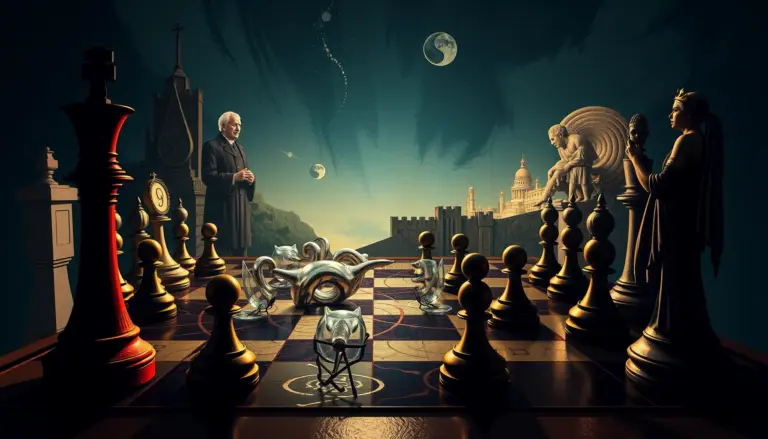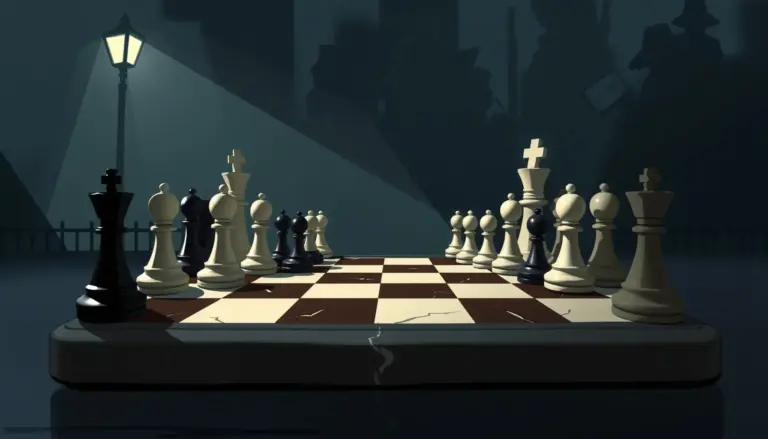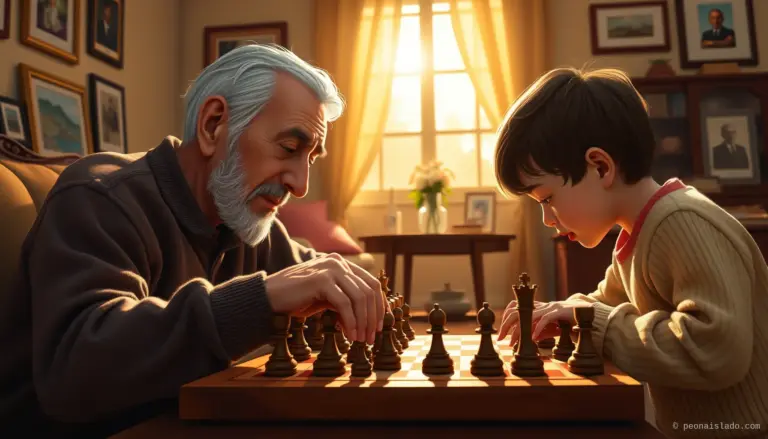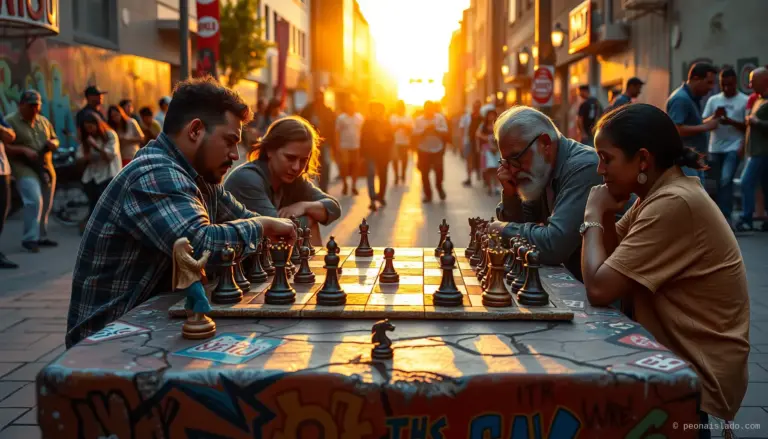
Chess is a game of strategy, calculation and, above all, decisions. However, Even the most experienced players can get caught up in a psychological phenomenon known as “the fear of moving”: a paralysis that freezes the mind in front of the board, preventing clear progress. This crash not only affects performance, but rather reveals deep layers of human psychology applied to a competitive context. Why does it happen? How does it manifest? Y, the most important thing, how do you overcome?
In this article, We will explore the roots of this fear, from the pressure for perfection to anxiety about the unknown. We will analyze its consequences in the game, how it distorts risk perception and what psychological and technical strategies can help break the cycle. Why, in the end, chess is not just a duel of pieces, but a battle against oneself.
The psychological roots of fear of moving
The fear of moving in chess does not come from nowhere. It has deep psychological foundations, linked to mechanisms that we all experience in high-pressure situations. One of the main triggers is imposter syndrome, that inner voice that whispers: “I don't deserve to be here” o “I'm going to make a mistake and everyone will notice”. in chess, where every move can be analyzed and criticized, this syndrome is amplified. The players, especially those at intermediate or advanced levels, They feel that any mistake will expose them as “cheats”, although its level is real.
Another key factor is the loss aversion. Studies in behavioral psychology, like those of Daniel Kahneman, show that human beings feel the pain of a loss more intensely than the pleasure of an equivalent gain. in chess, This translates into a tendency to avoid risks, even when they are necessary. A player may hold on to an even position for fear of making it worse., although statistics indicate that a bold move could tip the balance in your favor.
The information overload also plays a crucial role. In complex games, the brain faces an excess of variants, possible rival responses and long-term consequences. This saturation can lead to paralysis by analysis, where the player is stuck in a calculation loop without reaching a conclusion. It's as if the mind, overwhelmed, I would rather not decide than risk choosing wrong.
How fear distorts the perception of the board
When the fear of moving sets in, the board stops being a field of possibilities and becomes a labyrinth of threats. This perceptual distortion has concrete consequences in the game:
- tunnel vision: The player focuses on a single aspect of the position, ignoring alternatives. For example, may become obsessed with defending a weak piece and overlook a counterattack on the opposite flank.
- Underestimation of one's own strengths: Under pressure, it is common to minimize one's own advantages. A player with initiative can see his position as “fragile” and opt for passive movements, when in reality you have tools to press.
- Exaggeration of rival threats: Each opponent's move is interpreted as a death trap. A simple pawn advance can be seen as a prelude to a devastating attack., leading to unnecessary defensive responses.
This distortion is not only subjective; has a measurable impact on performance. A study published in the Journal of Cognitive Enhancement found that players who experienced anxiety during games committed a 30% more tactical errors than those in a state of “flow”. The reason is clear: fear consumes cognitive resources. working memory, essential for calculating variants, is overwhelmed by intrusive thoughts such as “What if I lose?” o “What will they say if I fail??”.
Besides, fear alters decision making under uncertainty. in chess, like in life, there are rarely absolute certainties. A movement can be good in the 70% of the cases, but fear leads us to look for the option “perfect”, that does not exist. This explains why many players run out of time on the clock.: It's not a lack of skill., but the impossible search for total security.
The cost of paralysis: when fear wins the game
Paralysis on the board is not a minor problem. It has tangible consequences that go beyond a lost game:
- Loss of opportunities: Chess rewards initiative. A player paralyzed by fear cedes control to his rival, allowing you to dictate the pace of the game. What could have been a victory becomes a defeat due to inaction.
- Erosion of trust: Every time a player crashes, reinforces the belief that “is not capable”. This creates a vicious cycle.: fear generates paralysis, paralysis generates errors, and mistakes feed more fear.
- emotional exhaustion: Games where fear dominates are exhausting. The player leaves them with a feeling of frustration, as if he had fought an invisible enemy. Over time, this can lead to avoidance: abandon tournaments, play fewer games or, in extreme cases, quit chess completely.
A paradigmatic example is that of players who, after reaching a promising level, they stagnate. It is not a lack of technical knowledge, but the inability to apply it under pressure. The great teacher Vassily Ivanchuk, known for his tactical genius, He has had games where his indecision has cost him crucial points. In an interview, admitted: “Sometimes, the fear of making a mistake is worse than the mistake itself”.
But the most serious cost is the creative stagnation. Chess is a game of ideas, and fear stifles innovation. A player who is afraid to move will rarely try new openings., bold sacrifices or risky plans. It is limited to “insurance”, which condemns him to repeat predictable patterns. In the long term, This not only affects its performance, but also your enjoyment of the game.
Strategies to break the cycle of fear
Overcoming the fear of moving is not a matter of willpower, but of concrete tools. These strategies combine psychological techniques and adjustments in the approach of the game:
1. Accept imperfection as part of the process
The first step is to internalize that error is inherent to chess.. Even world champions make mistakes. The difference is in how they are handled.. A useful technique is rule of 80/20: If a movement meets the 80% of what you are looking for, is enough. Perfect that 20% remaining is rarely worth it and is often counterproductive.
2. Train decision making under pressure
Deliberate practice is key. exercises like:
- Play quick games (blitz o bullet) to get used to deciding with little time.
- Analyze own games, identifying moments of doubt and reconsidering what could have been done differently.
- Use tools like Chessable o Lichess to solve time-limited tactics, simulating the pressure of a real game.
3. Develop a pre-movement ritual
Creating a routine helps anchor the mind in the present. For example:
- Breathe deeply before each movement.
- Repeat mentally: “Only this movement matters”.
- Evaluate the position with simple questions: What threatens my rival? what is my plan?
This ritual reduces anxiety by breaking the game into manageable steps.
4. Reframing fear as a signal, not as an enemy
Fear is not an obstacle, but an indicator that something important is at stake. Instead of fighting it, can be reinterpreted: “If I feel afraid, It's because this game matters to me. That's good”. This technique, known as cognitive reframing, It has been used by elite athletes to transform anxiety into positive energy.
5. Learn from mistakes without punishing yourself
After a game, instead of obsessing about what went wrong, it is more productive to ask: “What did I learn?”. A useful exercise is to write down three things that went well, no matter how small they are, and a concrete lesson. This prevents fear from turning into destructive self-criticism..
Conclusions: chess as a mirror of the mind
The fear of moving in chess is much more than a technical obstacle; It is a reflection of how we face uncertainty, the pressure and our own expectations. Throughout this article, We have seen that its roots are deep, anchored in universal psychological mechanisms such as loss aversion, Cognitive overload and imposter syndrome. However, We have also proven that it is not an inevitable destiny. Paralysis on the board can be overcome with concrete strategies, from acceptance of imperfection to deliberate decision-making training.
chess, in essence, It's a game of choices. Every move is a bet on an uncertain future, and fear arises when we forget that error is not the end, but part of the way. Great teachers are not those who are never wrong, but those who learn to live with doubt and, even so, they advance. In that sense, the board becomes a mirror: shows us not only our strategic capacity, but also our emotional resilience.
The next time you feel fear paralyzing you, Remember that the most difficult rival is not on the other side of the board, but inside you. And, like in life, the true victory is not in avoiding mistakes, but to continue moving the pieces despite them.