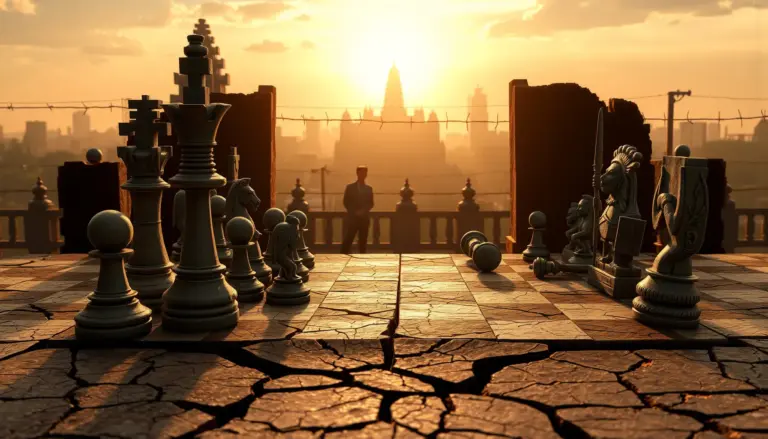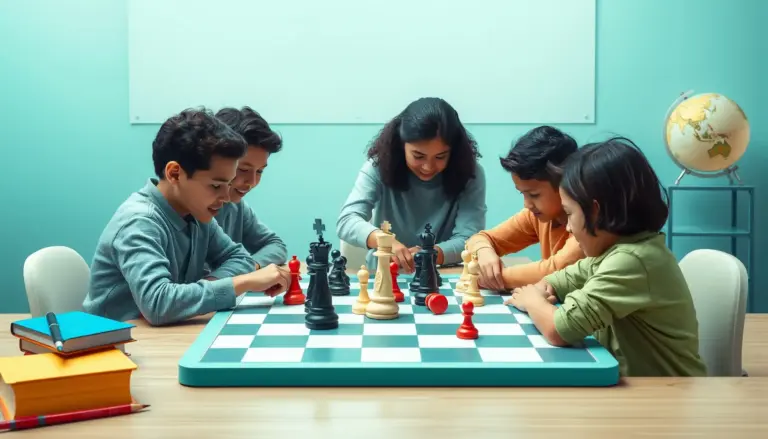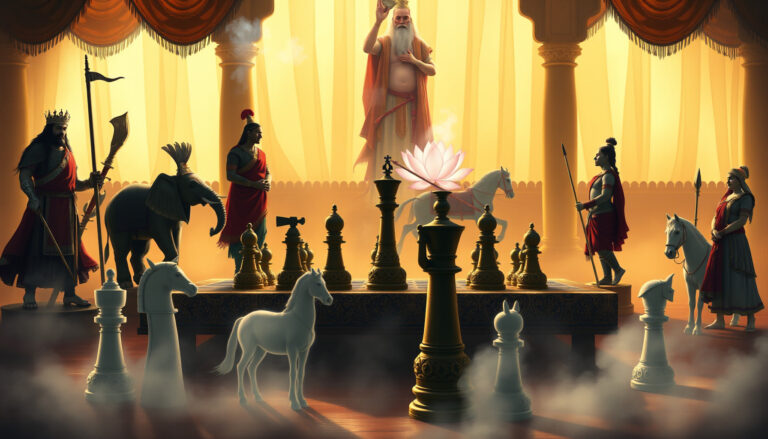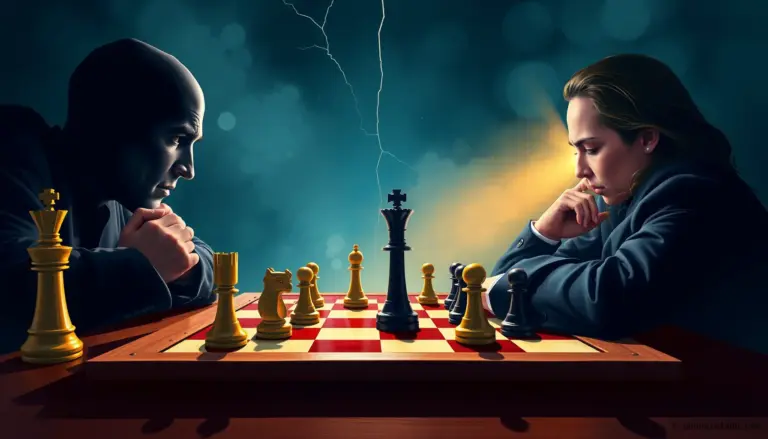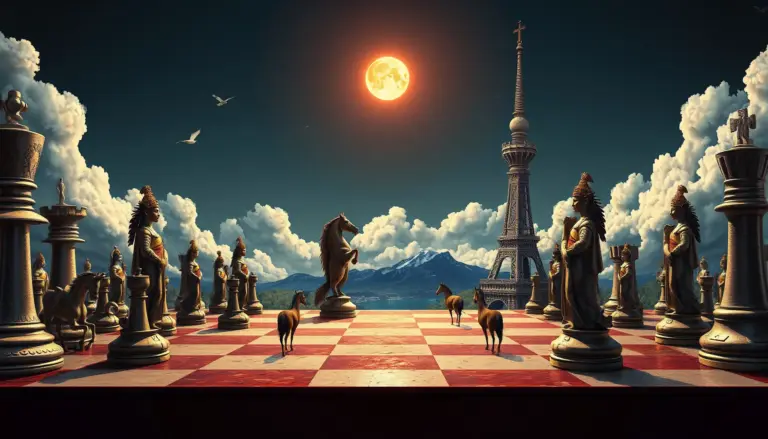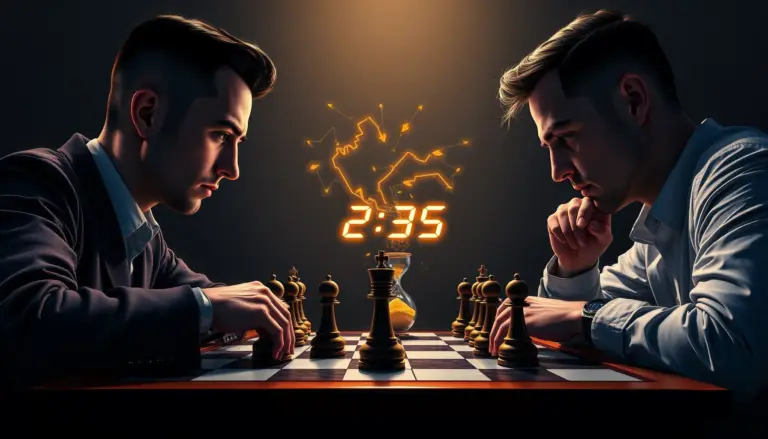
Imagine a chess board where each piece, instead of representing an army, embodies a conversation. The pawns advance like timid questions, bishops draw diagonals of shared memories, and the king, motionless on his wooden throne, watch how two generations meet without the need for words. This scenario, far from being a poetic metaphor, It is an everyday reality: chess as an intergenerational bridge, where grandparents and grandchildren learn together without a formal lesson. How does the ancient game achieve this alchemy of silence and complicity?
The board as neutral territory: when age fades
Chess does not distinguish between ages, but yes between levels of care. An eight-year-old child and an eighty-year-old adult can sit in front of the same board and, in a matter of minutes, forget the generation gap. This occurs because the game activates a shared way of thinking, where logic replaces experience as currency. The grandparents, who are usually repositories of accumulated wisdom, They discover that in chess their advantage does not lie in what they know, but in how they observe. A study published in Journal of Aging and Mental Health revealed that older adults who taught chess to children improved their working memory in a 30%, not by memorizing openings, but for adapting their language to children's curiosity.
The key is in the intentional asymmetry. Grandparents don't “they give lessons”; instead, raise questions: “What would happen if you moved the horse here?” o “See how the tower controls this whole row?”. These interventions, seemingly innocuous, They are actually exercises cognitive scaffolding, a pedagogical concept that describes how experts guide novices without imposing answers. In this context, chess becomes a mutual learning laboratory, where the child learns patience and the grandfather rediscovers creativity.
Memory as legacy: items that are inherited
Every family has its rituals: cooking recipes, repeated stories at Christmas, or even objects that pass from hand to hand. Chess adds a unique element to this tradition: the possibility of inheriting games. It's not just about teaching movements, but to transmit live games, with your mistakes, its unexpected twists and moments of genius. A grandfather who recreates the Immortal de Anderssen (1851) It is not showing a sequence of plays, but a story of sacrifice and audacity. The boy, by repeating those movements years later, not only reproduces a strategy, but it revives an emotion.
This phenomenon has a name in psychology: transgenerational memory. Researchers at the University of California showed that children who learn chess from their grandparents develop a deeper connection with the game because they associate it with emotional experiences, no to abstract rules. in an experiment, two groups of children were asked to study the same opening: one did it with a professional instructor, and the other with his grandfather. one week later, The children in the second group remembered a 40% more variants, not because of his memory capacity, but because they associated each movement with an anecdote (“Here my grandfather laughed and said: 'You fooled me!'” ).
chess, in this sense, works as a moving photo album. Every game played as a family becomes a chapter in a shared story, where mistakes are not failures, sino teaching moments. A longitudinal study in Spain, cited in “Chess that revives towns”, showed that children who played regularly with their grandparents had a 25% less likely to quit chess in adolescence, precisely because they linked it to an emotional bond, not to an obligation.
Silence as language: what chess teaches without words
In an era dominated by hypercommunication, chess offers something radically different: the possibility of communicating without speaking. When a grandfather and his grandson sit in front of the board, They don't need to fill the silence with words. The movements, The looks and even the sighs become a non-verbal language that strengthens the emotional connection. This silence is not empty; is loaded with meaning. A study from the University of Oxford analyzed the interactions between grandparents and grandchildren during chess games and found that the 70% of communication occurred through non-verbal cues: a frown, a knowing smile, or even the gesture of moving a piece aside to indicate an error.
This type of interaction has a profound impact on child development.. Child psychologist Alison Gopnik has argued that children learn best when they are allowed explore instead of receiving direct instructions. chess, with its structure of clear rules but infinite possibilities, It is the perfect setting for this type of learning. When a grandfather lets his grandson make a mistake (how to lose a tower due to carelessness), he is not being negligent; is teaching a more valuable lesson: resilience. The child learns that mistakes are not failures, but opportunities to rethink the strategy.
Besides, the silence of chess contrasts with the digital noise that children are accustomed to. In a world where screens offer instant gratification, chess demands patience and concentration. A University of Michigan study found that children who played chess with their grandparents at least once a week showed improved 20% in their ability to sustain attention, compared to those who only played on digital platforms. The reason is simple: the physical board, with its tangible pieces and its slow pace, forces children to slow down and connect with the present moment.
Chess as intergenerational therapy: heal invisible wounds
Chess not only unites generations; It can also heal emotional fractures. In migration contexts, divorce or loss, the game becomes a safe space where grandparents and grandchildren can reconnect without pressure. An emblematic case is that of the refugee camps, where organizations like Chess for Refugees have used chess to help children and the elderly overcome the trauma of war. In these environments, The board acts as a neutral mediator, where cultural and linguistic differences are diluted before the universality of the rules.
But even in families without apparent conflicts, chess can be a therapeutic tool. Family therapist Virginia Satir argued that board games are a form of metacommunication, that is to say, a way to talk about the relationship without addressing it directly. When a grandfather and his grandson argue about a play (“Why did you move the bishop there??”), they are actually negotiating power dynamics, trust and respect. chess, in this sense, it's a relationship mirror: if there is tension, will be reflected in the game; if there is complicity, also.
A moving example is that of the nursing homes, where chess has been used to combat isolation. In a pilot project in Buenos Aires, residents of a nursing home were paired with children from an elementary school. The results were surprising: older adults showed an improvement in 40% in your mood and a significant reduction in depression symptoms. But what was most revealing was the impact on the children. Those who participated in the program developed greater intergenerational empathy, that is to say, a sharper ability to understand and value the experiences of older people.
The future of intergenerational chess: technology and tradition
In an increasingly digital world, an inevitable question arises: Can intergenerational chess survive the age of screens? The answer is a resounding yes, but with nuances. Digital platforms, far from being a threat, can be an ally. A Harvard University study found that grandparents who learned to play chess online with their grandchildren not only maintained the bond, but they enriched it with new dynamics. For example, a grandfather in Madrid can play a game in Lichess with his grandson in Mexico, and then analyze it together via video call. The technology, in this case, does not replace human interaction; the amplify.
However, there is a risk: that digital chess loses its tactile essence. The weight of the pieces, the sound of the clock, the smell of wood from the board… These sensory elements are a fundamental part of the intergenerational experience. That's why, experts like the grandmaster Leontxo García recommend a hybrid approach: use technology to learn and practice, but reserve the physical boards for moments of emotional connection. As he himself points out: “Chess is not just a game; it's a ritual. And rituals need tangible objects”.
Besides, intergenerational chess is evolving into new forms. In countries like Armenia, where chess is a mandatory subject in schools, programs are being implemented reverse mentoring, where children teach their grandparents to play on digital platforms. This approach not only strengthens the bond, but it empowers children, giving them an active role in the transmission of knowledge.
Conclusion: chess as an act of love
In its essence, intergenerational chess is an act of love disguised as a game. It is not about teaching openings or tactics, but to create a space where two people, separated by decades of experience, can be found on equal terms. The board becomes a neutral territory, where age doesn't matter, just the ability to think, of making mistakes and laughing together.
Chess reminds us of something fundamental: that knowledge is not unidirectional. Grandparents have stories to tell, but the grandchildren have a way of looking at the world that we adults have forgotten. In each game, there is a hidden lesson: that wisdom is not in accumulating answers, but in asking the right questions. And perhaps that is the greatest lesson of all: that true learning occurs when we let go of the role of teacher and allow ourselves to be, simply, playmates.
So the next time you see a grandfather and his grandson in front of a board, don't think of them as an old man teaching a child. Think of them as two explorers, sailing together through an ocean of 64 casillas, where every movement is an adventure and every game, a memory in construction.