Imagine a game that has survived empires, crusades and technological revolutions. A board where silent battles were fought between brilliant minds, where each piece embodies a philosophy of power and each movement is an echo of ancient strategies. Chess is not just a hobby; it's a living fossil of human intelligence, a bridge between civilizations that stretches from the palaces of ancient India to the servers of chess online in the 21st century. But, How did a war game become a universal language?? The answer lies in its origin, a journey that reveals as much about the history of humanity as it does about the game itself.
The chaturanga: chess as a mirror of the Indian war
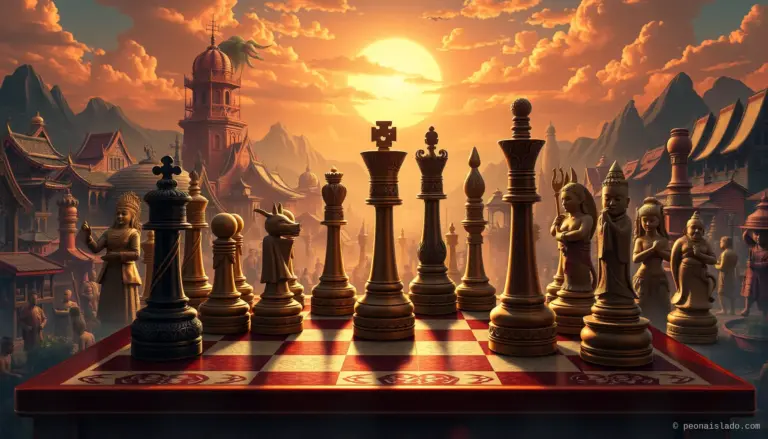
Modern chess owes its existence to a distant ancestor: he Chaturanga, born in India around 6th century AD. This game, whose name means “four divisions” in sanskrit, It wasn't just fun., but a battle simulation that reflected the military structure of the time. The four main pieces—the car (torre), the horse, the elephant (bishop) and the infantry (pawn)— represented the divisions of the Indian army, while the king and his advisor (to the future lady) They embodied leadership and strategy.
The fascinating thing about chaturanga is not only its design, but its purpose. The ancient texts, like him Manasolasa (12th century), They describe it as a tool to train princes and generals in the art of war. Every game was a lesson in tactics, where the loss of a piece did not just symbolize a defeat on the board, but a strategic error with real consequences. This connection between gaming and war is not accidental.: chess inherited its essence from chaturanga as metaphor of power, a quality that differentiated it from other board games and made it a symbol of intellectual status.
But chaturanga also hid a paradox. Although its goal was to prepare players for war, its practice fostered opposite abilities: patience, cold calculation and the ability to anticipate the rival's intentions. In a world where decisions were made in seconds on the battlefield, chess taught us to think before acting. This duality—between violence and reflection—is one of the keys to its durability..
From Persia to Europe: How chess became a global game
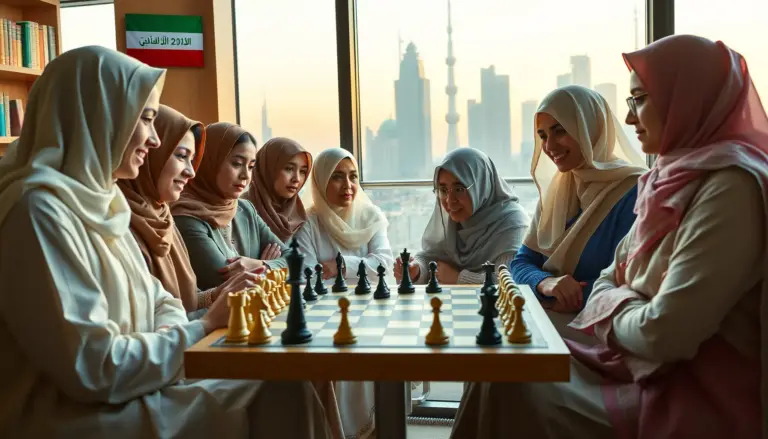
The chaturanga traveled west thanks to trade routes and Muslim conquests. Not Persia, the game became shatranj, where he acquired elements that still exist, like the term “jack dead” (from Persian shah mat, “the king is trapped”). The Persians not only adopted the game, but they enriched it with new rules and strategies, such as the possibility of the pawn becoming any piece upon reaching the opposite end of the board—a revolutionary concept that added layers of complexity.
However, It was in medieval Europe that chess underwent its most radical transformation.. The Arabs introduced it to the Iberian Peninsula during the 9th century, and from there it spread to the rest of the continent. But Europe did not limit itself to copying the shatranj; he adapted it to his own culture. The most significant piece of this change was the lady, who in the original shatranj was a weak advisor (he firz). In Europe, became the most powerful piece on the board, a reflection of the growing influence of figures such as Isabella the Catholic or Eleanor of Aquitaine. This change was not just aesthetic.: altered the dynamics of the game, accelerating its pace and increasing its strategic complexity.
The Christianization of chess in Europe also brought with it an interesting paradox. While the Church prohibited it in some periods because it was considered a game of chance or a sinful distraction., monks practiced it in monasteries as an intellectual exercise. This tension between the sacred and the profane was resolved over time, and chess ended up being accepted as a tool for moral education. Books like The Book of Games (1283), commissioned by Alfonso X the Wise, They presented it as a game that taught virtues such as prudence and justice.
To delve deeper into how chess rules evolved in this period, It is key to understand that each culture left its mark on the game, shaping what we know today as modern chess.
The queen and the bishop: pieces that changed the history of the game
If chaturanga was the skeleton of chess, two pieces in particular—the queen and the bishop—gave it its modern soul. The transformation of the queen into the most powerful piece on the board was not a minor change; It was a strategic revolution. In the chess, he firz could only move one square diagonally, which limited their influence. In Europe, Its evolution reflected broader social changes. During the 15th and 16th centuries, Figures such as Joan of Arc and Catherine de' Medici demonstrated that women could exercise political power, and chess was not immune to this transformation. The queen became a symbol of female ability to influence the game, and her new power on the board coincided with a period of greater visibility of women in the public sphere.
The bishop, for his part, It also had a fascinating metamorphosis. in the chaturanga, represented a war elephant, a fearsome piece but with limited movements. In Europe, became a bishop (bishop in Spanish, from Arabic al-fil, “the elephant”), reflecting the importance of the Church in medieval society. Its diagonal movement, which was previously limited to two boxes, spread to the entire board, which allowed greater fluidity in the games. This change not only made the game more dynamic, but also introduced new tactical possibilities, such as diagonal attacks and dunks.
These modifications were not mere technical adjustments; were cultural statements. The queen and the bishop not only changed chess, but they turned it into a reflection of the societies that adopted it. Hoy, when a player sacrifices his queen to win a game, is repeating—unknowingly—a gesture that has roots in Renaissance Europe, where female power began to challenge traditional structures.
Chess as a tool of power: from aristocratic salons to the Cold War
Chess has always been more than a game; has been a instrument of power. In the Middle Ages, Kings and nobles used it to demonstrate their intellect and their ability to govern.. In the Renaissance, became a symbol of cultural refinement, and figures like Leonardo da Vinci designed boards and pieces that were works of art in themselves. But it was in the 20th century when chess reached its peak as a geopolitical tool..
The rivalry between the USSR and the United States during the Cold War found a symbolic battlefield in chess. The Soviet Union dominated the game for decades, not by chance, but as part of a deliberate strategy to demonstrate the superiority of their system. Chess became a ideological weapon, and Soviet players were trained as elite athletes, with access to resources and state support. This hegemony was broken in 1972, when Bobby Fischer defeated Boris Spassky in the “Match of the Century”, an event that transcended sport and became a symbol of the fight between capitalism and communism.
But chess has also been a bridge between cultures. In 1978, The meeting between the Soviet Anatoli Karpov and the dissident Viktor Korchnoi—who had fled to the West—became a reflection of the political tensions of the time.. The games were not just movements on a board; They were coded messages between two worlds in conflict. Hoy, in a globalized context, chess remains a universal language, but also a field where battles are fought for cultural and technological influence, As demonstrated by the rise of artificial intelligence in chess.
The legacy of chess: a game that continues to evolve
Chess' journey from India to the modern world is a story of adaptation and resistance. Every culture that adopted it transformed it, adding layers of meaning and complexity. But the most notable thing is that, despite all these changes, chess has maintained its essence: It's still a game that challenges the mind, that teaches strategy and that, ultimately, reflects the human condition.
Hoy, chess faces new challenges. Artificial intelligence has redefined the boundaries of gaming, and platforms like Lichess o Chess.com they have democratized their access. But, at the same time, classic chess is still alive, as demonstrated by the games of Magnus Carlsen or the innovative strategies of players like Ding Liren. The game that started as a war simulation in ancient India is now a global phenomenon, a bridge between generations and cultures, and a reminder that, in an increasingly complex world, The ability to think strategically remains one of the most valuable skills.
Chess is not just a game; It's a legacy. And like any legacy, Its future depends on those who play it, study it and reinvent it. On a board 64 casillas, the history of humanity is written, one game at a time.
To reflect on the origin of chess is to remember that, behind every game, there are centuries of history, culture and conflict. But it is also an invitation to look forward.. In a world where technology advances by leaps and bounds, Chess reminds us that true intelligence does not lie in speed, but in the ability to anticipate, adapt and, above all, think. As the great teacher Savielly Tartakower said: “Chess is the art of analysis”. And in that analysis, we find not only the key to winning games, but also to understand the world.