chess, a strategy game, logic and patience, has been the scene of brilliant minds that, beyond his skills on the board, They have left an indelible mark due to their eccentricity. throughout history, Some players not only stood out for their tactical genius, but also by behaviors, customs and personalities that defied conventions. From obsessive geniuses to figures who mixed art with competition, These chess players showed that greatness in chess does not always follow a predictable path. His eccentricity, far from being a simple curious trait, was often linked to his creativity, his unique approach to the game and even his ability to revolutionize the way we understand chess. In this article, We will explore the lives and anecdotes of some of the most eccentric players who have left their mark on the history of the game. “science-game”.
Obsession as the engine of genius: the case of Bobby Fischer
Bobby Fischer it, definitely, one of the most iconic and controversial chess players in history. His eccentricity was not only manifested in his aggressive and perfectionist playing style., but also in his personal life, marked by an almost pathological obsession with chess. From childhood, Fischer demonstrated exceptional ability for the game, but also a difficult personality. To the 13 years, He already challenged consecrated masters, and to the 15 he became the youngest Grandmaster in history at that time, a record he held for decades.
However, His genius was accompanied by a series of behaviors that distanced him from the stereotype of the calm and reflective chess player.. Fischer was known for his outlandish demands: required absolute silence during games, He changed hotels constantly for fear of being spied on and, on one occasion, He even asked for the air conditioning to be turned off because the noise was distracting him.. His obsession with perfection led him to reject ties in positions that other players would have accepted without hesitation., always seeking absolute victory.
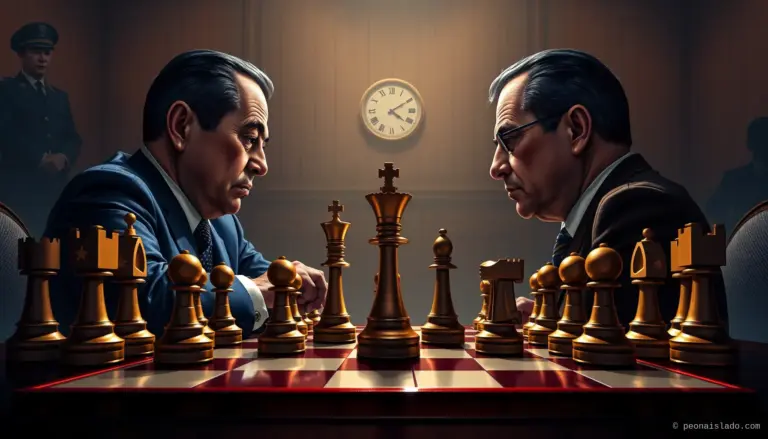
But where his eccentricity reached its peak was in his retirement from competitive chess after becoming World Champion in 1972. Fischer, who had dedicated his entire life to the game, disappeared from the public scene for years, only to reappear in 1992 in a controversial revenge match against Boris Spassky in Yugoslavia, violating international sanctions imposed on the country. This act not only cost him his reputation, but it led him to live as a fugitive for years. Fischer was not just a genius of ajedrez; He was a man whose obsession consumed him to the point of isolating him from the world.
Chess as art: the creative eccentricity of Marcel Duchamp
Marcel Duchamp is a central figure in modern art, known for works such as “The source” o “The big glass”. However, What many do not know is that Duchamp was also a passionate chess player., to the point of almost completely abandoning his artistic career to dedicate himself to gaming. His eccentricity did not lie in extravagant behavior, but in his ability to see chess as an art form in itself, an extension of your creativity.
Duchamp learned to play chess at 20 years and, in a short time, He became a master level player. In 1925, participated in the French Championship and, although he didn't win, His approach to the game was so original that it caught the attention of his contemporaries.. For Duchamp, chess was not just a mental sport, but a metaphor for life, a battle of ideas where creativity and strategy were intertwined. He even designed chess pieces and boards., fusing his passion for art with his love for the game.
His dedication to chess was such that, in 1933, decided to retire from the art world to focus on gaming. for years, He competed in international tournaments and was part of the French team in the Chess Olympics.. Duchamp did not see a contradiction between his artistic side and his passion for chess.; for him, both were expressions of the same intellectual quest. His eccentricity, in this case, lay in its ability to break down the barriers between disciplines, proving that chess could be as creative as any other art form.
Chess as a spectacle: the theatrical life of Mikhail Tal
Mikhail Tal, known as “The Wizard of Riga”, He is one of the most charismatic and eccentric chess players in history. His playing style, based on spectacular sacrifices and risky combinations, made him an idol for chess fans. But beyond his talent on the board, Such was a theatrical character, a showman who understood chess as a spectacle as much as a mental sport.
Tal not only played chess; I lived it with an almost dramatic intensity. During the games, I smoked non-stop, drank coffee in industrial quantities and, on more than one occasion, he was seen drinking vodka during tournaments. His eccentricity was not limited to his lifestyle: on the board, It was unpredictable. He often sacrificed pieces without apparent justification, trusting in his intuition and his ability to destabilize his rivals. This strategy, although risky, earned him the title of World Champion in 1960, when he defeated Mikhail Botvinnik in a match full of emotions.
But Tal was not just a player; he was a showman. On one occasion, during a tournament in Moscow, He showed up at the gaming room in a fur coat and a top hat., as if he were about to go on stage. In another game, He was seen walking around the board while his rival thought, as if he were conducting an invisible orchestra. His eccentricity, however, It was not a simple whim: It was an extension of his creative personality and his desire to make chess more than just a game.. For Such, every game was a play, and he was the protagonist.
Chess as philosophy: The ascetic life of Emanuel Lasker
Emanuel Lasker, World Chess Champion 27 years (1894-1921), He is a unique figure in the history of the game. Not only was he an exceptional player, but also a philosopher, mathematician and writer. His eccentricity did not lie in striking behaviors, but in his intellectual approach to chess, whom he considered a metaphor for life and a tool to understand human psychology.
Lasker was born in 1868 in Prussia and, since young, demonstrated a brilliant mind. He studied mathematics and philosophy, and his approach to chess was deeply influenced by these disciplines. for him, the game was not just a battle of movements, but a psychological duel where the understanding of the rival was as important as the strategy on the board. Lasker was known for adapting his playing style to that of his opponent, looking not only to win, but also understand the motivations and weaknesses of the person in front of him..
His eccentricity also manifested itself in his personal life.. Lasker was a man of simple habits, almost ascetic. He lived modestly, despite his successes, and he dedicated much of his time to reading and writing.. In 1907, published a book titled “Lucha”, where he explored the nature of conflict and competition, applying chess principles to everyday life. For Lasker, chess was not just a game; It was a way of understanding the world..
His reign as World Champion was the longest in history, and his legacy goes beyond his victories. Lasker showed that chess could be a tool for philosophical reflection, and his eccentricity lay in his ability to see the game as more than just a competition.. for him, Each game was an opportunity to explore the human mind and, ultimately, to understand yourself.
Eccentricity as a legacy: genius or madness?
The most eccentric chess players in history share a common trait: your ability to see the game in a unique way, away from conventions. Fischer, Duchamp, Tal and Lasker not only stood out for their talent, but for his way of living chess, each one in their own way. Fischer turned it into an obsession that consumed him; Duchamp transformed it into an art form; He lived it like a spectacle, and Lasker understood it as a philosophy of life.
But, Was his eccentricity a symptom of genius or madness? The answer, probably, It's somewhere in between.. What is clear is that their unique approach to chess not only made them stand out in the game, but also left an indelible mark on the history of chess. His legacy reminds us that “science-game” It's not just a battle of movements, but also an expression of personality, creativity and, in some cases, the eccentricity of those who play it.
In a world where chess has become increasingly technical and analytical, These players invite us to remember that, in its essence, chess is still a human game. A game where genius and eccentricity often go hand in hand, and where true greatness doesn't always follow a predictable path. Maybe, in the end, eccentricity is nothing more than another form of genius, a way of seeing the world from a unique perspective, In the case of these players, to revolutionize chess forever.