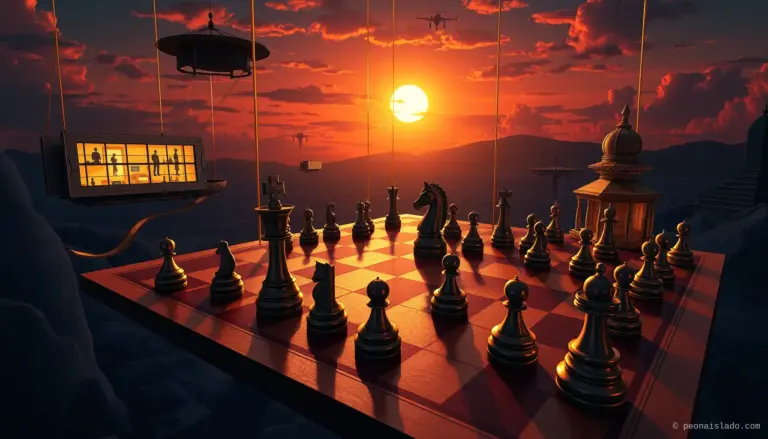
In the heights of the Bolivian Andes, where the air becomes thinner and breathing becomes a challenge, a unique event in the world rises: the highest chess tournament on the planet. Located in the city of El Alto, to more than 4,000 meters above sea level, This competition not only tests the strategy and minds of the players, but also its physical resistance in extreme conditions. More than a sports competition, This tournament is a symbol of the passion for chess in Bolivia, a country where “science game” transcends social and geographical boundaries. Through this article, We will explore how this event has become a cultural phenomenon, the challenges participants face and the impact it has on the local community. From adapting to altitude to organizing a tournament that attracts international players, we will find out why “Chess a 4,000 metros” It is much more than a simple championship.
The High: a unique setting for chess
The High, one of the highest cities in the world, It is not just a place of passage to La Paz, but a cultural and sports epicenter with its own identity. With a majority indigenous and Aymara population, This city has known how to merge ancient traditions with modern activities, like chess. extreme altitude, which ranges between 4,000 y 4,150 meters above sea level, turns any physical or mental activity into an additional challenge. However, far from being an obstacle, This feature has become a hallmark of the tournament.
The choice of El Alto as headquarters is not coincidental. The city is home to a vibrant chess community, with local clubs that promote the game from an early age. Besides, its cold and dry climate, typical of the Andean region, creates an ideal environment for concentration, although it requires prior adaptation for visitors. The tournament organizers have been able to take advantage of this context, designing an event that not only rewards tactical skill, but also the players' ability to manage the physiological stress that comes with competing in these conditions..
Another key aspect is infrastructure. Although El Alto does not have the luxuries of other international venues, its people have demonstrated an exceptional ability to improvise and adapt. Tournaments are usually held in public spaces, such as squares or cultural centers, which brings chess closer to the population and encourages its massive practice. This accessibility has been essential for the event to grow year after year, attracting not only Bolivian players, but also to competitors from neighboring countries like Peru, Argentina and Chile.
The physical and mental challenges of playing 4,000 metros
Compete in chess over 4,000 meters of altitude is not comparable to doing it at sea level. The human body faces a series of physiological challenges that can affect the performance of players., even in a sport that does not require intense physical effort. The main problem is the hypoxia, o lack of oxygen, that causes fatigue, dizziness and, in extreme cases, altitude sickness. For chess players, This translates into greater difficulty maintaining concentration during long games, especially in tournaments that can last several hours.
The local players, accustomed to living in these conditions, They have a clear advantage. Your body has developed natural adaptations, such as increased lung capacity and increased red blood cell production. However, for foreign competitors, adaptation can be a slow and painful process. Many arrive days before the tournament to acclimatize, but even so, some suffer symptoms such as headaches, nausea or insomnia. These discomforts not only affect your performance, but they can also influence your emotional state, generating anxiety or frustration.
Beyond the physical, High-altitude chess requires exceptional mental preparation. Altitude can alter the perception of time, making players feel that games are developing more slowly than usual. Besides, The psychological pressure of competing in an unknown and hostile environment can lead to tactical errors or hasty decision-making. Some participants resort to breathing or meditation techniques to counteract these effects., while others opt for supplements such as coca tea, a traditional Andean infusion that helps relieve the symptoms of altitude sickness.
An emblematic case is that of the Peruvian grandmaster Jorge Cori, who participated in an edition of the tournament and described the experience as “a battle against oneself”. Cori, accustomed to competing in cities like Lima or Buenos Aires, He admitted that the altitude worked against him in the first rounds, but he managed to adapt thanks to a strategy of constant hydration and prolonged rest. His testimony reflects the reality of many players who, despite the obstacles, They find in this tournament an opportunity to demonstrate their resilience.
The cultural and social impact of the tournament
The El Alto chess tournament is not just a sports competition, but a phenomenon that transcends the playful to become a symbol of identity and resistance. In a region where chess has not always had the same recognition as other sports, This event has managed to position it as an accessible and high-level discipline. Its impact is reflected in three key areas: social inclusion, promoting chess in rural areas and strengthening local self-esteem.
First of all, The tournament has served as a platform to make players from vulnerable sectors visible. Many participants come from humble families who, thanks to scholarships or support from local clubs, They have been able to develop their talent. The case of Maria Shock, a young chess player of Aymara origin who represented Bolivia in international competitions, It is an example of how this sport can open doors. María, who learned to play in a community club in El Alto, She has stated that the tournament gave her the confidence to dream of being a grandmaster. Stories like yours show that chess can be a tool for social mobility in a country with deep inequalities..
In second place, The event has promoted the practice of chess in rural and peri-urban areas. Unlike other competitions that are concentrated in big cities, This tournament has brought the game to communities where it was previously almost unknown. Organizations like the Bolivian Chess Federation have implemented training programs in schools in El Alto and other regions, using the tournament as inspiration. These efforts have borne fruit: in recent years, The number of federated players in Bolivia has increased by 30%, according to federation data.
Finally, The tournament has contributed to changing the world's perception of Bolivia. In a country often associated with poverty or political instability, he “Chess a 4,000 metros” shows a different facet: that of an innovative nation, capable of organizing world-class events in extreme conditions. Media like BBC Mundo y The Country they have covered the tournament, highlighting its originality and the spirit of improvement of its participants. This media exposure not only attracts more foreign players, but also generates a sense of pride in the local population, who sees in chess a way to project their culture to the world.
The future of chess in the heights
The success of the El Alto tournament has opened a debate about the future of chess in Bolivia and other high-altitude regions. Could this model be replicated in other Andean countries? What innovations could be implemented to improve the player experience? These questions are key to understanding where this event is headed and how it can continue to grow without losing its essence..
One of the main opportunities is expansion to other Bolivian cities. Cities like Potosí (a 4,090 metros) u Oruro (a 3,706 metros) They have already shown interest in hosting editions of the tournament. This would not only diversify the venues, but would also allow more local players to participate without having to travel long distances. Besides, The rotation of venues could help decentralize chess in Bolivia, preventing it from concentrating only in La Paz or Santa Cruz.
Another aspect to consider is the professionalization of the event.. Although the tournament has gained international recognition, still faces logistical challenges, such as the lack of stable sponsors or the shortage of certified referees. To attract more elite players, Organizers could seek alliances with international federations or private companies. An example to follow is the Gibraltar Chess Tournament, that combines high-level competition with a festive and tourist atmosphere. If El Alto managed to replicate this model, could become a must-see destination for chess lovers.
Finally, the tournament has the potential to become a scientific research laboratory. Extreme altitude offers a unique opportunity to study how the human body and mind adapt to adverse conditions. Bolivian and foreign universities could collaborate with the organizers to analyze data on player performance, the effectiveness of different acclimatization methods or the psychological impact of competing at altitude. These studies would not only benefit chess, but they could also provide valuable knowledge for other sports or activities that take place in similar conditions..
However, The biggest challenge will be maintaining the community spirit that has characterized the tournament since its inception.. In a world where professional chess tends to become elitist, El Alto has shown that it is possible to organize a high-level event without losing sight of its social dimension. The challenge for the coming years will be to balance growth with inclusion, ensuring that the tournament remains a space where players of all backgrounds can compete on equal terms.
Conclusions: more than a tournament, a legacy
The El Alto chess tournament is much more than a sports competition: It is a testament to the human ability to adapt, innovate and overcome limits. A 4,000 meters above sea level, where the air is scarce and the body resists, hundreds of players prove every year that the mind can triumph over adversity. This event has achieved something extraordinary: turn a geographic challenge into a competitive advantage, drawing the world's attention to a discipline that, in Bolivia, has found an unexpected home.
Throughout this article, We have explored how El Alto has become a unique setting for chess, the physical and mental obstacles faced by participants, the cultural and social impact of the tournament, and the possibilities that open up for your future. Each of these aspects reveals a fundamental truth: he “Chess a 4,000 metros” It is not just a Guinness record or a geographical curiosity, but a symbol of resilience, inclusion and passion for the game.
For Bolivia, This tournament represents an opportunity to redefine your image in the world. Instead of being seen only as a country of impressive landscapes or social conflicts, now it is also associated with innovation and sport. For the players, It is a litmus test that allows them to measure their mettle and their ability to face the unknown.. And for the local community, It is a source of inspiration that shows that, even in the most difficult conditions, it is possible to achieve greatness.
The legacy of this tournament transcends the games and the trophies. He has inspired a new generation of Bolivian chess players, It has brought the game closer to sectors that previously saw it as unattainable and has put El Alto on the world chess map.. While the world continues to marvel at the idea of competing at heights, Bolivia is already writing its own history, one in which chess knows no geographical or social limits. The challenge now is to ensure that this legacy endures., grow and continue to be a beacon of hope for those who believe that, with strategy and determination, any goal is possible.