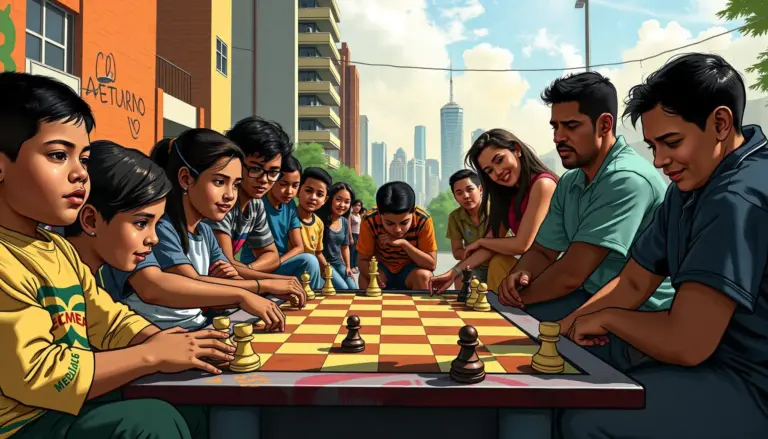
In a world where technology advances by leaps and bounds and education seeks to adapt to the demands of the 21st century, Chess emerges as a revolutionary pedagogical tool. Far from being a simple board game, This ancient mental sport has become a key ally to develop cognitive skills, emotional and social in students. Schools around the world, from Finland to Singapore, They are integrating chess into their educational programs, not as an extracurricular activity, but as an essential part of the curriculum. What makes this game, with more than 1500 years of history, be so relevant in the training of new generations? In this article, We will explore how chess is transforming classrooms, the scientific benefits that support its implementation and the challenges that educational systems face when adopting it. Besides, We will analyze success stories and the future of this discipline in modern education.
Chess as a pedagogical tool: more than a game
Chess is not just a hobby; It is a miniature learning laboratory. Neuroscientific studies, such as those carried out by the Institute of Education of the University of London, have shown that playing chess activates areas of the brain related to memory, logical reasoning and decision making. For example, a research published in *Frontiers in Psychology* (2019) revealed that children who play chess regularly improve their ability to concentrate in a 50% compared to those who do not. This is because the game requires anticipating movements, evaluate consequences and adapt to changing situations, skills directly transferable to mathematics, problem solving and even programming.
But its impact goes beyond the cognitive.. Chess encourages patience, the perseverance and the emotional management. In a study carried out in New York schools, It was observed that students who participated in chess tournaments showed a reduction in 30% in impulsive behaviors, thanks to the fact that the game teaches them to think before acting. Besides, being an individual activity but with a social component (since it is played against an opponent), promotes respect for rules and empathy, by understanding that each move affects the other player.
In countries like Spain, where chess is a mandatory subject in some autonomous communities, the results are tangible. According to data from the Ministry of Education, Students who receive chess classes improve their math grades by an average of 15%, and in reading comprehension, and 12%. This is explained because chess not only exercises the brain, but also teaches to structure thought in an orderly manner, a key skill for any area of knowledge.
From Finland to Singapore: educational models that bet on chess
The adoption of chess in schools is not uniform; varies according to the educational culture of each country. However, Some models stand out for their innovative approach and proven results.
Finland: chess as part of “playful learning”
Not Finland, a country recognized for its cutting-edge educational system, Chess is integrated from primary education as a tool for game based learning. Here, It's not about memorizing openings or tactics., but to use chess to teach abstract concepts. For example, in some schools, Students solve geometry problems by moving pieces on a board or learn history by reenacting famous battles. A report from the University of Helsinki (2021) points out that this approach has improved student motivation in a 40%, especially in those with learning difficulties, since the game reduces the anxiety associated with traditional evaluations.
Singapore: chess and critical thinking in the digital age
Singapore, leader in global educational rankings, has incorporated chess as part of its program Critical Thinking Skills. The government invested more than 2 millions of dollars in 2020 to train teachers and develop teaching materials. The goal is not to create champions, but citizens capable of analyzing information in a world saturated with data. According to the Singapore Ministry of Education, students participating in chess programs show a 25% more ability to identify bias in fake news, a crucial skill in the age of misinformation.
USA: chess as a tool for social inclusion
In cities like Chicago or Los Angeles, Chess has become a bridge to reduce the educational gap. Organizations like Chess in the Schools They work in marginal neighborhoods, where gaming not only improves academic performance, but also keeps young people away from violence. A study from the University of Chicago (2018) found that students who participated in chess clubs had a 20% less likely to drop out of school. Besides, Chess is used as therapy in programs for young people with autism spectrum disorder (TEA), as it helps them develop social skills in a structured environment.
These models show that chess is not a passing fad, but an educational strategy with solid foundations. However, its implementation is not without challenges.
Challenges and resistance: why don't all schools adopt chess?
Despite its benefits, The integration of chess in schools faces obstacles ranging from logistical to cultural.
1. Lack of teacher training
One of the biggest challenges is teacher training. Many educators do not know how to play chess or do not know how to link it with other subjects. In Spain, For example, only the 18% of primary school teachers have received specific training in educational chess, according to a report from the Spanish Chess Federation (2022). This leads to, in many cases, Chess is taught as a recreational activity without clear pedagogical objectives.
2. Resistance to change in curricula
Educational systems are often rigid, and adding a new subject implies restructuring schedules, evaluations and resources. In countries like Mexico, where chess is optional in some schools, Its impact is limited because it competes with other extracurricular activities. Besides, There is skepticism among some parents and administrators, who see chess as a “game” and not as a learning tool.
3. Technological gap and unequal access
Although chess is an accessible game, Your teaching requires materials (boards, parts, books) that not all schools can afford. In rural areas of Latin America or Africa, where resources are scarce, implementation is almost impossible without external support. However, initiatives such as Chess for Schools of FIDE (International Chess Federation) They are working to donate materials and train teachers in vulnerable communities.
4. Results evaluation
Measuring the impact of chess on learning is not easy. Unlike mathematics or language, where results are evaluated with standardized tests, the benefits of chess (such as improvement in critical thinking or creativity) are difficult to quantify. This makes some governments hesitate to invest in long-term programs.
Despite these challenges, chess continues to gain ground, thanks to scientific evidence and success stories that inspire other educational systems.
The future of chess in the classroom: technology, artificial intelligence and new methodologies
Chess not only adapts to the schools of the future, but also evolves with them. Technology is transforming the way this game is taught and learned, opening up possibilities that were previously unthinkable.
Digital platforms and gamification
Tools like Chess.com, Lichess o ChessKid They are revolutionizing chess teaching. These platforms not only allow you to play online, but they also offer interactive lessons, analysis of games and exercises adapted to the level of each student. In Sweden, For example, he 70% of primary schools use ChessKid as part of your chess program, combining traditional gaming with gamification. Children earn points, Unlock levels and compete in virtual tournaments, which increases your motivation.
Artificial intelligence and personalized learning
artificial intelligence (IA) is taking chess to another level. Programs like AlphaZero (developed by DeepMind) not only do they play better than humans, They can also analyze games and provide instant feedback. In some schools in China, AI systems are being tested that adapt chess lessons to the pace of each student, identifying your weaknesses and proposing specific exercises. This is especially useful in classrooms with a variety of levels., where a teacher cannot always serve everyone equally.
Virtual reality and immersive chess
virtual reality (RV) is beginning to be used to teach chess in an immersive way. In pilot projects in the United States, students use VR glasses to “to enter” on a giant board and move the pieces with your own hands. This experience not only makes learning more fun, but also helps visualize abstract concepts, as the control strategy of the center of the board. Although it is still an expensive technology, It is expected that in the coming years it will become more accessible.
Chess as a bridge to STEM
In a world where careers in science, technology, engineering and mathematics (STEM) are increasingly in demand, chess is positioning itself as a gateway. And Israel, For example, Programs have been developed that use chess to teach basic programming algorithms. Students learn to “program” moves on the board, which helps them understand the logic behind code languages. This approach not only makes chess more relevant to new generations, but also prepares students for the professions of the future.
chess, therefore, It's not just a game from the past, but a key tool for the present and future of education. Its ability to adapt to new technologies and methodologies makes it an indispensable ally in the training of critical and creative minds..
In an increasingly complex world, where the ability to analyze information, making decisions and adapting to change are essential skills, Chess is presented as an accessible and effective pedagogical solution. Throughout this article, We have seen how this ancient game not only improves academic performance, but also develops social-emotional skills, encourages inclusion and prepares students for the challenges of the 21st century. From the educational models of Finland and Singapore to inclusion initiatives in the United States, chess is showing that its value goes beyond the four corners of a board.
However, its implementation is not without challenges. Lack of teacher training, resistance to change in curricula and the technological gap are obstacles that must be overcome so that chess reaches all classrooms. But, as we have seen, Technology and new methodologies are paving the way, making this game more accessible and relevant than ever.
The future of chess in education is promising. With the support of artificial intelligence, virtual reality and digital platforms, This game is evolving to adapt to the needs of new generations. It's not just about training better players., but to train better thinkers, more critical, creative and resilient. In a world where education must prepare us for the unknown, Chess is a compass that guides us towards meaningful learning. The schools of the future are already here, and chess is one of its key pieces.