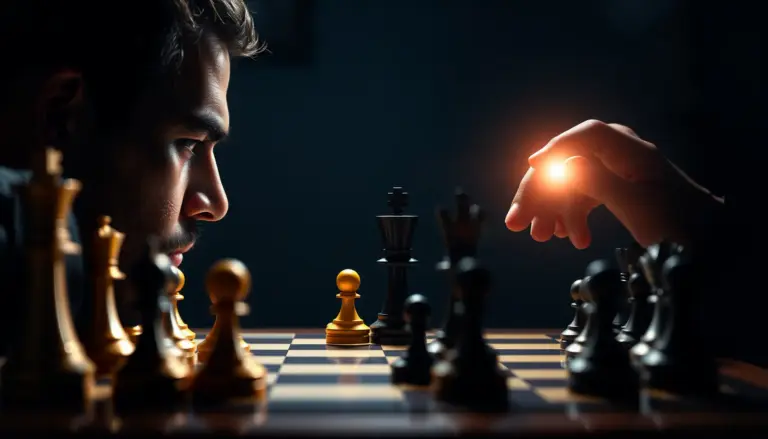
chess, that ancient game that combines strategy, intelligence and psychology, It has been the scene of some of the most fascinating—and sometimes absurd—moments in history.. From games that defied the laws of logic to anecdotes that border on the surreal, the board has witnessed feats that transcend the simple movement of pieces. What leads a great master to sacrifice his queen in a gesture of genius? Or a player losing a game for a mistake so ridiculous it seems straight out of a comedy?? Beyond tournaments and theoretical openings, chess keeps stories that mix drama, humor and even a touch of madness.
In this article, We will explore eight of those moments that marked a before and after in the game, either for its brilliance, its rarity or its impact on chess culture. From the “Game of the Century” until the day a player abandoned a game because his opponent smelled bad, Each episode reveals an unexpected facet of this mental sport. Get ready to discover how chess, in its apparent solemnity, has been able to generate some of the most epic—and strange—situations in history.
He “Game of the Century”: when a child of 13 years humiliated a great teacher
He 17 October 1956, at the New York Tournament, a teenager named Bobby Fischer —who had only been playing chess competitively for three years— faced the grandmaster Donald Byrne, one of the strongest players in the United States at that time. What happened in that game not only amazed the chess world, but it became a historical milestone: Fischer, with only 13 years, executed a combination so brilliant that experts dubbed it the “Game of the Century”.
The game began with a seemingly innocuous opening, the Defensa Grünfeld, pero Fischer, playing with black, he sacrificed his lady in the movement 17. It wasn't a mistake, but a masterful calculation: in the following movements, He coordinated his pieces with surgical precision, leaving Byrne with no options. The key play came in the movement 23, when Fischer sacrificed his bishop to open a decisive file. Byrne, stunned, could not avoid defeat, and the game ended with an inevitable mate in the move 41.
The most shocking thing was not just the victory, sino the way Fischer did it. At that age, most players still struggle to understand advanced strategy concepts, but he demonstrated a deep understanding of the dynamics of the board, something that usually develops after decades of experience. He “Game of the Century” not only catapulted Fischer to fame, but also redefined what was considered possible in chess. Many analysts, like the great teacher Garry Kasparov, have pointed out that this game was a harbinger of the aggressive and creative style that would characterize Fischer in his career..
But beyond its technical value, this moment encapsulates the magic of chess: a game where age, Experience and even reputation can be swept away by a flash of genius. Fischer not only won; taught the world that chess has no limits.
The game that lasted 20 hours (and ended in a draw due to exhaustion)
If chess is a mental battle, the game between Ivan Nikolić y Goran Arsovic in the Yugoslavian Championship 1989 took that concept to the extreme. What began as just another duel in the tournament became an unprecedented test of physical and psychological endurance.: 269 movements in 20 hours and 15 minutes, a Guinness record that still stands today.
The game took place in the final phase of the tournament, when both players were already accumulating fatigue from days of competition. Nikolic, with white, opted for a solid opening, the French Defense, looking for a positional game. However, Arsović responded with unwavering tenacity, defending each position with millimeter precision. What seemed like a technical tie dragged on for hours, with both players repeating movements in an attempt to wear down the opponent. At a given moment, The game reached a stalemate in which neither side could force a victory without risking losing..
The real drama, however, was not on the board, but in the conditions in which it was played. The referees, concerned about player burnout, They tried to mediate so that they would accept a tie, but they both refused, obsessed with the idea that the other would make a mistake. The game room, usually silent, was filled with murmurs among the spectators, some of whom left the place to return hours later and find the two players still in the same position. Even the organizers considered suspending the game for health reasons., but the tournament rules prevented it.
Finally, after more than 20 hours of tension, the players agreed to a draw on the move 269. But the true legacy of this game was not the record, sino the reflection it generated on the limits of competitive chess. To what extent is it worth prolonging a battle that no longer makes strategic sense?? Is exhaustion a legitimate part of the game, or should there be limits to protect the players? This game, more than a curiosity, became a symbol of human obsession with victory, even when the cost is one's own health.
The day a player quit because his rival smelled bad
In 2008, during the Norwegian Chess Championship, the great teacher Magnus Carlsen —which then had only 17 years—he faced his rival, the also great teacher Simon Agdestein. What should have been just another game in the career of the future world champion became one of the most surreal anecdotes of modern chess.. Carlsen, upset by his opponent's body odor, abandoned the game on the move 33, claiming he couldn't concentrate.
The incident sparked immediate debate.: Was it valid for a player to leave for a reason apparently unrelated to the game?? The referees, after deliberating, They decided that Carlsen had violated the rules by not completing the game, and they gave the victory to Agdestein for walkover. However, The case transcended the sports field. Some critics argued that Carlsen had acted in an unsportsmanlike manner., while others defended that chess is a mental game that requires absolute concentration, and that any distraction—even an unpleasant smell—could be a determining factor.
The most ironic thing about the case is that Carlsen was already known for his sensitivity to external stimuli. In later interviews, admitted that the noises, lights and even smells could affect its performance. This particularity, far from being a weakness, became part of his legend: the player who not only dominated the board, but also its environment. However, The episode also highlighted a recurring problem in high-level chess: the lack of protocols for unconventional situations.
Should a player have the right to request a change of conditions if something distracts him? Or chess, as a mental sport, requires participants to adapt to any circumstance? The Carlsen-Agdestein case did not have a clear answer, but it left an uncomfortable question: How far can the demands go in a game where the mind is everything??.
The match that almost caused a war: Fischer vs. Spassky, 1972
He World Chess Championship 1972, held in Reykjavik, Iceland, It was much more than a duel between two great masters: was a geopolitical spectacle in the middle of the cold war. On the one hand, Boris Spassky, the soviet champion, representative of a system that saw chess as a propaganda tool. On the other, Bobby Fischer, the american genius, an obsessive man, paranoid and brilliant, who came to the match with a list of demands so absurd that it almost made him cancel.
Fischer, who had not played an official tournament in more than a year, He arrived in Iceland with a defiant attitude. He demanded that the television cameras be removed (why, according to him, They emitted radiation that affected their concentration), that the game table be changed (because he didn't like the color), and even increased the prize by one 50%. The organizers, desperate to avoid a fiasco, They gave in to almost all their demands. But the real drama began when Fischer lost the first game in a humiliating way: a blunder at the opening left him in a lost position. Furious, accused the Soviets of cheating and threatened to leave the tournament.
What followed was a series of diplomatic negotiations involving the US Secretary of State, Henry Kissinger, who personally called Fischer to convince him to continue. “America needs you”, told him. Fischer, finally, agreed, but with one condition: that the second game would be played in a private room, without public or cameras. Spassky, in a gesture of sportsmanship (or perhaps psychological strategy), accepted. The result was historic: Fischer won the second game with a brilliant combination, and from there, The match took an unexpected turn.
Fischer not only won the championship, but broke Soviet dominance in chess, something that was considered impossible. His victory was celebrated in the United States as an ideological triumph., while in the USSR it was seen as a humiliation. But beyond politics, The Fischer-Spassky match showed something deeper: Chess can be a battlefield where not only two minds confront each other., but two visions of the world. And in this case, Fischer's genius was so overwhelming that even the Soviet propaganda machine could not contain it..
The most expensive mistake in history: when a grandmaster lost by a “checkmate in 1”
In it Linares Chess Tournament 1993, one of the most prestigious in the world, the great teacher Veselin Topalov —who years later would become world champion—made a mistake so basic that it is still studied today in chess schools as an example of what never must be done. In a game against the also grandmaster Judit Polgár, the best player in history, Topalov had a clearly superior position. However, in inexplicable carelessness, did not see a checkmate in a move and lost the game.
The error occurred in the movement 36. Topalov, with white, had an active rook and bishop, while Polgár, with black, defended a precarious position. Instead of continuing your advantage, Topalov moved his rook to a square that allowed Polgár to checkmate with his queen on the next move.. The board looked like this:
- Topalov (white): Rook on e8.
- Citizen (black): Lady in h3.
With a simple Dh3-h1++, Polgár finished the game. Topalov, unbeliever, He looked at the board for several seconds before shaking his rival's hand.. The most surprising thing was not the error itself, sino the context in which it occurred: an elite tournament, where players are used to calculating complex variants with millimeter precision. How could a grandmaster of his level overlook something so elementary??
Analysts have offered several theories. Some suggest that Topalov, in his desire to win, overloaded his mind with too complex variants, losing sight of the obvious. Others point to fatigue: The Linares tournament is known for its physical demands, and the players usually reach the end of the competition with their nerves destroyed. But perhaps the most plausible explanation is that chess, even at its highest level, it's still a human game, and humans make mistakes.
This episode serves as a reminder that, even though technology and preparation have evolved, Chess is still a duel between two minds, and in that duel, the pressure, Tiredness and even arrogance can work against you.. Topalov learned his lesson the hard way: in chess, a second of carelessness can cost a game, a tournament and even a race.
Conclusions: when chess transcends the board
chess, in its essence, It is a game of simple rules but infinite possibilities. However, as we have seen throughout these eight moments, His true greatness does not lie only in strategy or technique, but in the human stories that are woven around the board. From the precocious genius of Bobby Fischer to the extreme exhaustion of a game of 20 hours, going through errors that seem straight out of a nightmare and anecdotes that border on the absurd, chess has proven to be a reflection of the human condition: bright, fragile, obsessive and, sometimes, irrational.
These episodes teach us that chess is not just a mental sport, but also a mirror of our contradictions. How to explain that a player like Fischer, capable of calculating variants with superhuman precision, He was also a man tormented by paranoia? Or that a great teacher like Topalov, trained to see the invisible, I could overlook the most obvious? The answer is that chess, like life, it's not perfect. It is full of moments of glory and resounding failures., of sporting gestures and attitudes that defy common sense.
Beyond records and memorable games, What really endures from these moments is their ability to connect with something universal. All, at some point, we have felt the frustration of an avoidable mistake, the euphoria of an unexpected victory or the discomfort of a rival who, accidentally, It throws us off our game.. chess, in that sense, It's a microcosm of life: a space where intelligence and emotion collide, where logic and chaos intertwine, and where, in the end, what remains is not just the pieces on the board, but the stories we tell about them.
So the next time you watch a chess game, remember: behind every movement there is a story. Some will be epic, other strange ones, but they will all have something in common: They will remind us that, in the end, chess is not played only with the mind, but also with the heart.