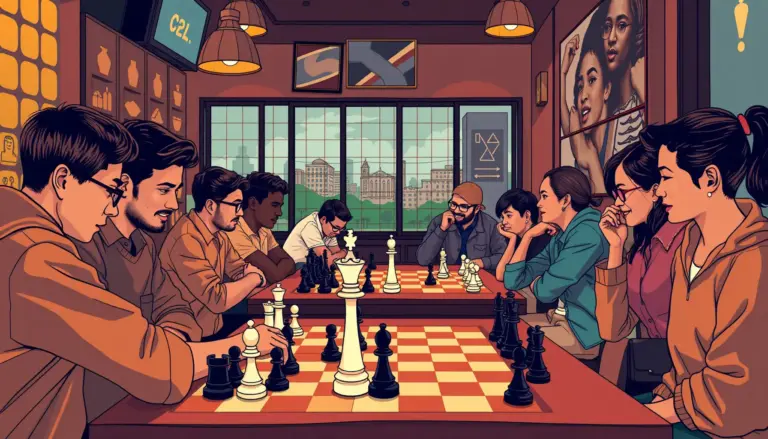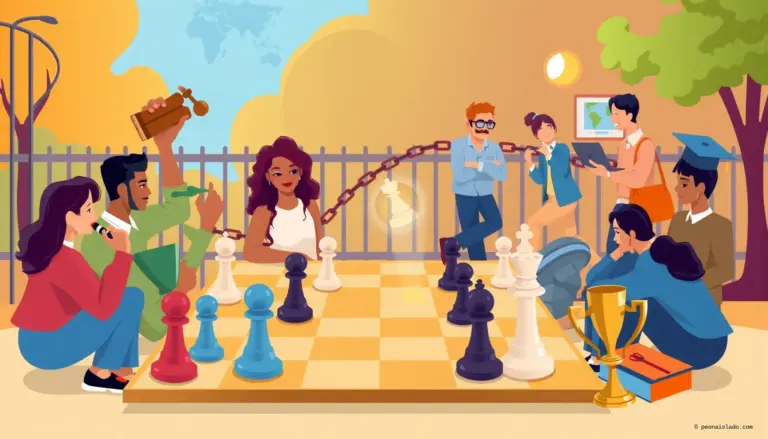
In a continent where political borders are blurred by the urgency of integration, chess emerges as a silent but eloquent language. It's not just a strategy game, but of a cultural bridge that transcends languages, creeds and passports. Europa, with its diversity of more than 200 languages and a history marked by migrations, found on the board 64 boxes an unexpected tool to weave networks of belonging. How an ancient game, Born in the Persian courts and perfected in the Viennese cafes, can become a key ally for those seeking to rebuild their lives in foreign lands? The answer lies in your ability to transform isolation into connection., uncertainty in planning, and the difference on common ground.
The board as neutral territory: when the pieces do not know flags
Migration in Europe is not a new phenomenon, but its current scale—with more than 82 millions of people displaced in 2023, according to UNHCR—demands innovative solutions. chess, with its universal structure, acts as a safe space where the rules are clear and the hierarchies, ephemera. In cities like Berlin, Paris or Barcelona, clubs and associations have implemented specific programs for migrants, using play as a social catalyst. A paradigmatic example is the project “Chess for Refugees”, that operates in more than 15 european countries. Its success lies in a simple principle: board levels. A Syrian engineer and a Ukrainian farmer, sitting face to face, compete under the same rules, without the need to share a language. This symbolic equality is the first step to breaking the ice of mistrust.
But chess goes beyond mere interaction.. Studies such as the one carried out by Lund University (Sweden) in 2022 showed that migrants who participated in chess workshops improved their decision making in contexts of uncertainty, a critical skill for navigating bureaucratic paperwork or searching for employment. The game, with its demand to anticipate consequences, trains the mind to evaluate risks and opportunities, something invaluable in an environment where every choice can make the difference between integration and failure.
From individual resilience to community cohesion
Integration is not a one-way process; requires both migrants and host societies to adapt. Here, chess displays its second power: the one of build community. In cities like Malmö (Sweden), where the 32% of the population is of foreign origin, Inter-neighborhood tournaments have served to create ties between neighbors who, otherwise, they would remain isolated. The case of “Malmö Chess Open”, a tournament that mixes street chess with cultural activities, illustrates how gambling can become a political act. During the event, the participants not only compete, but they share stories, recipes and traditions, transforming the board into a microcosm of multicultural Europe.
This dynamic is not exclusive to Sweden. In Spain, the program “Chess without Borders” has taken the game to shelters and schools with a high migrant population. The results are revealing: Moroccan and Spanish children who did not interact before now collaborate in mixed teams, while adults of different nationalities organize games in public parks. chess, in this context, acts as a inclusion ritual, where victory is not the ultimate goal, but the participation itself.
Chess as a pedagogical tool: teach more than movements
Education is the pillar of any integration process, but how do you teach someone who has left his country behind, your language and, in many cases, your emotional stability? Chess offers an answer: through the experiential learning. In Germany, the project “Chess sets a precedent” (Chess makes school) has integrated the game into the curriculum of schools with high cultural diversity. Teachers use the board to teach mathematics, logic and even history, linking classical openings with the migratory movements that have shaped Europe. For example, the Sicilian Defense, an aggressive opening that seeks to control the center from the flanks, is compared with the adaptation strategies of migrants who, no initial resources, They must find niches in the host society.
But the most profound impact is seen in the development of soft skills. A study from the University of Barcelona (2021) revealed that migrant children who participated in chess workshops showed a 40% less anxiety in new situations and a 25% more empathy towards their colleagues. The game, with its combination of competition and collaboration, teaches that mistakes are not failures, but opportunities to improve. This mindset is crucial for those facing the challenge of rebuilding their lives in an unfamiliar environment..
The challenge of climbing: when social strategy surpasses the board
Although the benefits of chess in integration are evident, its large-scale implementation faces obstacles. The main one is the lack of resources. Many programs depend on volunteers and donations, which limits its scope. In Italy, For example, the project “Chess for Integration” had to temporarily suspend its activities due to lack of funds, despite having benefited more than 5,000 migrants in three years. The solution, according to experts such as psychologist Vladimir Rašković—a pioneer in therapeutic chess—, involves greater collaboration between governments, NGOs and chess federations.
Another challenge is the cultural perception. In some Eastern European countries, where chess has historical roots as an elite tool, there is resistance to associating it with social integration. However, initiatives like the one in Poland, where chess is taught in migrant detention centers, They show that the game can be adapted to any context. The key is to present it not as a recreational activity, but as a empowerment tool.
The future: a checkmate to exclusion
Europe faces a crossroads: either builds inclusive societies or fragments under the weight of mistrust. chess, with its ability to unite the individual and the collective, offers a middle way. It is not about idealizing the game - as the article warns “Chess myths”—, but to recognize their potential as social transformation tool. On a continent where differences are often perceived as threats, the board 64 boxes remember that, in the end, We are all pieces in a bigger game..
Integration is not a destination, but a process. and on that path, chess can be the silent companion that, without asking for anything in return, teaches that even in defeat there are lessons, and in victory, the opportunity to lend a hand to the rival. Because deep down, as Stefan Zweig wrote, “Chess is the only war in which no one gets hurt”. In 21st century Europe, That premise could be the key to building a future where migrations are not seen as a problem, but as an opportunity to enrich the collective game.