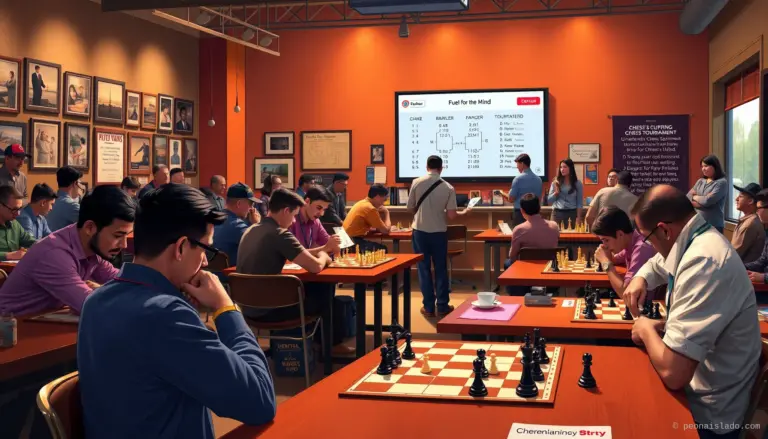
In the depths of Europe, where the earth folds into mysterious rock formations and the darkness holds ancient secrets, hides an event that defies the limits of convention: the chess tournament in the karst caves of Slovenia. This unique championship, considered the most underground on the continent, merges science-game strategy with the magic of a unique geological landscape. Away from traditional boards under artificial lights, The players face each other in a natural setting where the silence is only interrupted by the dripping of water and the echo of their movements. But, What makes this tournament so special?? How did the idea of taking chess to the bowels of the earth come about?? Y, above all, What unique experiences does it offer to participants and spectators?? Join us on this journey to discover how Slovenia has turned its caves into an unforgettable setting for the mental sport par excellence..
The stage: the karst caves of Slovenia, a world underground
Slovenia is home to one of the most impressive karst landscapes in the world, a geological phenomenon that has sculpted a labyrinth of caves for millions of years, underground rivers and unique rock formations. The term “karst” comes from the Karst region, in the southwest of the country, where this type of terrain is especially prominent. These caves are not simple cavities: They are complex ecosystems where humidity, constant temperature and darkness create an almost extraterrestrial environment. Among the most famous are the Cuevas de Postojna, a system of more than 24 kilometers of galleries, and the Cuevas de Škocjan, declared a World Heritage Site by UNESCO.
What makes these caves special for a chess tournament is not just their natural beauty, but also its acoustics and atmosphere. The absolute silence, only broken by the sound of water seeping through the stalactites, provides an ideal environment for concentration. Besides, stable temperature, which is around 10°C throughout the year, forces players to adapt physically, adding an additional challenge to the game. It is no coincidence that the organizers chose this setting: karst caves are not just a backdrop, but one more participant in the experience.
But, How do you light up a space designed for darkness?? Logistics is key. Low consumption LED lighting systems are used, strategically placed to highlight the rock formations without disturbing the natural environment. The boards, Made from moisture-resistant materials, They are placed on treated wooden tables to avoid deformations. Even chess clocks are adapted to work in high humidity conditions.. Everything is designed so that the tournament runs smoothly, proving that nature and sport can coexist in harmony.
The origin of the tournament: when chess found its home in the dark
The idea of holding a chess tournament in karst caves did not arise overnight. Its genesis dates back to a combination of Slovenian chess tradition and the search for innovative experiences.. Slovenia has a long history with chess: The country has produced great teachers such as Luka Lenič y Jure Borisek, and its national federation is one of the most active in Central Europe. However, in 2016, A group of chess and caving enthusiasts proposed taking the game to a new level, literally underground.
The first experimental tournament was held in Cuevas de Postojna, with only eight players and a small audience. The response was overwhelming: The participants highlighted the intensity of the experience, while the spectators were fascinated by the fusion between sport and nature. The following year, the event was expanded, attracting international players and media. Hoy, The tournament is a benchmark in the European chess calendar, although it continues to maintain an intimate and exclusive character, with a limit of 32 participants to preserve the essence of the place.
But, why chess? The answer lies in the very essence of the game. Chess is a sport of silence, strategy and patience, values that fit perfectly with the atmosphere of a cave. Besides, Darkness and isolation force players to rely solely on their mental abilities, eliminating external distractions. For many, this tournament is a metaphor for life: in the dark, only intelligence and perseverance can guide you to victory.
The player experience: physical and mental challenges underground
Participating in the chess tournament in the karst caves of Slovenia is not like playing in a local club or in a conventional tournament. Players face a series of unique challenges that test both their physical stamina and mental ability.. The first of them is the adaptation to the environment. The constant temperature of 10°C and the humidity close to 90% they can be uncomfortable, especially for those who are not used to. Many players choose to wear thermal clothing and fingerless gloves to maintain manual dexterity.
The second challenge is lightning. Although the caves are equipped with LED lights, the light is dim and directional, which can cause eye strain after several hours of gaming. Players must learn to move pieces accurately in low light conditions, something that does not happen in traditional tournaments. Besides, absolute silence can be overwhelming: without the murmur of other players or ambient noise, each movement resonates with an unusual intensity, increasing psychological pressure.
But the biggest challenge is, definitely, he isolation. in a cave, there are no windows, nor clocks that mark the passage of time, no external distractions. Players must rely solely on their chess clock and their ability to maintain concentration for hours. for some, this is a blessing: the absence of external stimuli allows them to completely immerse themselves in the game. For others, however, it can be torture, especially in long games where mental fatigue begins to take its toll.
Curiously, Many players highlight that this environment has helped them improve their game. The need to adapt to extreme conditions has forced them to develop new strategies and strengthen their mental resistance.. Some even claim that, after participating in the tournament, his performance in conventional competitions has improved, since they have learned to handle stress and pressure better.
The cultural and tourist impact: beyond chess
Chess tournament in Slovenia's karst caves is not just a sporting event: It is a cultural phenomenon that has put the country on the map of unique experiences worldwide.. Since its creation, The tournament has attracted thousands of visitors, not just chess fans, but also tourists interested in exploring the natural wonders of Slovenia. Las cuevas de Postojna y Škocjan, which were already popular tourist destinations, have seen a significant increase in the number of visitors, especially during tournament days.
But the impact goes beyond tourism. The tournament has served to promote Slovenian culture and its relationship with nature. Slovenia is a small country, but with a strong identity, and events like this help reinforce its image as an innovative and sustainable destination. Organizers have worked closely with local authorities to ensure the event is environmentally friendly, using recyclable materials and minimizing the impact on the caves.
Besides, The tournament has inspired other similar initiatives in Europe. In 2019, A chess tournament was held in Cuevas de Aggtelek in Hungary, and in 2022, in the Waitomo Caves in New Zealand. Although these events are less known, show that the idea of fusing chess and nature has permeated the international community. Slovenia, however, remains the reference, thanks to its unique combination of karst landscapes and chess tradition.
The tournament has also had an impact on the local community. Many inhabitants of the regions near the caves have found a source of income in the event., whether through tourism, the sale of artisan products or the provision of services. Besides, The tournament has served to bring chess closer to new generations, with workshops and parallel activities aimed at children and young people. In an increasingly digital world, Chess in caves offers a tangible and memorable experience, that contrasts with the coldness of the screens.
Conclusions: a tournament that transcends chess
The chess tournament in the karst caves of Slovenia is much more than a competition: It is an experience that challenges the limits of what we consider possible in mental sports.. From its unique setting, where nature and play merge in the same space, to the physical and mental challenges players face, this event redefines what it means to compete. It's not just about moving pieces on a board, but to immerse yourself in an environment where every decision counts twice as much, where silence and darkness amplify the intensity of each game.
Beyond chess, the tournament has left an indelible mark on Slovenia. It has valued its natural heritage, has promoted sustainable tourism and has inspired other countries to explore new ways of fusing sport and nature. But, above all, has shown that innovation has no limits: Even a game with more than a thousand years of history can be reinvented in a setting as unexpected as a cave.
For the players, Participating in this tournament is a unique opportunity to test your skills in extreme conditions, to live an adventure that goes beyond sports. For the spectators, It is an unforgettable experience, where chess becomes a visual and sensory spectacle. And for Slovenia, is a reminder that, sometimes, The most hidden places can harbor the brightest ideas. In a world where everything seems to be already invented, The chess tournament in karst caves reminds us that creativity and passion can take us to unexpected places, even underground.