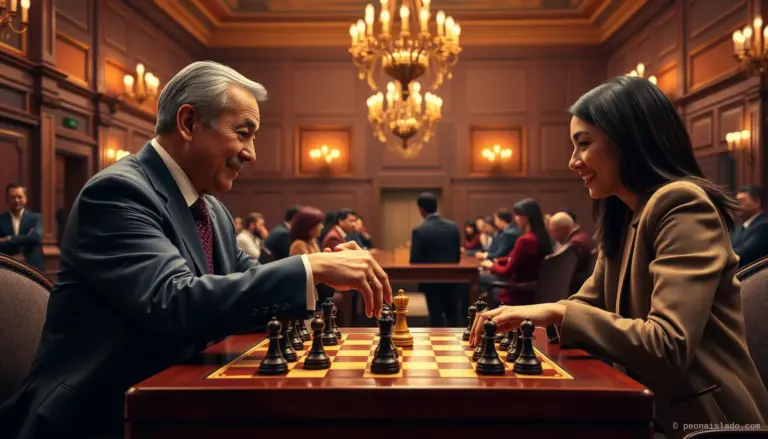
In the heart of the Caribbean, Haiti has been a symbol of resilience for decades. Between devastating earthquakes, political crises and extreme poverty, its people have found unexpected ways to rebuild themselves. One of the most fascinating is the resurgence of chess, a game that, against all odds, has become a beacon of hope and strategy in the midst of chaos. Far from being a simple hobby, chess in Haiti has become a tool of resistance, education and social transformation. How does a country mired in adversity manage to keep alive an intellectual tradition that defies ruins?? This article explores the renaissance of Haitian chess, from its historical roots to its current role as a symbol of improvement, analyzing how the game not only survives, but flourishes in the most difficult conditions.
Chess in Haiti: roots of a forgotten tradition
Chess came to Haiti during the colonial era, introduced by the French in the 18th century. However, its practice was long limited to urban elites, especially in Port-au-Prince, where private clubs and cafes became meeting spaces for game lovers. After independence in 1804, chess was relegated to the background, overshadowed by the political and economic struggles that marked the first centuries of the nation. It was not until the mid-20th century that the game began to gain popularity among the middle classes., although always in small circles.
The true expansion of chess in Haiti occurred in the last decades of the 20th century, driven by figures such as the international master Jean-Louis Laroche, who not only promoted the game at a competitive level, but also took it to marginalized schools and communities. Laroche understood that chess could be more than a mental sport: a tool to develop critical thinking in a society where formal education was (and it remains) a luxury for many. However, the earthquake of 2010 truncated this progress, destroying infrastructure and displacing thousands of people, including many chess players.
Despite this, chess never completely disappeared. In the displaced persons camps, in the streets of semi-destroyed cities and in the schools that managed to reopen, the game reemerged as an act of resistance. Improvised cardboard boards, Pieces carved in wood or even drawn on the ground became symbols of a lost normality.. For many Haitians, chess became a refuge: a space where, for a few hours, they could forget the hunger, violence and uncertainty.
The earthquake of 2010: the breaking point that changed everything
He 12 January 2010, a magnitude earthquake 7.0 devastated Port-au-Prince and its surroundings, leaving more than 200,000 dead and collapsed infrastructure. Among the destroyed buildings was the headquarters of the Haitian Chess Federation, you lost files, equipment and, the most valuable, to several of its most prominent members. The disaster was not only physical, but also symbolic: chess, who was already fighting to gain space in Haitian society, seemed doomed to disappear.
However, what happened next was unexpected. In the midst of chaos, international organizations such as Chess in Schools y FIDE (International Chess Federation) they started sending help in the form of boards, parts and manuals. But even more important was the local response.. teachers like Wesly Jean-Baptiste, a young chess player who lost his house in the earthquake, they decided that the game couldn't die. With limited resources, Jean-Baptiste and other volunteers organized tournaments in public squares, using borrowed wooden tables and chairs. These events not only kept the practice of chess alive, but they also became spaces for collective healing.
A study carried out by the Haiti State University in 2012 revealed that chess helped reduce post-traumatic stress levels in children and adolescents affected by the earthquake. Participants in chess programs showed an improvement in their ability to concentrate, decision making and frustration management, crucial skills in a context of permanent crisis. This finding reinforced the idea that chess was not just a game, but a therapeutic and educational tool.
Chess as a tool of education and empowerment
In a country where the 60% of the population lives below the poverty line and the education system is precarious, chess has emerged as a pedagogical alternative. Programs like “Chess for Hope” (Chess for Hope), founded by the NGO Knowledge and Freedom Foundation (FOCAL), have brought the game to public schools in marginal neighborhoods such as Cité Soleil and Martissant. These projects not only teach the rules of chess, but rather they use it as a vehicle to teach mathematics, logic and strategic thinking.
The results are remarkable. According to a FOKAL report, Students who participate in these programs improve their grades by a 20% on average, especially in areas such as mathematics and science. Besides, chess promotes values such as patience, discipline and respect for the rules, soft skills that are essential in a society marked by violence and instability. For many young people, chess has become an escape route: a way to avoid gangs, child labor or forced migration.
An emblematic case is that of Daphne Joseph, a young woman from 16 years of Cité Soleil that, thanks to a chess program, He obtained a scholarship to study at a secondary school in the Dominican Republic. “Chess taught me that every move has consequences”, dice Joseph. “That helped me understand that my decisions also have, and that I can choose a different future”. Stories like yours are becoming more common, and they show that chess not only entertains, but it transforms lives.
However, challenges persist. Lack of financing, insecurity in the streets and the shortage of materials are constant obstacles. Many programs depend on international donations or the volunteer work of local chess players., which makes them vulnerable to political and economic ups and downs. Despite this, chess continues to gain ground, even in the most remote areas of the country, where missionaries and community organizations have introduced it as part of their development projects.
competitive chess: Haiti on the international stage
Although chess in Haiti has grown primarily as a social tool, The country has also begun to stand out in the competitive field. The Haitian Chess Federation, reconstituted after the earthquake, has worked to send representatives to regional and international tournaments. One of the most significant achievements was Haiti's participation in the Chess Olympiad 2018 in Batumi, Georgia, where the national team, composed of young people trained in community programs, achieved respectable results.
Haiti's most prominent player today is Jean-Louis Laroche, who, to their 65 years, remains a key figure in the promotion of chess. Laroche has not only competed in international tournaments, but it has also trained a new generation of chess players, including Wesly Jean-Baptiste y Daphne Joseph. Its approach combines technical excellence with a strong social commitment, demonstrating that chess can be both an elite sport and a tool for change.
Nevertheless, the road to international competitiveness is arduous. Haiti lacks the necessary resources to train its players at the same level as countries with more consolidated chess traditions., like Cuba or Dominican Republic. Lack of sponsors, Political instability and the difficulty of traveling abroad are constant barriers. Even so, Haitian chess players continue competing, motivated by the desire to represent their country and demonstrate that, even in the most adverse conditions, talent can flourish.
An inspiring example is that of Josué Pierre-Louis, a young man from 22 years that, despite not having access to a professional trainer, managed to qualify for the Central American Chess Championship 2022. Pierre-Louis, who learned to play in a community program in Cap-Haïtien, Train using mobile apps and borrowed boards. “I don't have a teacher, but I have internet and desire to learn”, dice. His story reflects the spirit of a generation that refuses to give up, Even when the world seems to be against you.
Conclusions: chess as a symbol of resilience
Haiti is a country that has been hit again and again by natural disasters, political crises and extreme poverty. However, in the middle of the ruins, chess has emerged as a symbol of resistance and hope. What began as a game for elites has transformed into an educational tool, collective empowerment and healing. From the camps for displaced people after the earthquake 2010 to the classrooms of schools in marginal neighborhoods, chess has shown that it can flourish even in the most adverse conditions.
The renaissance of chess in Haiti is not just a story about a game, but about the human ability to find light in the darkness. It is a reminder that, even when all seems lost, creativity, strategy and community can open unexpected paths. Chess programs in Haiti have changed lives, improving education, reducing violence and offering alternatives to at-risk youth. Besides, They have put the country on the international chess map, proving that talent has no borders.
However, the future of chess in Haiti remains uncertain. The lack of resources, Political instability and economic challenges are obstacles that require long-term solutions. So that chess continues to grow, Greater support from the international community is needed, as well as public policies that integrate it into the educational system. But, above all, the commitment of Haitians themselves is needed, who have proven time and time again that they are capable of overcoming any adversity.
In a world where crises seem endless, chess in Haiti is a testimony that resilience is not just surviving, but find ways to prosper. As he once said Jean-Louis Laroche: “Chess teaches us that, even when the board is in ruins, There is always a play that can change the game”. And in Haiti, that play has already started.