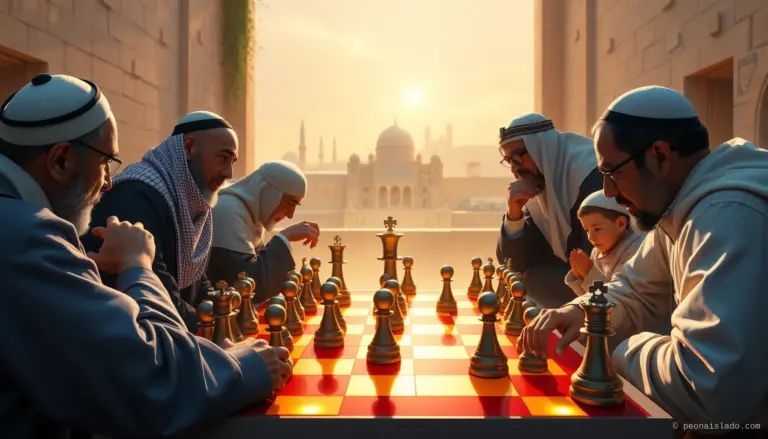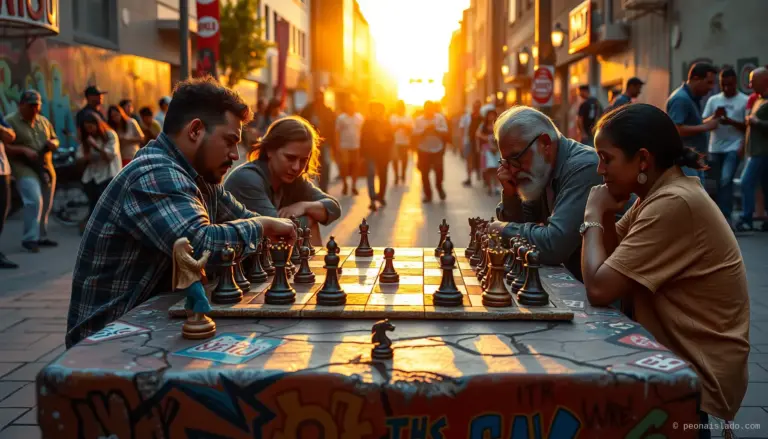
chess, more than just a strategy game, has exerted a profound and multifaceted influence on the art world throughout the centuries. From painting to literature, passing through cinema and music, this ancient board 64 Casillas has served as a metaphor for life, the conflict, intelligence and creativity. Its symmetrical structure, Its precise rules and its ability to reflect human tensions have made it a recurring symbol in masterpieces, inspiring artists to explore themes such as power, the war, destiny and duality. But, How has chess managed to transcend its playful nature to become a visual and conceptual language in art?? This question takes us on a journey through different disciplines, where the game becomes a tool of artistic expression, philosophical and even political.
Chess as a symbol in painting and sculpture
From the Renaissance to contemporary art, Chess has been represented on canvases and sculptures as a reflection of the human condition. In the 15th century, Works like *The Game of Chess* by Lucas van Leyden already showed games as allegories of courtly love, where each movement symbolized seduction strategies. Later, artists such as Marcel Duchamp, who was a passionate player, They incorporated the board into their works to question the perception of reality. His piece *The great glass* (1915-1923) includes chess elements that allude to the fragmentation of modern experience.
In surrealism, Salvador Dalí used chess in *The Temptation of Saint Anthony* (1946) to represent the fight between good and evil, where the pieces become almost mythical entities. Even in conceptual art, like in Yoko Ono's facilities, the board is transformed into a space for social interaction, where the spectator becomes a player and the work becomes a dialogue between strategy and chance.
Sculpture has also explored chess as an object of power. Works such as *The Chess of Death* by Hans Holbein the Younger (recorded in *The ambassadors*, 1533) or the giant pieces of Man Ray in the years 20, emphasize its role as a symbol of control, death and eternity. These renderings not only capture the formal beauty of the game, but they elevate it to a metaphysical plane, where each piece embodies a human archetype.
Chess in literature: metaphors of strategy and destiny
Literature has found in chess an inexhaustible source of metaphors to explore human psychology, conflict and free will. In *The Player* by Fyodor Dostoevsky, gambling obsession reflects addiction and self-destruction, while in *Through the Looking Glass* by Lewis Carroll, The board becomes an alternate world where the rules of logic are distorted. These examples show how chess transcends its recreational function to become a mirror of the mind..
in poetry, Authors such as Jorge Luis Borges used chess as an allegory of the universe. In his poem *Chess*, describes the game as a “repeating labyrinth” and one “time machine”, where every movement is an echo of past decisions. This cosmic vision of chess also appears in *The Book of Sand*, where the board symbolizes infinity and the impossibility of predicting the future.
Theater and cinema are not far behind. In *The Departure* of Samuel Beckett, chess is used to represent the futility of existence, while in films like *The Seventh Seal* by Ingmar Bergman, The game between the knight and Death becomes a reflection on faith and mortality. These works show that chess is not just a game, but a universal language to talk about what is human.
Chess in the cinema: narrative tension and visual symbolism
Cinema has exploited chess as a narrative and visual resource to build tension, develop characters and convey deep messages. In *The Great Dictator* (1940), Charlie Chaplin uses a chess game between Hynkel (Hitler) and Napaloni (Mussolini) to satirize the diplomacy of totalitarian regimes, showing how the game can be a metaphor for political manipulation. The scene, full of irony, underlines the fragility of the agreements and the hypocrisy of power.
In the psychological thriller, chess becomes a key element to reveal the characters' minds. In *The footprint* (1972), The game between the protagonists is not only a duel of wits, but a battle of egos where each movement exposes their fears and weaknesses. Stanley Kubrick, in *2001: A space odyssey* (1968), takes the symbolism further: the HAL computer 9000 plays chess with astronaut Frank Poole, anticipating his betrayal and the fight between human and artificial intelligence.
Author cinema has also explored chess from more intimate perspectives.. In *Gerry* (2002) the Gus Van Sant, two friends lost in the desert play an imaginary game, using the board as a last link to civilization. Here, chess is not just a game, but an act of resistance against the absurdity of existence. These films show that the board is a perfect setting to explore the human condition, where each piece represents an aspect of the psyche.
Chess in music and performing arts
Music has found in chess a source of inspiration to compose works that reflect its rhythm, structure and drama. Composers like Prokofiev, in his *Symphony No. 2*, They used the game as a metaphor for the struggle between order and chaos, while in *The love of the three oranges*, chess appears as a surreal element that defies logic. Even in jazz, musicians like John Zorn have created pieces based on famous games, where each note corresponds to a move on the board.
at the opera, *El ajedrez* de Björn Ulvaeus and Benny Andersson (from the ABBA group) is an outstanding example. This work, released in 1984, tells a story of love and espionage during the Cold War, where the board becomes a symbolic battlefield. The arias and choruses reflect the tension of the games, while the characters are torn between loyalty and betrayal, like pieces in a bigger game.
The performing arts have also incorporated chess as a choreographic element. At the ballet *Checkmate* (1937) by Ninette de Valois, with music by Arthur Bliss, the dancers represent chess pieces in a battle between love and death. The choreography, full of precise and symbolic movements, transforms the board into a scene of conflict and passion. Even in contemporary theater, Works such as *Ajedrez* by the Catalan company La Fura dels Baus use the game to explore themes such as war and identity, mixing technology and performance in an immersive experience.
In the end, chess in music and performing arts is not just a topic, but a language that allows the abstraction of the game to be translated into tangible emotions. Its binary structure (black and white, attack and defense) lends itself to the creation of works that oscillate between the rational and the emotional, the individual and the collective.
Conclusions: chess as a mirror of art and humanity
Chess has proven to be much more than a game: It is a prism through which art has explored the great themes of existence. From Renaissance paintings to modern operas, Its presence in different disciplines reveals a profound truth: The board is a microcosm where the strategy is reflected, the conflict, destiny and human creativity. Each artistic representation of chess, whether on a canvas, a novel or a movie, not only captures the formal beauty of the game, but also invites us to reflect on our own nature.
in the painting, chess became a symbol of power and duality; in literature, in a metaphor of free will and obsession; in the cinema, in a resource to build tension and psychological depth; and in music, in a language to express the rational and the emotional. These demonstrations demonstrate that chess transcends its recreational function to become a bridge between art and philosophy., between the individual and the universal.
In the end, The influence of chess on art reminds us that, like in a game, Life is full of calculated moves and unexpected surprises.. The board, with his 64 casillas, It's a reminder that every decision counts., and?, just like in art, beauty often arises from the tension between order and chaos. Perhaps that is why chess continues to fascinate artists.: why, in the background, It's a game we all play, although not always with the same rules.