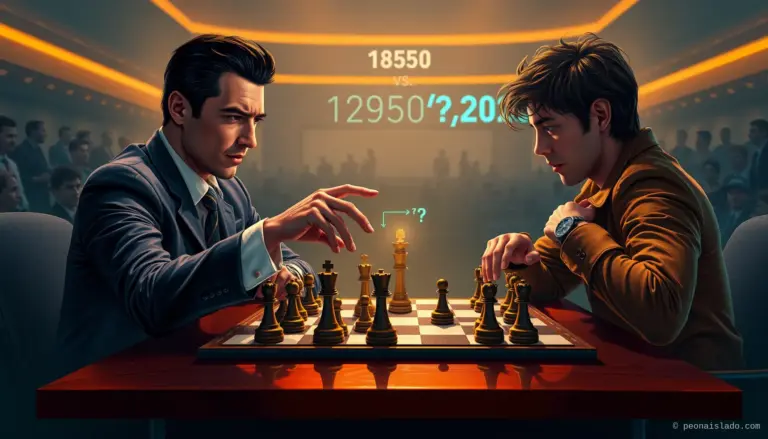
Chess has witnessed rivalries that transcended the board, but few have captured the world's imagination like the duel between Anatoli Karpov and Garry Kasparov en 1985. It wasn't just a world title showdown., but a clash of ideologies, generations and visions about the future of the game. While Karpov represented the Soviet tradition—methodical, cold and calculating, Kasparov embodied the rebellion of a new era: aggressive, innovative and willing to challenge established structures. This article explores how their rivalry redefined chess, not only as a sport, but as a mirror of political tensions, cultural and even existential.
The board as an ideological battlefield
To understand the magnitude of the Karpov-Kasparov duel, It is impossible to separate it from the context of the Cold war. Chess was another weapon in the propaganda arsenal of the USSR, a symbol of intellectual superiority that the regime masterfully exploited. Karpov, champion since 1975, It was the perfect product of this system: a player trained in Soviet schools, where discipline and obedience to doctrine were as important as talent. Your style, based on the accumulation of small advantages and positional asphyxiation, reflected the strategic patience of an empire that believed in long-term victory.
Kasparov, instead, broke out like a hurricane. with only 22 years, He became the youngest world champion in history, but his rise was not just a matter of age. His game was chaotic, unpredictable, Full of spectacular sacrifices and lightning attacks. For the Soviets, represented a threat: not only did he challenge Karpov, but also the established order. His victory in 1985 It was not just a sporting triumph, but a symbolic blow to the hegemony of Soviet chess, that already showed cracks. As analyzed in this article about the dominance of the USSR in chess, The system that had produced geniuses like Botvinnik or Tal was beginning to crack under the weight of its own rigidity..
The psychology of a rivalry: beyond the 64 casillas
The confrontation between Karpov and Kasparov was also a study in psychological contrasts. Karpov, described by many as a “chess machine”, He rarely showed emotion during games. His approach was almost clinical: every movement responded to a cold calculation, no room for improvisation. Kasparov, on the contrary, I played with my heart in my hand. Their games were emotional battles, where intuition and audacity often trumped pure logic. This difference was not accidental.: while Karpov had been molded by a system that rewarded conformity, Kasparov grew up in an environment where dissent—even creative dissent—was a form of survival..
A paradigmatic example of this dynamic occurred in the Match 16 of the World Championship 1985. Kasparov, with black, opted for an unconventional opening (the Grünfeld Defense), sacrificing a pawn to gain initiative. Karpov, true to his style, tried to neutralize the position, but Kasparov cornered him with a series of tactical blows that left the champion without answers. The game not only demonstrated Kasparov's superiority at that time, but also how his disruptive approach could destabilize even the most prepared players. These types of strategies, where the psychological intertwines with the technical, is analyzed in depth in this article about psychology in chess.
Chess as a metaphor for power: from Moscow to globalization
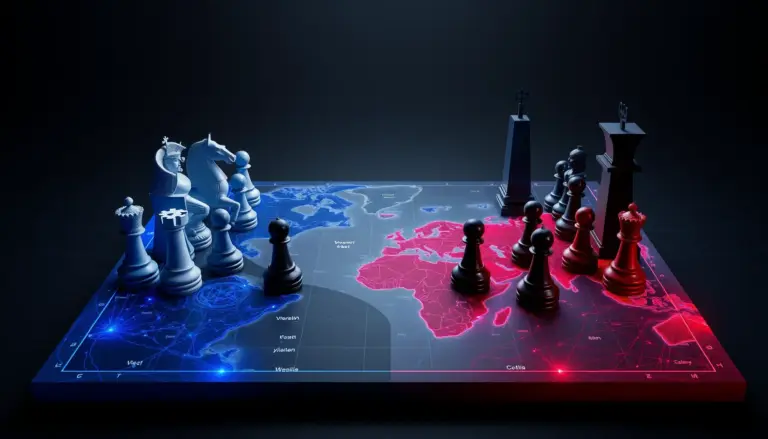
The Karpov-Kasparov rivalry also reflected a broader geopolitical shift. For decades, Chess had been an instrument of soft power for the USSR, a way to demonstrate their intellectual superiority compared to the capitalist West. However, with the arrival of Kasparov, the game began to go global. His victory in 1985 coincided with the beginning of perestroika, a period of reforms that, ironically, accelerated the decline of the system that had formed it. Kasparov not only challenged Karpov on the board, but also to the structures that supported it: He became an outspoken critic of the Soviet regime, using their platform to advocate for democracy and human rights.
This turn was not well received by the authorities. In 1993, Kasparov broke with FIDE (International Chess Federation) to create the PCA (Professional Chess Association), an organization that sought to professionalize the game and free it from political control. This schism divided the chess world for years, but it also laid the foundations for its modernization. As explored in this analysis about FIDE, the federation had long been an instrument of Soviet influence, and the Kasparov rebellion marked the beginning of a new era.
Legacy: What did this duel leave us??
Beyond the results and the controversies, The rivalry between Karpov and Kasparov left a lasting legacy in chess. First of all, showed that gaming could be both an art and a science. While Karpov represented mathematical precision, Kasparov embodied overflowing creativity. This duality continues to define modern chess, where theoretical preparation coexists with improvisation.
In second place, Their confrontation accelerated the professionalization of chess. Before them, The players depended on state sponsorships or private patrons. Kasparov, in particular, He understood that chess could be a global business, attracting sponsors and massive audiences. Hoy, thanks in part to his vision, Figures like Magnus Carlsen or Hikaru Nakamura are media stars, with millions of followers on platforms like Twitch.
Finally, Their rivalry reminds us that chess is much more than a game. It is a reflection of social tensions, political and cultural of his time. As pointed out in this article about chess and politics, The board has historically been a setting where conflicts that go beyond the 64 casillas. Karpov and Kasparov not only competed for a world title; They struggled to define what chess meant in a changing world..
Conclusion: chess as a mirror of humanity
The duel between Karpov and Kasparov was a defining moment in chess history, but also in the history of the 20th century. It represented the end of one era and the beginning of another., where gambling stopped being a Soviet monopoly and became a global phenomenon. Beyond the games, Their rivalry teaches us that chess is a universal language, capable of expressing the contradictions and aspirations of the human condition. Hoy, When artificial intelligence threatens to redefine the boundaries of gaming, It is useful to remember that, in the end, chess is still a reflection of ourselves: of our ability to create, compete and, above all, to dream.
If this article has inspired you to delve deeper into the history of chess, We invite you to explore other key moments, as the duel between Fischer and Spassky, where the board became a Cold War scene, or to reflect on How AI is transforming modern chess. Why, after all, every game is a story, and every story deserves to be told.