chess, in its essence, has always been a reflection of human tensions: strategy, power and, sometimes, divisions that transcend the board. The unification of the world title in 2006, after decades of fracture between FIDE and PCA, It was not just a sporting milestone, but an act of symbolic reconciliation in a game that, like few, has served as political metaphor. Vladimir Kramnik and Veselin Topalov not only competed 12 games in Elista; They closed a wound that had divided the chess elite since the times of Bobby Fischer, when chess became another battlefield of the Cold War.
This story, however, does not start in 2006. Its roots go back to previous decades., when the ego, money and personal ambitions fractured what should have been a unified title. To understand its meaning, it is necessary to unravel how chess, a game that was born as simulation of battles in ancient India, became a scene of power struggles that almost destroyed it.
The schism: when chess was split in two
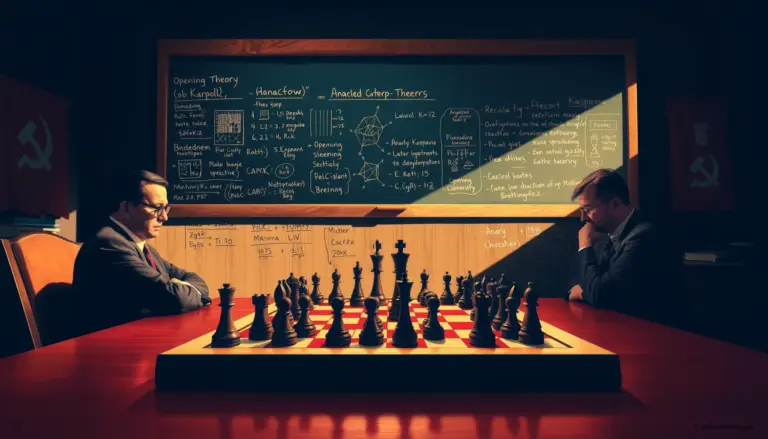
World title split was no accident, but the result of a series of calculated decisions - and strategic errors - that began in the years 90. After the fall of the USSR, chess lost its main patron: a State that had turned it into propaganda weapon and symbol of intellectual superiority. Without Soviet support, FIDE, under the direction of Florencio Campomanes, found itself in a financial crisis that threatened to collapse the tournament system. That's when Garry Kasparov, the reigning champion, decided to break with the federation and create the Professional Chess Association (PCA) in 1993, taking with them the commercial rights and the main sponsors.
The schism was not only institutional; It was existential.. On the one hand, FIDE organized its own world championships, with a format questioned by many great masters. On the other, the PCA kept alive the tradition of classic matches, but with a problem: Both sides claimed to be the legitimate heirs to the title.. This duality not only confused fans, but it devalued the very meaning of the world championship. What value did a title have if it was not recognized by everyone??
The case of Anatoly Karpov illustrates this paradox. After losing his title to Kasparov in 1985, Karpov remained FIDE champion for years, even after Kasparov left the federation. Meanwhile, Russian Viswanathan Anand won the FIDE title in 1995, but many in the elite considered him a “second champion” because Kasparov was still the undisputed number one in the ranking. This fragmentation not only weakened the credibility of professional chess, but turned it into a shadow board, where loyalties and economic interests took precedence over the game itself.
Money and ego: the pawns that moved the game
Behind the world title split were two driving forces: money and ego. Kasparov, aware of its commercial value, sought to maximize its income through agreements with private sponsors, something that FIDE, with its bureaucratic structure, couldn't match. The PCA not only offered juicier prizes, but also greater control over broadcasting rights and the organization of tournaments. For a player like Kasparov, who had already challenged the USSR with his aggressive playing style and charismatic personality, Breaking with FIDE was a logical step in their search for independence.
However, This independence came at a cost.. The PCA was heavily dependent on sponsors, and when these began to withdraw - as happened with Intel in 1996 -, the organization was left without sustenance. Meanwhile, FIDE, although weakened, maintained its legitimacy as the federation recognized by the International Olympic Committee and the majority of countries. The paradox was clear: Chess needed both the commercial innovation of the PCA and the global structure of FIDE to survive..
The ego also played a crucial role. Kasparov and Karpov, two chess giants, They represented opposing visions of the game. Kasparov embodied modernity: a dynamic style, almost aggressive, which reflected his combative personality. Karpov, instead, was the embodiment of Soviet precision, a player who won games without the need for fire, through relentless logic. This personal rivalry transcended the board and became an ideological conflict that divided the chess community.. While Kasparov sought to reform the system from outside, Karpov defended tradition, even if it meant aligning with an increasingly questioned FIDE.
Elista 2006: the game that healed chess
The unification match between Kramnik and Topalov in Elista, capital of Kalmykia, It was an event full of symbolism. It wasn't just about deciding who would be the undisputed champion; It was an opportunity to close a wound that had lasted 13 years. Kramnik, heir to Kasparov's classic title, represented the continuity of the PCA. Topalov, FIDE champion, embodied institutional legitimacy. They both came into the match with something to prove.: Kramnik, that his title was not a “invention” of the PCA; Topalov, that FIDE still had relevance.
The match, however, It was far from being a simple sporting duel. From the first moment, The tensions were evident. Topalov accused Kramnik of cheating by visiting the bathroom too often, suggesting he might be getting outside help. The accusation, although never tested, led to organizers closing players' private bathrooms, a move that Kramnik considered a violation of his privacy. The conflict escalated to the point that Kramnik refused to play the fifth game., which was declared lost due to non-appearance. chess, one more time, seemed to be on the verge of collapse.
However, What followed was an example of how sport can overcome its own divisions. After a series of negotiations, the match resumed, and Kramnik managed to win the tiebreaker with a score of 6-6 in classic games and 2.5-1.5 in the rapids. Beyond the result, the important thing was that, for the first time in more than a decade, the world of chess had an undisputed champion. The unification was not perfect—FIDE kept its tournament system, and some purists still questioned the legitimacy of the title—, but it was a necessary step to restore the credibility of the game.
Lessons from a schism: what did chess learn?
The unification of the world title in 2006 left several lessons, not only for chess, but for any area where power, money and ego come into conflict. The first is that institutional divisions rarely benefit anyone., except for those who promote them. During the years of the schism, chess lost sponsors, audience and, the most important thing, its ability to inspire new generations. Fragmentation not only weakened the world title, but turned him into a symbol of disunity in a game that, in its essence, celebrates unity through strategy.
The second lesson is that chess, as mirror of the world, reflects the tensions in society. The Cold War divided players between East and West; Globalization divided them between those who sought to modernize the game and those who defended tradition.. The world title schism was, ultimately, a reflection of these conflicting forces. However, also showed that, even in the darkest moments, chess has the ability to reinvent itself.
Finally, the unification of 2006 made it clear that chess cannot survive without a balance between innovation and tradition. The PCA provided dynamism and resources, but without the FIDE structure, the game lacked global legitimacy. For your part, FIDE, although necessary, could not be modernized without incorporating the lessons of the PCA. This balance is fragile, but essential: chess must evolve to stay relevant, but without losing sight of its essence as a game of strategy and thinking.
The legacy of 2006: stronger chess, but not invincible
Hoy, chess is more popular than ever. Platforms like Chess.com and Lichess have democratized access to the game, and series like The Queen’s Gambit have brought chess to mass audiences. However, the legacy of 2006 still relevant. World title unification did not solve all chess problems — FIDE continues to be criticized for its management, and online cheating scandals threaten the integrity of the game—, but it laid the foundations so that chess could grow without the shadows of the past.
Kramnik, after winning the match, declared: “This is not just my title, is everyone's title”. It was a phrase that resonated because, then, chess needed to remember that, beyond egos and divisions, Its true value lies in its ability to bring people together. The unification of 2006 It wasn't the end of the story, but a reminder that, even in the most strategic games, unity is the most powerful move of all.
chess, like life, is full of fractures. But it is also full of reconciliations. The one of 2006 was one of them: a checkmate to the division, and a reminder that, on the board and off it, what really matters is not who wins, but how the game is played.