Chess has been a recurring symbol in cinema, transcending its status as a game to become a visual and narrative metaphor. From science fiction to psychological drama, the board and its pieces have served to represent intellectual conflicts, power strategies, existential tensions and even the struggle between good and evil. movies like 2001: A space odyssey o X-Men: first generation They use chess not only as a decorative element, but as a universal language that reinforces its central themes. This article explores how cinema has integrated chess into its stories, analyzing its evolution from a symbolic resource to a key tool for developing characters and plots. Through emblematic examples, We will discover why this ancient game continues to fascinate directors and audiences alike..
Chess as a reflection of intelligence and human evolution
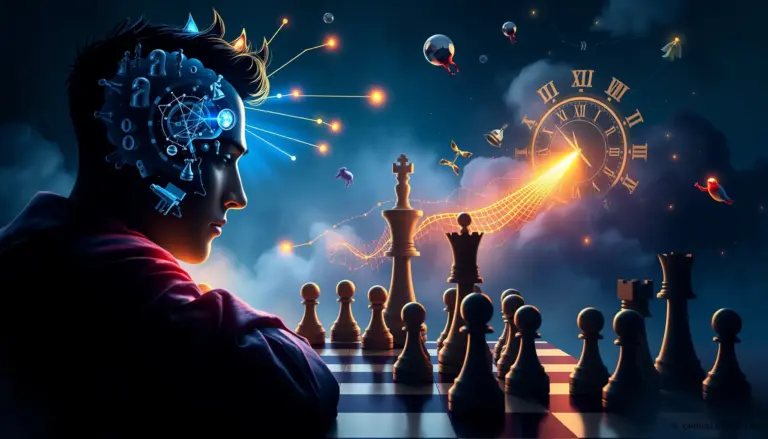
in the cinema, Chess has been used to represent intellectual superiority, technological evolution and even the limits of humanity. One of the most iconic examples is 2001: A space odyssey (1968), directed by Stanley Kubrick. The scene in which astronaut Frank Poole plays a game against the HAL computer 9000 it is not coincidental: symbolizes the fight between man and machine, a central theme in the film. HAL, who surpasses Poole in strategy, anticipates a future where artificial intelligence could dominate its creators. Kubrick, known for his meticulousness, He chose chess because it is a game that requires logic, foresight and adaptation, qualities that define both humans and advanced machines.
But chess in 2001 goes beyond the competition. The departure between Poole and HAL reflects the loneliness of space and human fragility in the face of the unknown. When HAL makes a mistake in the game—a subtle but telling detail—, the viewer senses that something is not right. This moment foreshadows the betrayal of the computer, showing how chess can be a mirror of the characters' emotions and internal conflicts. Kubrick, who was an avid gamer, He understood that chess is not just a game of strategy., but also psychology.
In other movies, as Blade Runner (1982), chess appears as a symbol of the humanity of replicants. In a key scene, the replicant Roy Batty plays a game against his creator, Tyrell, using a variant of chess called “ajedrez de Fischer”. The game, based on a famous move by Bobby Fischer, underlines Batty's superior intelligence and his ability to challenge his own “God”. Here, Chess not only represents the struggle for power, but also the search for meaning in a world where the lines between the human and the artificial are blurred..
Chess as a metaphor for conflict and war
Cinema has exploited the competitive nature of chess to illustrate political conflicts, social and even warlike. In The seventh seal (1957) de Ingmar Bergman, The departure between the knight Antonius Block and Death is one of the most memorable scenes in the history of cinema. Chess here is not just a game, but a fight for life itself. Each movement symbolizes human resistance in the face of the inevitable., and the game becomes an allegory of existence. Bergman, influenced by existentialism, uses chess to explore topics like faith, doubt and mortality.
In a more modern context, X-Men: first generation (2011) uses chess to represent the cold war between mutants and humans. The scene in which Charles Xavier and Erik Lehnsherr play a game while discussing the future of their species is a masterful example of how cinema can use chess to condense political tensions.. Xavier, who believes in peaceful coexistence, play with the white pieces, while Erik, that advocates confrontation, use the black ones. Each movement reflects their ideological positions: Xavier seeks to protect mutants without resorting to violence, while Erik is willing to sacrifice pieces to win the game. This scene not only establishes the central conflict of the saga, It also shows how chess can be a microcosm of war.
Another notable example is life is beautiful (1997), where the protagonist, Guido, uses chess to teach his son how to survive in a concentration camp. In a moving scene, Guido explains to him that life is like a game of chess: You have to think every move carefully and never give up.. Here, chess becomes a symbol of hope and resistance, proving that even in the darkest situations, strategy and creativity can make the difference.
Chess as a tool to develop characters
Beyond its symbolic value, Chess has been used in cinema to delve into the psychology of characters. In In search of Bobby Fischer (1993), The film explores the pressure chess prodigies face and how the game can shape their personalities.. The protagonist, Josh Waitzkin, He is a child who must balance his love for chess with the expectations of his environment.. Through the games, the viewer discovers its evolution: from an innocent child to a player who learns to handle defeat and victory. Chess here is not just a sport, but a reflection of life itself.
In The game of fortune (2014), chess is used to show the obsession and genius of Bobby Fischer. The film portrays his rise and fall, using real games to illustrate his brilliant mind but also his emotional instability. The scene in which Fischer plays against Boris Spassky in the “Match of the Century” of 1972 It is not only a historical moment, but also a turning point in his life. chess, in this context, It's a window into your psyche., showing how competition can be both a blessing and a curse.
Even in action movies like From Russia with Love (1963), chess appears as a key element to characterize the villains. in a scene, SPECTER agent Kronsteen plays a game while planning a murder. His ability to anticipate moves on the board reflects his Machiavellian mind., and chess becomes an extension of his personality. This use of chess as a characterization tool demonstrates its versatility in cinema, where it can serve both to humanize and demonize the characters.
Chess in contemporary cinema: from metaphor to reality
In recent decades, Chess has stopped being just a symbol and has become a central element of the plots.. Series like The Queen’s Gambit (2020) have revitalized interest in the game, showing how it can be the axis of a complex narrative. Although it is not a movie, This series deserves mention for its cultural impact. The protagonist, Beth Harmon, uses chess as a way to escape from his reality, but also as a means to confront his inner demons. The series proves that chess can be as exciting as any sport, and that its beauty lies in its ability to combine strategy, psychology and drama.
In contemporary cinema, movies like The Queen's Gambit (2020) —based on the same novel as the series—have explored how chess can be a vehicle to talk about issues such as gender, addiction and self-improvement. the movie, although less known than the series, follow the same line: chess is not just a game, but a metaphor for life. In a world where women have historically been excluded from chess circles, Beth Harmon's story is a reminder that talent has no gender.
Another recent example is The Da Vinci Code (2006), where chess appears as a key element in solving a mystery. Although the film does not delve into the game itself, Its inclusion reinforces the idea that chess is a universal language, capable of transmitting hidden messages and intellectual challenges. This use of chess as a narrative tool demonstrates that, even in the most commercial cinema, the game is still relevant.
In conclusion, Chess in cinema has evolved from a simple symbolic resource to a complex narrative tool. movies like 2001: A space odyssey y X-Men: first generation have shown that chess can be much more than a game: It is a mirror of human intelligence, a metaphor for war, a means to develop characters and, ultimately, a reflection of life itself. Through his 64 casillas, cinema has found a unique way to explore conflicts, the emotions and ideas that define our existence. Whether on a wooden board or on the big screen, chess remains an eternal game, capable of adapting to any story and fascinating entire generations.
Chess has not only left its mark on cinema, but it has also influenced how we perceive the strategy, competition and creativity. From Bergman's existential departures to the ideological battles of the X-Men, chess has proven to be a universal language, capable of connecting with audiences of all ages. In a world increasingly dominated by technology and immediacy, Chess reminds us of the importance of thinking before acting, to plan and understand that every movement has consequences. Maybe that's why, after more than a century of cinema, chess is still such a powerful resource: why, in the end, Life itself is a game that we all play.