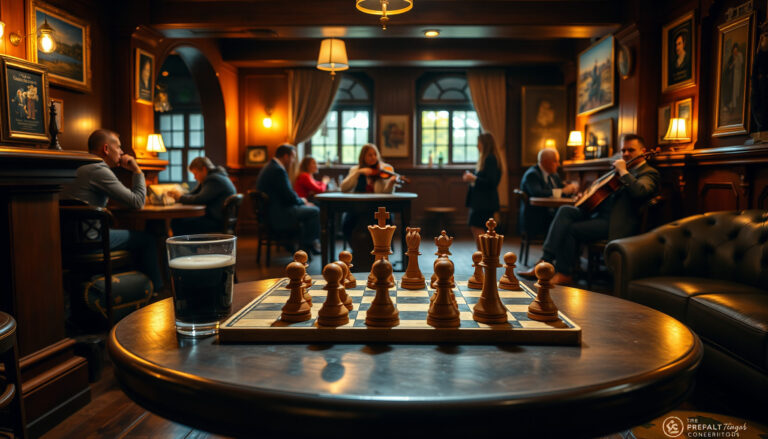
Imagine a classroom where students do not memorize formulas, but they discover them. Where every move on a board 64 boxes becomes a lesson in patience, strategy and resilience. chess, more than a game, It is a miniature cognitive laboratory, a pedagogical tool that has proven effective in training analytical minds, creative and emotionally intelligent. But, Why is this ancient pastime gaining ground in modern educational systems?? The answer does not lie in its complexity, but in his ability to rewire the brain, shaping skills that transcend the board and are applied in everyday life.
Chess as a brain gym: scientific evidence
Neuroscience has unraveled how chess acts as a personal trainer for the brain. Studies such as those carried out by the London Institute of Cognitive Neuroscience reveal that playing chess regularly increases the density of gray matter in areas associated with decision making and the working memory. But its impact goes beyond the structural: improves the cognitive flexibility, that ability to adapt to changing situations, an essential feature in a world where information flows at dizzying speeds.
A paradigmatic example is the program “Chess in Schools” implemented in Armenia, where chess is a mandatory subject since 2011. The results are eloquent: Armenian students not only lead international rankings in mathematics and science, but also show a reduction in 20% in academic stress levels. This case is not isolated. In Spain, the project “Chess at School” has shown that students who participate in chess workshops improve their performance in mathematics even in a 15%, thanks to the improvement in skills such as logical reasoning and the problem solving.
However, chess is not a magic wand. Its effectiveness depends on how it is integrated into the curriculum. It is not about teaching complex openings or endings., but to use the game as a metaphor of life: each game is a problem to solve, every mistake an opportunity to learn. As educational psychologist Robert Ferguson points out, “chess teaches children to think before acting, to evaluate consequences and develop critical thinking that will serve them in any field”.
Beyond logic: chess as a school of emotional intelligence
Chess not only sharpens the mind; also educate the heart. In a world where immediacy and instant gratification dominate, chess forces players to pause, reflect and assume responsibilities. Every move is a decision that can't be undone, what teaches children (and adults) to manage frustration, patience and perseverance.
A study published in the journal Frontiers in Psychology found that children who play chess develop a greater frustration tolerance and a superior capacity for regulate your emotions. This is because the game exposes players to high-pressure situations where they must manage stress., the uncertainty and, in many cases, the defeat. As Grandmaster Jonathan Rowson explains, “chess is a mirror of our psyche: reveals our fears, our ambitions and our ability to learn from mistakes“.
In therapeutic contexts, Chess has proven to be a powerful tool. Programs like “Chess for Therapy” in the United Kingdom they use games to work with children with ADHD y autism spectrum disorders (TEA). The board structure and clear rules provide a safe environment where these children can develop social skills, like him teamwork and the nonverbal communication. In the case of ADHD, chess helps improve concentration and the impulsiveness, since it forces the player to stop and analyze before acting. To delve deeper into how chess can be a therapeutic tool, We invite you to explore our article on therapeutic chess.
Chess in the classroom: methodologies that work
Integrating chess into education does not require a pedagogical revolution, but one intelligent adaptation. Countries like Hungary, where chess is part of the curriculum since 1978, have developed methodologies that combine the game with other disciplines. For example, in Hungarian schools, chess is used to teach history (analyzing historical games), geography (studying the origins of the game) and included literature (creating stories based on famous games).
One of the keys to success is gradual progression. It's not about teaching complex openings to six-year-olds., but to introduce basic concepts such as movement of the pieces o to importance of the center of the board. In this sense, he overcutting —a simplified version of the game— is an invaluable tool. As detailed in our practical guide to teaching chess to children, Prechess allows little ones to become familiar with the board and rules without the pressure of competition.
Another effective methodology is problem based learning. Instead of memorizing plays, students solve chess problems, like dunks in one or two plays, what stimulates your creative thinking and its ability to identify patterns. This approach not only improves your game, but also strengthens skills transferable to other areas, like mathematics or programming.
Chess as an intergenerational and social bridge
Chess transcends ages, cultures and social classes. It's a universal language that unites grandparents with grandchildren, to students with teachers, and entire communities. In Medellin, For example, he Isolated Pawn Club has used chess as a tool of social transformation, bringing the game to vulnerable neighborhoods and using its structure to teach values such as I respect, the discipline and the cooperation.
In an increasingly fragmented world, chess offers a meeting space. The language doesn't matter, religion or origin: on the board, they are all the same. This quality makes it a powerful tool for inclusion. In prisons in Argentina and Colombia, Chess programs have been shown to reduce recidivism by a 30%, by providing inmates with a sense of purpose and one tool for reintegration. As psychologist Vladimir Rašković points out, pioneer in the use of chess in therapy, “The board is a microcosm where players learn to negotiate, give in and find solutions, essential skills for life in society”.
Challenges and myths: Is chess for everyone?
Despite its benefits, chess faces barriers that limit its mass adoption. One of the most persistent myths is that it is a game only for geniuses or people with exceptional mathematical abilities. However, The reality is that chess is accessible to anyone, regardless of age or ability. As demonstrated by adapted chess programs, Even people with visual or motor disabilities can enjoy and benefit from the game.
Another challenge is the lack of teacher training. Many teachers do not feel qualified to teach chess, which limits its implementation in classrooms. However, digital platforms like Lichess o Chess.com offer free resources for educators, from tutorials to lesson plans. Besides, the essential guide for chess coaches provides practical tools to integrate play into the classroom effectively.
Finally, There is concern that chess could generate competitive anxiety in children. However, Experts agree that the key is focus on the process, not in the result. As the pedagogue José Antonio Marina points out, “chess should not be seen as a competition, but as a tool to learn to think. Defeat is not failure, but a lesson”.
Conclusion: chess as a catalyst for brilliant minds
Chess is not just a game; is a metaphor of life. In a world where technology accelerates the pace of learning and information is consumed superficially, chess offers an antidote: the opportunity to stop, reflect and act with intention. Its cognitive and emotional benefits are backed by decades of research, and its ability to bring people together makes it an invaluable tool in 21st century education.
But its true power lies in its simplicity. with only 32 pieces and 64 casillas, chess can transform minds, build bridges and change lives. As Grandmaster Garry Kasparov said, “chess is the gymnastics of the mind”. And in a world that needs agile minds more than ever, creative and resilient, Isn't it time for chess to take the place it deserves in the classrooms??
If this article has sparked your interest in integrating chess into education, We invite you to explore more about how implement it in schools or discover its therapeutic potential. The board is ready; you just need to make the first move.