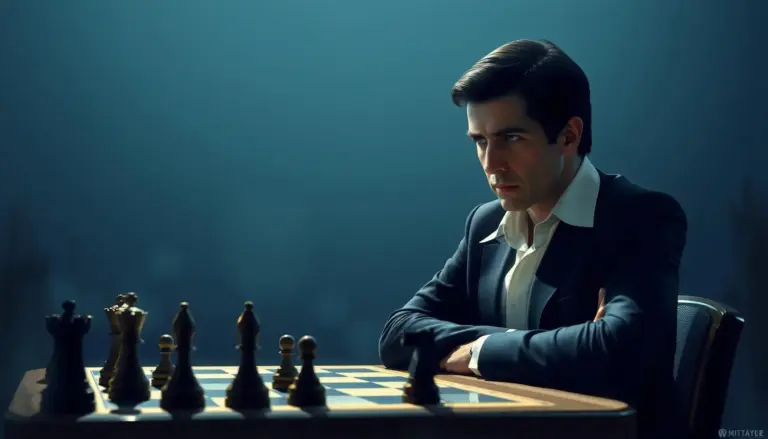
Chess is much more than a strategy game: It is a mirror that reflects our mind, our emotions and even our deepest fears. Every move on the board reveals thought patterns, decisions under pressure and, ultimately, who we are when no one is watching. Have you ever considered that your playing style could be a psychological portrait of your personality?? From the audacity of a gambit to the patience of a solid defense, the board becomes a stage where psychology and tactics intertwine. In this article, We will explore how your plays not only define your technical level, but also your essence as a player and as a person.
The board as a psychological setting
Chess is not just a duel of pieces, but a confrontation between two minds. Every game is a battle of perceptions, where the ability to anticipate, adapting and controlling emotions makes the difference between victory and defeat. Studies in cognitive psychology have shown that chess players develop unique skills, like the working memory and the decision making under pressure, which are reflected in his style of play. For example, an aggressive player who opts for risky openings, like him King's Gambit, usually someone who enjoys control and initiative, while those who prefer defensive structures, like the Sicilian Defense, can be more analytical and patient.
But the dashboard also exposes our vulnerabilities. The time anxiety, he fear of losing or even the overconfidence can lead to errors that, in retrospect, they seem obvious. A study published in the journal Frontiers in Psychology revealed that players suffering from competitive anxiety tend to make more mistakes in critical positions, especially when the clock ticks. This not only affects its performance, It also reveals how they handle stress in other areas of their life.. Are you one of those who freeze under pressure or one of those who flourish in decisive moments?? Chess has the answer.
Playing style as a reflection of personality
If chess is a mirror, then each piece and each movement are brushstrokes that draw our personality. Psychologists have identified correlations between playing styles and personality traits. For example:
- Tactical players: They are usually creative people, with a quick mind and a penchant for innovation. They prefer spectacular sacrifices and brilliant combinations, like those that characterized the genius Mikhail Tal, known as the “Mago de Riga”. His approach is intuitive and, sometimes, chaotic, but always fascinating.
- Positional players: They represent patience and planning. They are methodical, analytical and prefer to build their advantage gradually, how he did it Anatoly Karpov. These players tend to be more thoughtful and less impulsive, both on the board and in life.
- Defensive players: They are resilient and strategic. They do not seek immediate glory, but survival and the opportunity to fight back. A classic example is Vladimir Kramnik, who dominated chess with a solid and pragmatic style. These players are usually people who value stability and security.
- aggressive players: They love risk and initiative. They are competitive, ambitious and not afraid to face difficult challenges. Garry Kasparov It is the archetype of this style, with openings like King's Indian Defense or the English attack, where dynamism and constant pressure are key.
But chess does not only reflect positive traits. It can also expose our weaknesses. For example, A player who constantly falls into tactical traps may be someone who underestimates details or acts hastily.. In the same way, Those who avoid conflict and always look for draws may be revealing an aversion to risk or a lack of confidence in their abilities.. In this sense, the board becomes a tool for self-knowledge, where each game is an opportunity to identify and work on our areas of improvement.
If you want to delve deeper into how chess can be a reflection of your personality, We invite you to read our article on Does your chess style reveal your personality?, where we explore this topic in greater detail.
Chess as a metaphor for life
Chess is not just a game, but a powerful metaphor for life. Each game is a miniature narrative, where the decisions, mistakes and opportunities intertwine to create a unique story. In this sense, The board becomes a laboratory where we can experiment with strategies, learn from our mistakes and apply those lessons in other areas of our existence.
For example, the long term planning It is a key skill both in chess and in life. A player who only thinks about the immediate movement, without considering future consequences, is condemned to make mistakes. The same thing happens in life: Those who do not plan their future often encounter unexpected obstacles. In the same way, the adaptability it is essential. in chess, like in life, plans can change in an instant, and the ability to adjust to new circumstances is what separates good players from great ones..
Another valuable lesson is risk management. in chess, as in business or personal relationships, taking calculated risks can lead to great rewards, but also to resounding failures. The key is to evaluate the probabilities and act intelligently. A player who always plays it safe can avoid defeats, but you will also miss out on growth opportunities. Instead, Those who take judicious risks can achieve memorable victories..
Chess also teaches about resilience. Losing a game is not the end of the world, but an opportunity to learn and improve. This mentality is applicable to any area of life.: failures don't define who we are, but how we get up after falling. As the great teacher said Emanuel Lasker: “in chess, like in life, the most dangerous opponent is oneself”.
If you are interested in exploring how chess can be a metaphor for life, Don't miss our article Chess and life: literary metaphors in 64 casillas, where we analyze this connection from a literary and philosophical perspective.
The board as a tool for self-discovery
Chess not only reflects our personality, It can also be a powerful tool for self-discovery and personal growth.. Each game is an opportunity to explore our thinking patterns, Identify our strengths and work on our weaknesses. For example, if you tend to make mistakes under pressure, Chess can help you develop strategies to manage stress. If you are impulsive, the game will teach you the importance of patience and reflection.
Besides, chess can be a way of therapy. In recent years, has been used as a tool in psychiatry y clinical psychology to treat disorders such as ADHD, the anxiety and the depression. The concentration required to play chess helps calm the mind and develop cognitive skills, while the game structure provides a sense of control and achievement. In this sense, The board becomes a safe space where players can explore their emotions and learn to manage them in a healthy way.
A notable example of this is the work of the psychiatrist Vladimir Raskovic, who used chess as a therapeutic tool in psychiatric hospitals. Rašković discovered that the game not only improved patients' cognitive abilities, but also helped them develop self-confidence y resilience. His approach revolutionized the way chess is perceived in the field of mental health., proving that this ancient game can be much more than a hobby.
If you want to know more about how chess can be a therapeutic tool, We recommend you read our article Therapeutic chess: how it saves lives in hospitals, where we explore this topic in depth.
Chess as a mirror of society
Chess not only reflects the individual, but also to the society in which it is played. throughout history, the game has been a symbol of power, resistance and social change. In the Middle Ages, For example, chess was a pastime of the nobility, a reflection of the hierarchical structure of society. The pieces represented the different social classes, from the rey and the reina until the pawns, that symbolized the peasants. In this sense, the board was a microcosm of feudal society, where each piece had a specific role and value.
In the 20th century, Chess became a battlefield during the Cold war. The games between USA and the Soviet Union They weren't just sports competitions, but also ideological confrontations. Chess was used as a propaganda tool, where a player's victory represented the superiority of his political system. An iconic example of this was Match of the Century between Bobby Fischer y Boris Spassky in 1972, which captured the attention of the entire world and became a symbol of the rivalry between the two superpowers.
Nowadays, chess continues to be a reflection of society. In countries like Armenia y India, play is an integral part of education, teaching children skills such as critical thinking and the problem solving. In other places, as Colombia y El Salvador, Chess is used as a tool social transformation, helping vulnerable young people develop life skills and stay away from violence.
Chess has also been a symbol of endurance in contexts of oppression. During the apartheid in South Africa, For example, the game was a way to challenge racial barriers and promote equality. In Afghanistan, Women have used chess as a tool of empowerment, challenging cultural norms and asserting their right to participate in public life. In this sense, the board becomes a space of freedom and resistance, where the rules of the game are fairer than those of society.
Conclusion
Chess is much more than a game: It is a mirror that reflects our mind, our emotions and our society. Every move on the board reveals who we are, how we think and how we face challenges. From the audacity of a gambit to the patience of a solid defense, Chess offers us a unique opportunity to explore our personality, develop cognitive and emotional skills, and learn valuable life lessons.
But chess is also a reminder that, at the end of the day, we are the ones who control the game. It doesn't matter if you are a tactical player, positional, defensive or aggressive: The important thing is that each game is an opportunity to grow, learn and, above all, enjoy the process. As the great teacher said José Raúl Capablanca: “Chess is more than just a game; It is an intellectual diversion that has some art and a lot of science”.
So next time you sit in front of a board, remember that you are not just playing against your opponent, but also against yourself. Every movement is an opportunity to get to know yourself better, to challenge your limits and to discover new facets of your personality. and who knows, maybe at the end of the game, not only have you won or lost, but you have also learned something new about yourself.