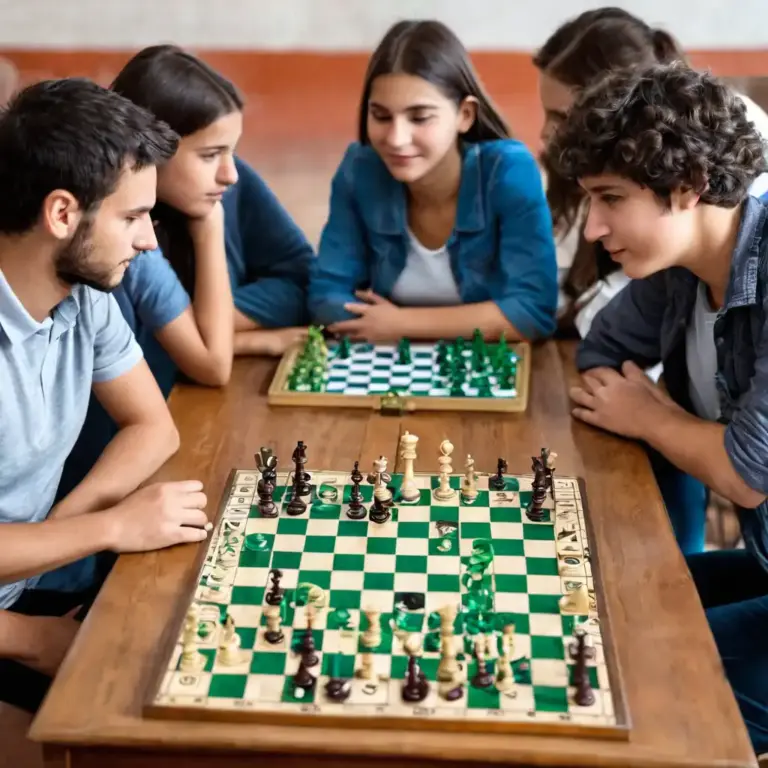
Chess has transcended its status as an ancient game to become a mirror of the human mind.. Each move on the board reveals not only a calculated strategy, but also a metaphor for decision making under pressure. In the corporate sphere, where work stress and mental fatigue are commonplace, Chess emerges as an unexpected but powerful tool for occupational health. It's not just about entertaining employees during a break, but to train your brain to face work challenges with greater clarity, resilience and creativity. Can a game 64 boxes transform the way companies care for their teams?
Chess as a mental gym at work
Occupational health is not limited to preventing physical accidents or ensuring ergonomics in the workplace.. Your real challenge is to preserve the cognitive and emotional well-being of employees, especially in environments where information overload and multitasking are the norm. This is where chess proves its unique value: It is an exercise in pure concentration, where every decision counts and mistakes are paid for with immediate consequences. This controlled pressure acts as a simulator of complex work situations, teaching players to:
- Assess risks accurately, without falling into paralysis by analysis.
- Anticipate consequences in the medium and long term, a critical skill for strategic planning.
- Handle frustration when a plan fails, developing adaptability.
Studies such as those conducted by the University of Memphis have shown that playing chess regularly improves working memory and problem-solving abilities., two skills directly transferable to the workplace. But beyond the data, there is the subjective experience: chess forces players to “disconnect” from external noise and immerse yourself in a state of flow, similar to that achieved with meditation. In a world where fragmented care is the norm, This ability to focus on a single task—even for 15 minutes—can be revolutionary for productivity and well-being.
From theory to practice: how to implement it in companies
Integrating chess into corporate culture does not require a million-dollar investment or radical changes in the organizational structure.. Small initiatives can generate significant impacts:
- Internal tournaments: Organize weekly or monthly games, whether in person or virtual mode, fosters camaraderie and breaks routine. Companies like Google and Microsoft have already adopted this practice, not only for its cognitive benefits, but also for its ability to humanize relationships between colleagues.
- Strategy workshops: Sessions where famous games are analyzed (like the “Immortal” de Anderssen et al “Game of the Century” between Fischer and Spassky) and lessons are drawn that are applicable to business decision making.. Here, he chess becomes a common language to discuss risks, leadership and creativity.
- Wellness programs: Include chess as part of mental health activities, along with options such as yoga or mindfulness. Its advantage is that it does not require physical flexibility and can be practiced in any space., even during a coffee break.
An emblematic case is that of the Spanish company Indra, that implemented a chess program for its employees with the aim of improving team cohesion and innovation capacity. The results were tangible: an increase in job satisfaction and a reduction in reported stress levels. But perhaps the most valuable benefit was intangible: chess gave employees a new way to connect, beyond endless emails and meetings.
Chess as occupational therapy: beyond entertainment
Chronic work stress not only affects productivity; It also has serious health consequences, from anxiety to cardiovascular diseases. In this context, chess acts as a cognitive escape valve, offering a space where the brain can “reset” without completely abandoning the strategic mode of thinking. Unlike other recreational activities, Chess keeps the mind active but in a game state, which reduces the feeling of being “working” even when useful skills are being developed.
Besides, Chess has a social component that makes it especially valuable in work environments. Playing a game with a partner not only strengthens interpersonal ties, but also encourages empathy: to win, you have to understand how the rival thinks, a skill that translates directly into better working relationships and more effective communication. This aspect is particularly relevant in multicultural teams., where chess—with its universal rules—can serve as a bridge to overcome linguistic or cultural barriers.
An inspiring example is that of therapeutic chess in prisons and hospitals, where it has been used to rehabilitate people with anxiety disorders or depression. If chess can help rebuild lives in extreme contexts, Why not take advantage of its potential in the corporate sphere?, where stress—although less visible—also leaves deep marks?
Resistance to change: Why are some companies still not adopting it??
Despite its benefits, chess faces skepticism in some business circles. The most common arguments are:
- “It's an elite game, not suitable for everyone”: This perception ignores that chess is one of the few mental sports where experience and intuition can compensate for a lack of theoretical knowledge.. Besides, platforms like Lichess o Chess.com offer accessible tutorials for beginners, democratizing learning.
- “Does not have a clear ROI”: Measuring the return on investment of chess is complex, but not impossible. Companies that have implemented it report improvements in indicators such as talent retention, creativity in problem solving and reducing absenteeism due to stress. Besides, Implementation cost is minimal compared to other wellness programs.
- “It is competitive and could generate tensions”: This is a misunderstanding. Chess doesn't have to be competitive; can also be played collaboratively, analyzing games as a team or solving strategic problems as a group. The key is how the activity is framed.
The real obstacle is not practical, but cultural. Many companies still see workplace well-being as an expense, not as an investment. However, as mental health gains visibility in the corporate arena, Chess is positioning itself as an innovative and low-cost solution to improve the work environment.
Conclusion: a checkmate to work stress
Chess is not a panacea, but a powerful tool to address some of the most pressing challenges of modern occupational health. Its ability to train the mind, fostering human connection and offering a creative outlet makes it an invaluable ally for companies looking to go beyond traditional benefits. In a world where remote work and digitalization have blurred the boundaries between personal and professional life, chess offers something that is in short supply: a space to think, no distractions, no rush, and with the satisfaction of knowing that every movement—no matter how small—has a purpose..
Companies that adopt this practice will not only be investing in the well-being of their employees., but also in its own long-term sustainability. After all, a team that knows how to think clearly, Adapting to changes and working in harmony is the best asset any organization can have.. and all that, in alone 64 casillas.