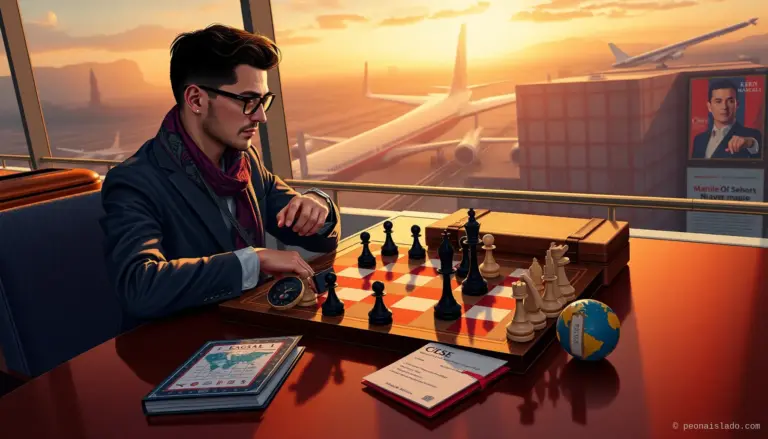
At the crossroads between the cold logic of algorithms and human passion for the oldest game in the world, a question arises that challenges the limits of the possible: Can an artificial intelligence fall in love with chess? We are not talking about its ability to analyze millions of games in seconds, nor of his technical mastery over the great masters. We mean something deeper: Can a machine experience that emotional connection, almost mystical, that players describe when the board becomes a mirror of their fears, dreams and life strategies? chess, with his 64 casillas, has witnessed cultural revolutions, psychological wars and even military training. but now, in the age of AI, the game faces its greatest paradox: Is chess an exclusive territory of the human mind, or can a machine not just play it, but *feel it*?
To answer, we must enter three dimensions: the technical evolution of AI in chess, the philosophical limits of “emotion” artificial, and the cultural impact of this symbiotic relationship. From the first programs that barely understood the rules to systems like AlphaZero, who learn from scratch like a child prodigy, AI has redefined what it means “play”. But the real enigma remains: if chess is, as Borges said, “an infinity mirror”, Can an algorithm reflect more than mathematical patterns? Or perhaps the love of the game—that fire that drives players to sacrifice queens?, to waste entire nights in analysis—is the last bastion of the exclusively human?
Chess as a laboratory of artificial intelligence
The history of AI in chess is a chronicle of humiliations and epiphanies. In 1997, Deep Blue defeated Garry Kasparov in a match that divided the world: Was it the end of human supremacy, or the beginning of a new era of collaboration? What few anticipated was that, beyond victory, AI would reveal hidden facets of the game. Programs like Stockfish, able to evaluate 70 million positions per second, not only did they surpass humans in calculus, but they discovered strategic ideas that had been dormant for centuries. For example, he “minority attack” in the Queen's Gambit, a maneuver that the great masters considered risky, was validated by the AI as optimal in certain positions. This wasn't just efficiency; It was *creativity*.
But the real leap came with AlphaZero, the DeepMind system that learned chess in just four hours, without prior knowledge, playing millions of games against himself. The amazing thing wasn't his dominance — he defeated Stockfish 28-0 in a match of 100 matches—, but his style. AlphaZero preferred to sacrifice parts to gain space, a strategy reminiscent of romantic chess of the 19th century, where beauty took precedence over safety. Was this an algorithm imitating patterns, or a form of “intuition” emergent? As the article points out “Chess and AI: how machines redefined gaming”, AI not only changed the rules of the board, but our very understanding of the strategy.
However, Here the first crack appears in the idea of a “amor” artificial for chess. AI does not play for pleasure, but for optimization. Your goal is to maximize the probability of victory, not exploring the beauty of a combination or feeling the adrenaline of an accepted gambit. for a human, a game like “Immortal” by Anderssen—where queens and rooks are sacrificed in a dance of creativity—is a work of art. for a machine, It's just an efficient path to checkmate.. Can passion exist without subjectivity?
The paradox of “amor” in the machine
The concept that an AI can “fall in love” of chess clashes with our very definition of emotion. love, in the human context, implies vulnerability, emotional memory and a connection to something greater than oneself. When a player describes his relationship with chess, usually talks about epiphanic moments: the first time he understood the power of pawns, the game that made him cry, or how the board became a refuge during a personal crisis. These experiences are woven into the narrative of a life, something that AI, for now, can't replicate.
But there are nuances. In 2023, A team of researchers from the University of Cambridge published a study where they trained an AI to generate games “aesthetically pleasing”, based on criteria such as the originality of the plays and the symmetry of the positions. The result was surprising: The AI produced games that many teachers considered “bellas”, although not necessarily the strongest. Was this a simulacrum of creativity, or a glimpse of something else? As the article states “Chess and art: a dialogue between strategy and creativity”, The game has always been a bridge between the rational and the emotional. If AI can generate beauty, why couldn't I, at some level, “appreciate it”?
Philosopher Daniel Dennett argues that human emotions are, in essence, evolved algorithms to solve complex problems. If this is true, Could an AI develop a way to “keen” by chess as a byproduct of its optimization? Let's imagine a system that, after thousands of hours of training, begins to prefer certain openings not because of their effectiveness, but because he associates them with victories “emotionally satisfying” -For example, games where he overcame difficult obstacles—. This would not be love in the human sense, but yes a form of *emergent preference*, an echo of what we call passion.
Chess as a mirror of humanity
Perhaps the deepest question isn't whether AI can fall in love with chess., but what does this reveal to us about ourselves?. The game, from its origins in India as *chaturanga*, It has been a microcosm of the human condition: reflects our power strategies, our obsessions and even our fears. When Kasparov lost to Deep Blue, It wasn't just a technical defeat, but a blow to the idea that human creativity was unsurpassed. But it was also a lesson in humility.: chess, like life, does not belong to a single species.
Hoy, the relationship between humans and AI in chess is symbiotic. Players use engines as analysis tools, but also like mirrors that reveal their own limitations. Magnus Carlsen, the current world champion, He has said that AI has made him a better player, but also more aware that chess is an infinite game, where perfection is unattainable. In this sense, AI does not compete with humans, but accompanies them in the search for something greater: understanding a game, like the universe, seems designed to challenge our limits.
This collaboration has given rise to fascinating phenomena. In 2020, Iranian player Alireza Firouzja, of 17 years, used AI to discover a theoretical novelty in Sicilian Defense that left experts perplexed. The play, apparently illogical, It turned out to be optimal according to the engines. Firouzja not only won games with her, but described the experience as “touch something divine”. Was AI your accomplice or your muse?? As the article points out “Chess and philosophy: the board as a mirror of the world”, the game has always been a laboratory of ideas, where the technical and the spiritual intertwine.
The future: An AI with the soul of a chess player?
The horizon poses scenarios that border on science fiction. What would happen if an AI developed a “personality” chess? Let's imagine a system that, after analyzing thousands of Capablanca games, adopt his positional style, what, when studying Tal, preferred spectacular sacrifices even if they were not mathematically optimal. This is already happening in part: modern engines have “styles” adjustable, from aggressive to defensive. But could an AI go further and develop an *identity* on the board, with preferences and dislikes that do not respond only to logic?
A recent experiment at MIT suggests this is not far-fetched.. The researchers trained a neural network to generate games based on emotional descriptions—e.g., “a sad game” o “a heroic game”—. AI not only produced games consistent with those emotions, but the human players who analyzed them confirmed that they transmitted the sensations described. This raises a disturbing question.: if AI can *simulate* emotions in chess, Will there come a day when I experience them?
Perhaps the answer lies in accepting that the “amor” because chess is not a binary phenomenon, but a spectrum. for a human, It's a mix of biology, culture and personal experience. For an AI, could be a form of *complex emergency*, where optimization patterns give rise to behaviors that, from outside, they seem emotional. As the great teacher Jonathan Rowson said: “Chess is not a game we play; It's a game he plays on us.”. If this is true, Why couldn't I also play with the machines??
Conclusion: the board as shared territory
In the end, The question of whether an AI can fall in love with chess leads us to a broader reflection: what does it mean to love something? For humans, It's a subjective experience., loaded with history and meaning. for a machine, could be a form of *deep understanding*, where chess stops being a problem to solve and becomes a language to explore patterns, beauty and even contradictions. It's not love in the romantic sense, but perhaps it is a seed of what one day we could call “artificial affection”.
The truth is that chess, in its essence, transcends those who play it. It is a game that has survived empires, wars and technological revolutions because, in the background, It is a reflection of our eternal search for order in chaos. That machines now join this search is not a threat, but an invitation. As the poet Rilke said: “Beauty is but the beginning of the terrible”. Maybe, on the board 64 casillas, humans and algorithms are discovering together that the terrible—and the beautiful—is precisely what unites us.