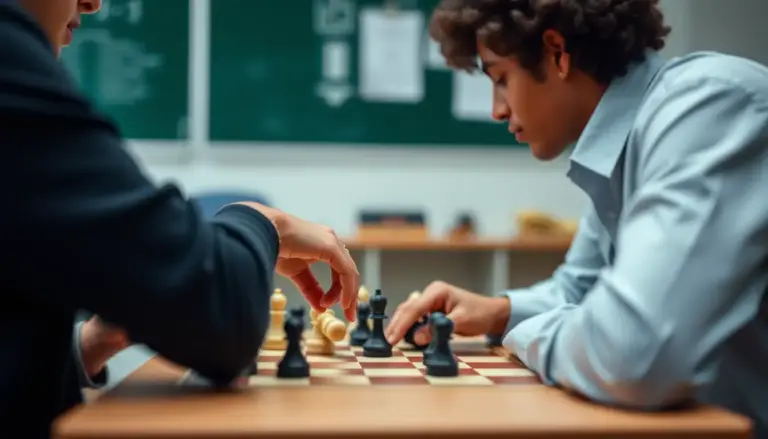
Chess is much more than a game: It is a laboratory of the mind where each movement teaches patience, strategy and resilience. When it comes to teaching chess to children, the challenge lies not only in transmitting rules, but to awaken a curiosity that lasts. Children don't learn chess; they discover it. And in that process, the board becomes a mirror of their cognitive and emotional development. How to transform the 64 boxes in a meaningful learning space without falling into the rigidity of traditional instruction?
Chess as a pedagogical tool: beyond the rules
Teaching chess to children requires understanding that their mind works by associations, not for abstractions. A study published in Frontiers in Psychology showed that children who learn chess improve their problem-solving ability in a 32% compared to peers. However, The most common mistake is to start with pure theory: parts movements, openings or advanced tactics. Instead of that, the focus should be playful and contextual.
For example, before explaining the movement of the horse, you can tell a story: “Imagine that the horse is a superhero that jumps over buildings (the pieces) to reach your destination”. This analogy not only facilitates memorization, but it activates the imagination, an invaluable resource at an early age. Besides, platforms like Lichess o Chess.com offer interactive modes that allow children to explore the board without pressure, as if it were a video game.
Another key aspect is the learning personalization. Not all children learn at the same pace or have the same interests.. Some are attracted to competition, while others enjoy the creative aspect more, how to design games or solve chess problems. Here, instructor flexibility is essential. A child who is bored with openings can become excited by analyzing historical games, like the Immortal de Anderssen, where the sacrifice of pieces becomes a visual spectacle.
The psychology behind the board: how to handle frustration and success
Chess is a game of mistakes. Every game is a lesson in humility, but for a child, a defeat can feel like a personal failure. This is where the chess psychology. According to a study by the University of California, Children who receive constructive feedback after a defeat improve their performance by a 40% in later games. The key is to normalize the error: “you didn't lose; you learned what not to do next time”.
Besides, It is crucial to teach children to manage success. A Child Who Wins Consistently May Develop a Fixed Mindset, believing that their ability is innate and not the result of effort. To avoid this, It is recommended to introduce progressive challenges, how to play against a adjustable chess engine, that allows the difficulty to be graduated. So, the child understands that progress is a process, not a destination.
The self-esteem also plays a crucial role. A study from the University of Cambridge found that children who play chess develop greater confidence in their mathematical and reasoning skills. However, This only happens if the environment is safe and judgment free. For example, instead of saying “That move was bad.”, it's better to ask: “What other options did you have??”. This question invites reflection without imposing direct criticism..
Chess as a social bridge: tournaments, clubs and community
Chess is not just an individual game; is a socialization tool. Children who participate in chess tournaments or clubs develop skills such as empathy, negotiation and teamwork. An inspiring example is the program Chess for Peace, implemented in conflict zones such as Colombia or Israel, where children from different backgrounds learn to resolve differences through the board.
To introduce children to this social aspect, can be organized local tournaments with an inclusive approach. For example, instead of rewarding only the winner, You can recognize categories such as “Best sportsmanship” o “Most creative game”. This encourages the participation of children with different skill levels and prevents the less competitive from feeling left out.. Besides, platforms like ChessKid offer tools to organize virtual events, ideal for children who are not yet comfortable competing in person.
Another important aspect is the diversity in chess. Historically, the game has been dominated by male figures, but nowadays, initiatives such as Chess Queens They seek to break stereotypes and show girls that chess is for them too. Include stories of chess pioneers, como Judit Polgár o Hou Yifan, can inspire girls to persevere in the game.
Technology and chess: ally or distraction?
In the digital age, technology is an inevitable tool, but its use in children's chess must be strategic. On the one hand, platforms like YouTube o Twitch offer educational and entertaining content, like the videos of GothamChess o Agadmator, that can arouse children's interest. On the other hand, Excessive time in front of the screen can reduce the ability to concentrate in face-to-face games.
One solution is to combine digital with analog. For example, after watching a video about chess tactics, you can propose to the child that draw your own game on a paper, explaining each movement. This reinforces memory and understanding of the game. Besides, the use of chess apps with offline mode allows you to practice without distractions, as Chess Free o Dr. Wolf, offering interactive lessons adapted to each level.
However, it is important to set limits. An Oxford University study found that children who spend more than two hours a day playing chess online have a 25% less social interactions in face-to-face games. That's why, It is recommended to balance time on digital platforms with activities such as street chess or local clubs, where human contact enriches the experience.
The role of parents: how to support without pressuring
Parents are a key player in learning chess, but your participation must be balanced. A common mistake is projecting one's own expectations onto children., such as the obsession with winning or achieving a certain rating Elo. This can cause anxiety and, in extreme cases, lead the child to abandon the game.
Instead of that, parents should focus on encourage enjoyment. For example, play casual games at home, without stopwatch or pressure, allows the child to explore the game at their own pace. It is also useful to get involved in related activities, how to visit chess museums or read books on the subject, as Chess for children de Murray Chandler.
Another important aspect is the communication. Questions like “What did you like most about the game??” o “What would you do differently next time??” They invite the child to reflect without feeling evaluated. Besides, It is essential to celebrate small achievements, like learning a new opening or solving a chess problem, instead of focusing only on results.
Finally, Parents should be alert for signs of overtraining. If the child shows signs of stress or disinterest, It is important to take a step back and remember that chess should be a source of fun, not of obligation.
Conclusion: chess as a seed of growth
Teaching chess to children is not about creating champions, but to cultivate curious and resilient minds. Every game is an opportunity to learn about strategy, patience and, above all, about oneself. As the great teacher Savielly Tartakower said: “Chess is the gymnastics of the mind”. But for this gymnastics to be effective, must be fun, inclusive and adapted to the needs of each child.
The board is not just a battlefield; It is a space where children can explore their creativity, develop social skills and, the most important thing, discover the pleasure of thinking. In the end, true success is not measured in victories, but in the ability to see the world with a more strategic and compassionate view. And so, after all, It is the most valuable legacy that chess can leave in the new generations.