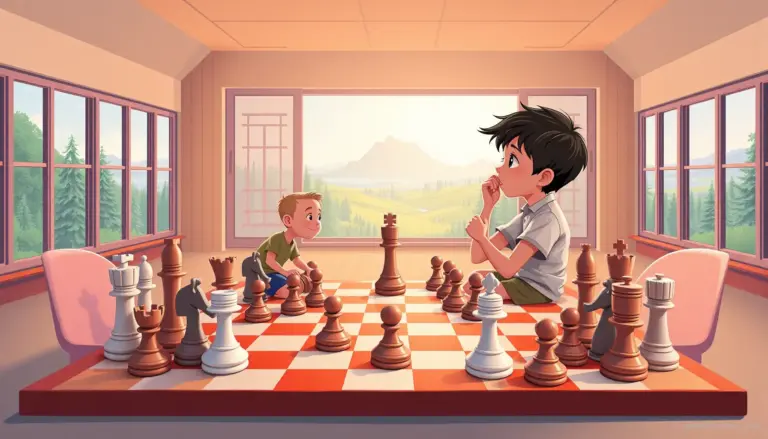
chess, an ancient game known for its ability to challenge the mind, has transcended its role as simple entertainment to become an innovative therapeutic tool. In recent years, Mental health professionals and educators have explored its potential to address disorders such as Attention Deficit Hyperactivity Disorder (ADHD), a condition that affects millions of people around the world, especially children and adolescents. ADHD is characterized by difficulties in concentration, impulsivity and, in some cases, hyperactivity, which can significantly interfere with academic performance, social relationships and self-esteem.
Chess-based therapy does not seek to replace traditional treatments, such as medication or cognitive behavioral therapy, but to complement them. Its focus is on taking advantage of the game's unique features—such as the need for planning, patience and impulse control—to develop cognitive and emotional skills in those who practice it. Through strategic moves and the anticipation of consequences, Chess offers a structured space where patients can exercise their minds in a playful and motivating way.. In this article, We will explore how chess has been integrated into therapies for ADHD, the benefits it brings, the scientific studies that support its effectiveness and the practical strategies to implement it effectively.
Chess as a mirror of the challenges of ADHD
To understand why chess can be a valuable tool in the treatment of ADHD, It is essential to analyze how the game's features align—and, sometimes, collide with the symptoms of the disorder. ADHD is not simply “lack of attention”, but a complex pattern of difficulties in executive functions, like the working memory, the response inhibition and the cognitive flexibility. These functions are precisely those that chess constantly tests..
In a game of chess, Every move requires careful evaluation of multiple variables: the position of the pieces, the opponent's possible moves and the short and long term consequences. For a person with ADHD, This process can be overwhelming., since your mind tends to jump from one idea to another without delving into any. However, This same complexity is what makes chess a natural training for executive functions. Studies like the one published in the journal Frontiers in Psychology (2019) have shown that regular chess practice improves planning ability and sustained attention in children with ADHD, even compared to other recreational activities.
Besides, chess acts as a mirror of impulsivity, one of the most disruptive symptoms of ADHD. in the game, A hasty move can lead to the loss of a piece or, even worse, to defeat. This immediate and tangible consequence serves as direct feedback to the player, teaching him to pause, reflect and evaluate before acting. Unlike other situations in everyday life, where the consequences of impulsivity may be diffuse or delayed, Chess offers a safe environment to experiment and correct this behavior.
Another key aspect is the intrinsic motivation that generates the game. Many children with ADHD quickly lose interest in tasks they perceive as boring or repetitive., but chess, with its competitive component and its infinite variability, manages to capture your attention. The chance to win, the excitement of a checkmate or even the curiosity to discover new strategies keep the player engaged, something that more traditional therapies sometimes fail to achieve.
Cognitive and emotional benefits backed by science
Scientific evidence on the benefits of chess on ADHD has grown significantly in the last decade. Beyond anecdotes or individual testimonies, Controlled studies have shown measurable improvements in key areas for sufferers of this disorder. One of the most consistent findings is the improvement in sustained attention. A study conducted by the University of California in 2016, published in Journal of Attention Disorders, found that children with ADHD who participated in a chess program for 12 weeks showed a significant reduction in careless errors in attention tests, compared to a control group that performed sports activities.
But the benefits are not limited to attention. Chess also strengthens working memory, an executive function critical for learning and problem solving. In a game, players must remember previous moves, anticipate future plays and keep multiple possibilities in mind. This constant practice acts as an exercise for memory, something that translates into a better ability to retain information in other contexts, like the schoolboy. A Spanish study published in Journal of Sports Psychology (2018) confirmed that children with ADHD who regularly practiced chess improved their performance on short-term memory tests, even after just 8 weeks of intervention.
In the emotional sphere, Chess offers tools to manage frustration and emotional regulation. Losing a game can be a difficult experience, especially for children with ADHD, who tend to have a low tolerance for frustration. However, in a therapeutic environment, These situations become opportunities to work on resilience. Therapists can guide the child to identify his emotions, Analyze what went wrong and develop strategies to improve in future games. This process is not only applicable to chess, but it is transferred to other areas of life, such as social conflicts or academic challenges.
Another less obvious benefit, but equally important, is he self-esteem development. Many children with ADHD grow up hearing criticism for their impulsivity or lack of concentration., which can affect your self-perception. chess, Being a game where success depends on effort and strategy—and not on factors such as speed or physical strength—, gives them the opportunity to stand out and feel competent. achieve a victory, solving a tactical problem or even just maintaining a balanced game can be positive reinforcement that counteracts years of negative messages.
Therapeutic strategies: how to integrate chess into the treatment of ADHD
Although chess has clear therapeutic potential, Its effectiveness depends largely on how it is implemented. It's not just about sitting a child in front of a board and expecting the benefits to magically appear.. Professionals who use it in therapy follow structured approaches, adapted to the specific needs of each patient. Next, We explore some of the most effective strategies.
1. Gradual approach adapted to the patient's level
For a child with ADHD, facing a full game of chess from day one can be overwhelming. For this reason, many therapists start with simplified exercises, as mini-games that focus on specific aspects of the game. For example:
- Checkmate in one move: The pieces are placed in positions where the child must find checkmate in a single movement. This works on attention to detail and the ability to anticipate..
- Limited time games: Chess clocks are used to teach time management and avoid impulsivity. The child learns to distribute his time between thinking and acting.
- Tactical puzzles: Situations arise where the child must find the best possible move., how to capture a piece or defend yours. This reinforces working memory and planning.
These exercises not only make learning more accessible, but also avoid the frustration that could arise from overly complex games.
2. Use of positive reinforcement and achievable goals
Children with ADHD respond better to immediate, tangible reinforcements. In the context of chess, this can be translated into:
- Reward systems: For example, Earn points for each game won or for each exercise completed, which can then be exchanged for symbolic prizes (how to choose the next therapeutic activity).
- Custom challenges: Set small, achievable goals, as “today you will learn to move the horse correctly” o “try not to lose your tower in the first few 10 movements”.
- Feedback inmediato: After each game or exercise, the therapist must highlight the successes (“Excellent play with the bishop!”) and correct errors constructively (“What would happen if you had moved the pawn instead of the queen??”).
These strategies keep the child motivated and give them a sense of progress, something crucial for your self-esteem.
3. Integration with other therapies
Chess should not be seen as an isolated solution, but as part of a multidisciplinary approach. For example:
- Cognitive behavioral therapy (TCC): The principles of chess, such as planning and impulse control, can be used as metaphors in CBT sessions. For example, the therapist might say: “in chess, if you move a piece without thinking, you lose. in life, if you act without reflecting, you can also miss opportunities”.
- Mindfulness and success: Before a game, breathing or mindfulness exercises can be done to help the child focus. This is especially helpful for those with hyperactivity, since it teaches them to calm their mind before making decisions.
- Teamwork: In some cases, games are organized in pairs, where a child with ADHD plays with a peer (which could be another patient or the therapist). This encourages collaboration, communication and patience.
Success stories and real testimonials
To illustrate the impact of chess in the treatment of ADHD, nothing better than analyzing real cases where this therapy has made a significant difference. One of the most documented examples is that of program “Chess for ADHD”, developed in Sweden by the psychologist Ingrid Carlsson. This program, implemented in schools and clinics, has shown that children who participate in weekly chess sessions for at least 6 months improve their ability to concentrate by 30% and reduce their impulsive behaviors by 25%, according to data published in Scandinavian Journal of Psychology (2020).
One of the most notable cases is that of Lucas, a child of 9 years diagnosed with combined ADHD (with symptoms of inattention and hyperactivity). Before starting the program, Lucas had difficulty sitting in class for more than 10 minutes, He constantly interrupted his colleagues and showed a low tolerance for frustration. After 4 months of chess therapy, His teachers reported that he could concentrate on schoolwork until 25 minutes in a row, and his parents noticed a decrease in his emotional outbursts. “Chess taught him to think before acting”, his mother commented in an interview. “Now, when faced with a problem, takes a moment to breathe, just like you do before moving a piece”.
Another relevant case is that of María, a teenager from 14 years with predominantly inattentive ADHD. Maria struggled with organization and procrastination, what affected their academic performance. His therapist incorporated chess as part of his treatment plan, using quick games (of 5 minutes) to train your ability to make decisions under pressure. Besides, planning exercises were assigned, how to write down your moves before performing them and then compare them with your opponent's. In 3 months, María improved her grades in mathematics and science, and began using similar strategies to organize their schoolwork. “Chess taught me that everything has an order”, explained. “If you are a plan, things turn out better”.
These testimonies are not isolated. In Spain, the Spanish Chess Federation (SACRIFICE) has collaborated with educational and psychological centers to implement similar programs. A FEDA report on 2021 revealed that the 78% of children with ADHD who participated in chess workshops showed improvements in at least one of the following areas: attention, impulse control or emotional regulation. Besides, he 65% of parents reported a decrease in family conflict related to ADHD symptoms.
These results are encouraging, but they also underline the importance of a personalized approach. Not all children with ADHD respond the same to chess, and some may require adaptations, such as shorter games or a more playful than competitive approach. However, Success stories show that, when implemented correctly, Chess can be a powerful tool to transform challenges into opportunities for growth..
Conclusions: chess as a bridge to a more focused mind
Chess is not a magic cure for ADHD, but its potential as a therapeutic tool is undeniable. Throughout this article, We have explored how this ancient game, with its unique combination of strategy, patience and creativity, can address some of the disorder's most challenging symptoms: lack of attention, impulsivity and difficulties in executive functions. Scientific studies and real cases support its effectiveness, showing significant improvements in areas such as concentration, working memory and emotional regulation.
However, The true value of chess in ADHD therapy lies not only in its cognitive benefits, but in his ability to transform patients' perception of themselves. For a child who has spent years hearing that “does not concentrate”, “is impulsive” o “does not think before acting”, chess offers a space where error is not failure, but an opportunity to learn. Every lost game becomes a lesson, and every victory, in strengthening your self-esteem. This change of perspective is, maybe, the greatest gift that chess can offer.
For mental health professionals and educators, Chess represents a flexible and accessible tool that can be integrated into traditional therapies or used independently. Its implementation does not require expensive resources — a board and a few pieces are enough to get started., and its playful nature makes it attractive to children and teenagers. Yes indeed, Your success depends on a structured approach, adapted to the individual needs of each patient, and the combination with other therapeutic strategies.
In a world where distractions are constant and patience seems a scarce resource, chess reminds us of the importance of stopping, think and plan. For those living with ADHD, This message is especially valuable.. It's not about changing who they are., but about giving them the tools to navigate a world that is often not designed for their unique minds.. chess, with its mix of rigor and creativity, It can be that bridge that allows them to reach their maximum potential..
If you are a father, madre, educator or health professional, consider exploring chess as part of ADHD treatment. Don't underestimate the power of a game that, for centuries, has challenged the greatest minds. Maybe, in their 64 casillas, find the key to help someone focus their mind, control your impulses and, above all, believe in your own abilities.